
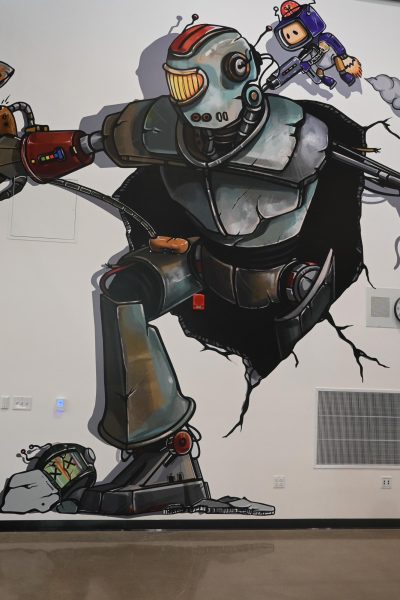
 The left wall of the center features a mural titled “Cyber Invasion,” which was designed by MVHS art students along with Art teacher Brian Chow. Photo | Meghna Dixit
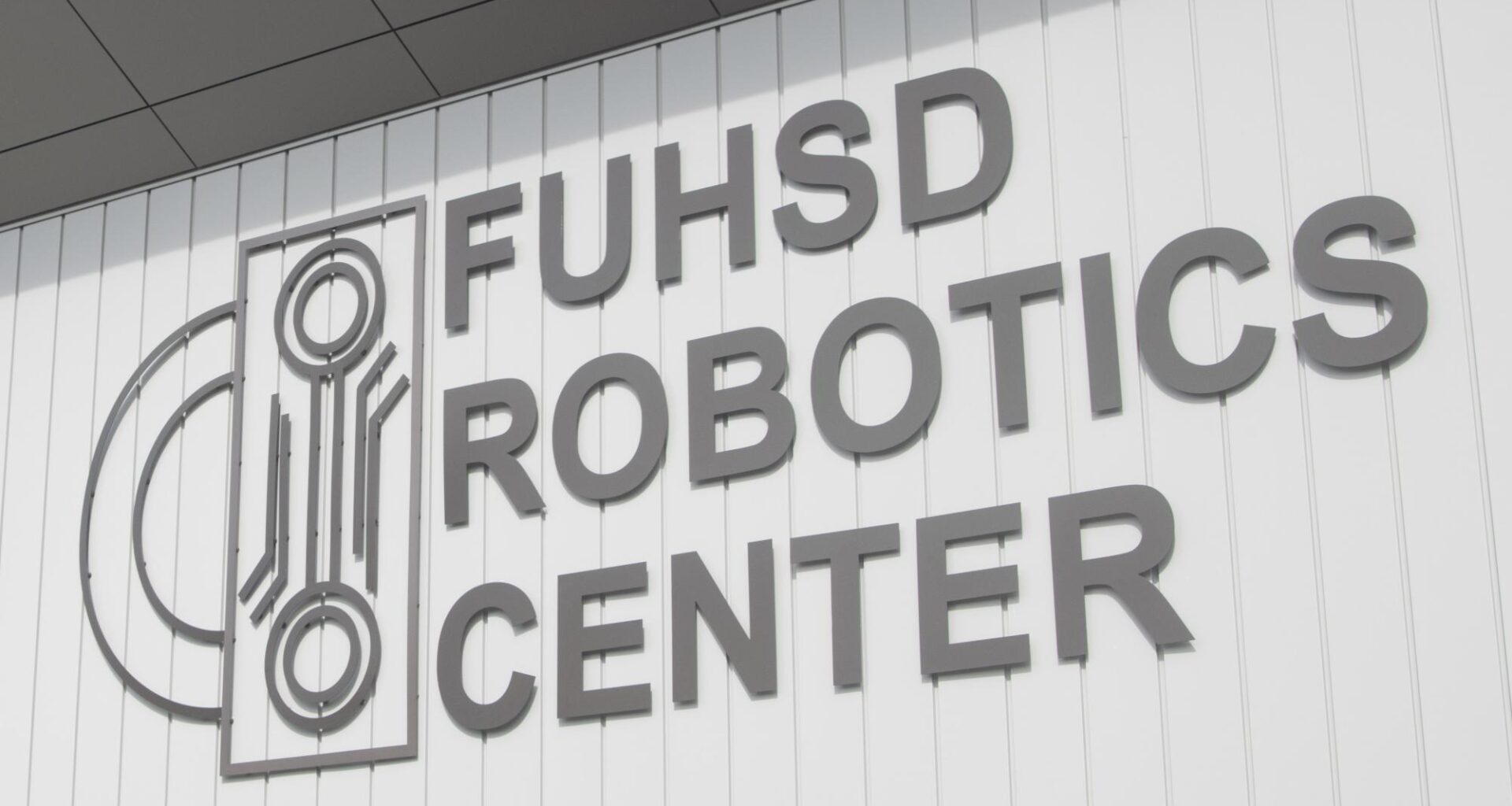
Over 100 FUHSD students, staff and family members gathered for the grand opening of the FUHSD Robotics Center on Wednesday, Sept. 9. Located at Cupertino High School, the building provides the five schools with a safe and accessible facility to practice and modify their robots ahead of competition, according to Superintendent Graham Clark.
The fully ventilated building includes a scrimmage field for robots, a mezzanine for spectators, storage areas for the five schools and a guest team, a conference room and CHS’ own makerspace.
At the opening, district leadership and students involved in the creation of the facility — including Clark, Board of Trustees President Stanley Kou, CHS Principal Yukari Salazar and Homestead High School ‘22 alum Janhavi Singhal — gave speeches about the creative process behind the building before the ribbon-cutting ceremony.
Singhal, currently a University of California, Berkeley graduate student, was involved in lobbying for the facility’s creation when she was a senior on the robotics team at HHS. Along with robotics members across the district, she presented the idea to the school board in a meeting for approval, then campaigned for the facility’s funding by canvassing for Measure G — a $275 million bond for modernizing buildings across the district.
“It took a ton of campaigning and meeting with people and harassing them,” Singhal said. “Measure G was a possibility, so we went door to door, knocking on people’s houses, asking them, ‘Can you please vote for this?’ And it only passed marginally, which was definitely at least the number of homes we talked to, so that was pretty awesome.”
Kou was also a volunteer campaigning for the Measure — which was passed on June 7, 2022. He was later elected to the Board of Trustees in August, where he pushed for the creation of the mezzanine and an additional storage space for a guest team despite additional costs.
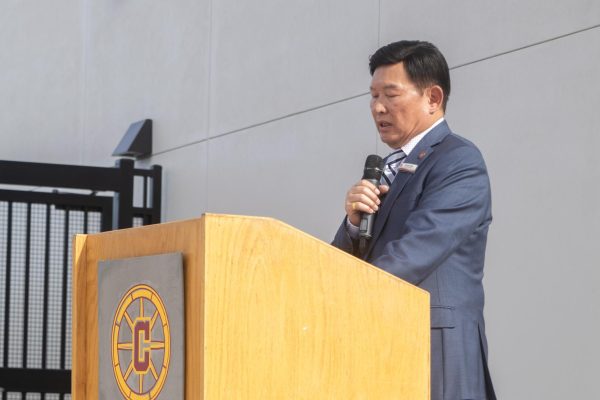 Kou gives a speech about the importance of the new center, emphasizing how the center will be welcoming to robotics members. Photo | Josiah Lim
“I volunteered to participate as a board liaison to fully engage with our design team,” Kou said. “At that time, we were thinking we only had to accommodate five schools, so we only needed five stations and five storage areas. But I had a vision: we need to have more teams, outside of our district, to join us. It’s not just closing the door to scrimmage — we want to give students opportunities to see other teams.”
Clark affirms this, stating that the building’s design targets the specific needs that Singhal and the other students outlined. According to sophomore and MVRT Head Lead of the Cadology Outreach Program Isaac Mok, the team needed to spend a majority of their practice time setting up and packing up prior to the opening of the center.
“The carpet was not smooth at our practice facility,” Mok said. “It was very wrinkled, so when we would drive on it, your bot could catch the carpet. And there are also safety concerns because we don’t have barriers. So when you’re there, you kind of just have to watch out for yourself.”
Clark explains that after assessing the needs of FUHSD robotics teams, they toured other Robotics facilities across the nation for design inspiration, including Bellarmine College Preparatory in San Jose and a school in Michigan, which they toured via Zoom. Afterward, they brought in the Division of the State Architect to make the facility safe for students. Overall, the construction took four years to complete.
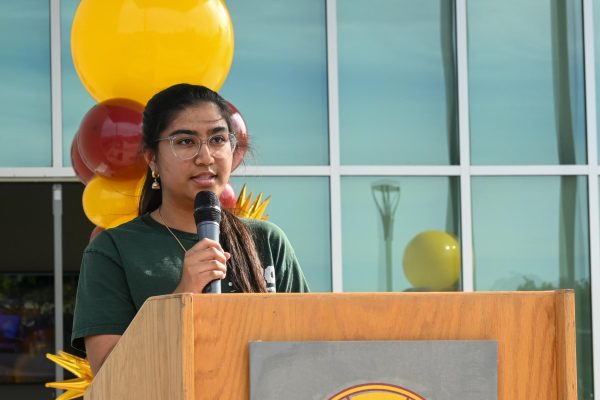 Singhal talks about the behind-the-scenes of the building’s creation, stating that Measure G was her first time voting. Photo | Meghna Dixit
“It’s been a long journey, and the students helped us identify this need,” Clark said. “The building is higher level construction than you might have in a business or residential home, so it takes a little bit longer to approve the plans. But we’re just so excited it could be open for this school year, and we just thank the students who had the idea, the passion and the energy to do that, knowing they would start it but not be able to use it.”
Even though Singhal was at college during the creation of the facility itself, she was still invested in its construction. Her sister, current vice president of HHS Robotics, frequents the new facility and gave Singhal progress updates while she was away at college, which Singhal says made its creation “surreal in steps” — each milestone building up to the opening has been its own shock.
“I was like, ‘Wow! I’m sitting in the PDF that we made,’” Singhal said. “I think the center will be exponential. When you get a new tool in robotics, you can develop your system four times faster, probably more. Having access to this center every day takes away the one hour spent setting up and tearing down; when you spend that actually doing stuff, you can see how it snowballs. That will be super transformative for every team, and it’ll only get better as they keep using it.”