
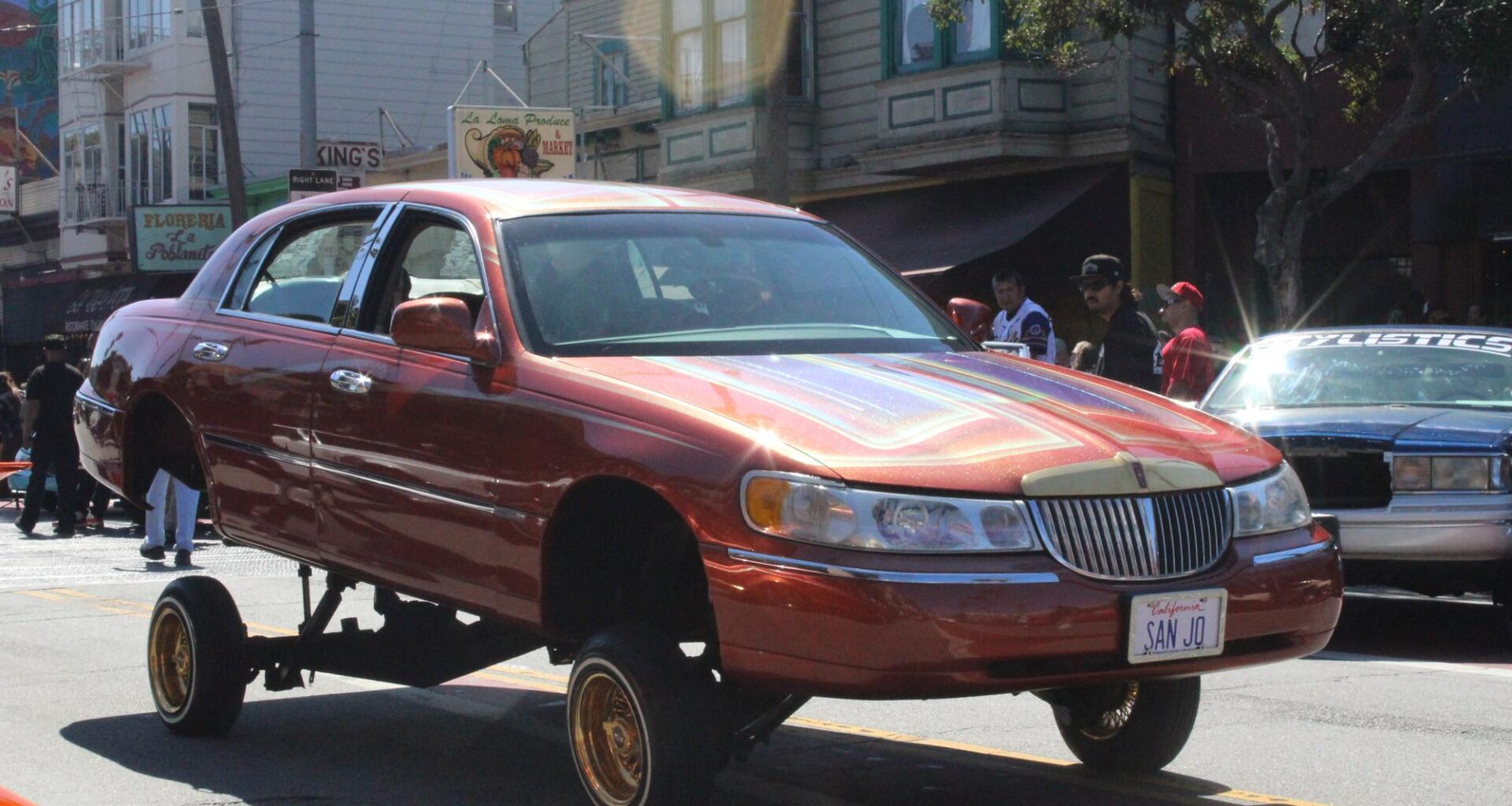
Dazzling vintage cars cruised Mission Street last Saturday to celebrate the San Francisco Lowrider Council’s 45th anniversary, featuring the King of the Streets Hop and Lowrider Parade.
Founded in 1981 by Roberto Y. Hernández, the San Francisco Lowrider Council was created in response to racial profiling of Latino youth and a ban on cruising along Mission Street.
The Council’s 45th anniversary celebration brought together lowrider owners, families, and spectators for a day centered on the history and culture of lowriding. With several of the cars heading out of Capp Street at 1 p.m., each stunning vehicle began to blast classics out of their radios while leaning on their hydraulics, showing the underbellies of their vehicles. Flags of several countries and clubs flew out of their windows, with people cheering as the cars began to jump up
As the parade finished around 3 p.m. , vehicles stationed themselves on Mission Street for ongoers to admire.
For lowrider enthusiasts like Oscar Monroy, the parade is the pinnacle of the lowrider community experience. Monroy described the immense effort of working on his red 1964 Chevrolet Impala as a push to enjoy community events like the parade.
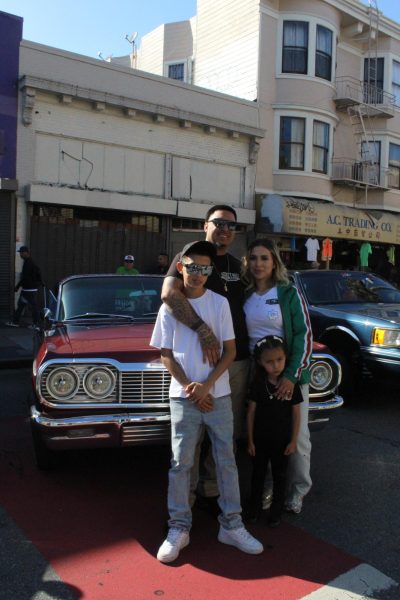 Oscar Monroy and his family posing in front of his 1964 Chevy Impala on Sept. 19, 2026. (Sofia I. Reyes / Golden Gate Xpress)
“Building from ground zero. It’s been a headache. But, you know, once you’re in the car, life changes,” Monroy said. “You forget about everything else; you’re enjoying the car, you’re enjoying the moment. So it’s awesome to be in the car.”
Monroy’s 1964 Chevrolet Impala is one of three classic cars that he owns. In the future, he hopes that his love for cars and lowriders extends to his kids.
Lowriding has a history of being criminalized by the government, with California enacting Vehicle Code Section 24008 in 1958. Only recently, in 2024, Assembly Bill 436 was signed into law by Governor Newsom, and the code was repealed to legalize cruising.
Monica Pantoja, the owner of a green 1966 Chevrolet Impala SS convertible, sees lowrider events as a way to engage with family and community. Having grown up in San Francisco, lowrider culture has always been a part of her life. Pantoja has owned the vehicle since she was 17, and feels a responsibility to keep her roots alive through lowriding.
While Pantoja works to keep lowrider culture alive, she takes pride in having her children continue the tradition of lowriding.
“It’s amazing because it was passed down to me and as I said to my kids, it’s something good to make sure my kids aren’t in the streets,” Pantoja said. “It teaches all the kids that lowriding isn’t a crime… It’s from our community. This is our people.”
George Barganier, an associate professor of criminal justice at San Francisco State University, sees lowriding’s integration into many families as a way to continue the culture.
Barganier’s yellow 1961 Chevrolet Impala ties him to his family’s long-standing passion for lowriders. For Barganier, the familial ties to lowriding ensure its cultural preservation.
“I don’t think it’ll ever die because there are so many family bonds,” Barganier said. “There are families that are four or five generations of lowriders.”
John Ulloa, dean of language arts and social sciences at West Valley College and SFSU alumnus, formerly taught a lowrider history class in 2018.
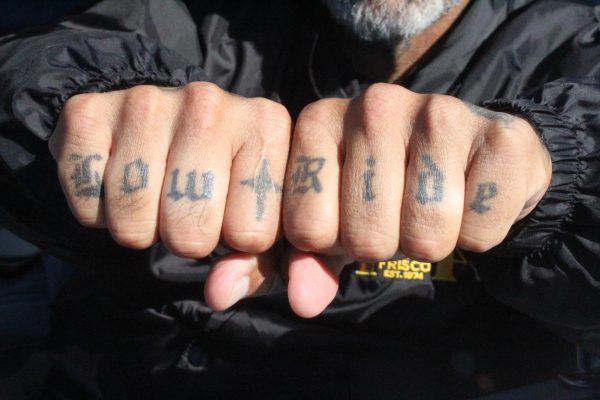 John Ulloa’s Low Ride Tattoo on his fists, Sept. 19th 2026 (Sofia I. Reyes / Golden Gate Xpress)
For Ulloa and his 1977 Pontiac Grand Prix, learning lowrider history opens the door for larger conversations.
“The curriculum really served as a gateway for us to talk about other issues affecting our community…Institutionalized racism, racial profiling, the political landscape, race, gender equality, and inequality,” Ulloa said. “Lowriding was just the filter for us to talk about all of these other things: racializing of aesthetics, institutionalized racism, the targeting of young people of color.”
While Ulloa opens the conversation about the institutional issues integrated in lowrider culture, he recognizes the uphill battle for many who want to be part of the lowrider lifestyle.
“What started out as a very blue-collar, working-class phenomenon has now become very white-collar because of how expensive it is to get in the game,” Ulloa said. “A car like that right now in that same condition is a $35,000 car. Prices have just gone through the roof because people are willing to pay that money. As long as people are willing to pay, the prices will stay up.”
As the cost of cars continues to rise, becoming part of the lowrider community has become more difficult for those who do not already have the resources to support the hobby. What was once a working-class form of car culture now requires a significant financial investment, making it harder for younger generations to build a car of their own.
Even for those who’ve been born into the hobby, such as Raul Ramirez, a second-generation lowrider owner, the restoration process can still be incredibly taxing.
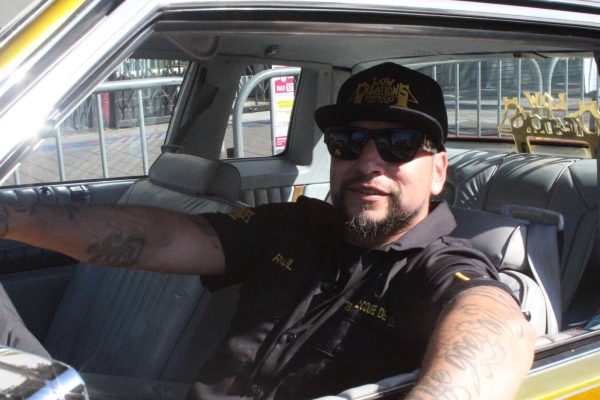 Raul Ramirez sitting inside his 1979 Cadillac Coupe DeVille after cruising in the parade on Sept. 19, 2026. (Sofia I. Reyes / Golden Gate Xpress)
“I bought it stock as can be. I basically built it into what it is now; it took time, took a lot of money and patience,” Ramirez said. “It’s nice to finally see my vision come to life.”
Ramirez and his 1979 Cadillac Coupe DeVille are part of Low Creations, one of San Francisco’s longtime lowrider car clubs. The club’s cars carry the history of the city’s lowrider community, with detailed nameplates and customized designs reflecting the time and work owners have invested in their vehicles.
For families who continue the tradition, the rising cost of lowriding does not erase its importance. Ramirez, for example, is including his son in his garage activities, exposing him early on to the lowriding lifestyle.
“He’s [Ramirez’s son] in the garage with me all the time now, whether it’s cleaning my rims or helping me fix something on the car,” Ramirez said. “Letting him use tools and stuff like that. It’s been great.”