
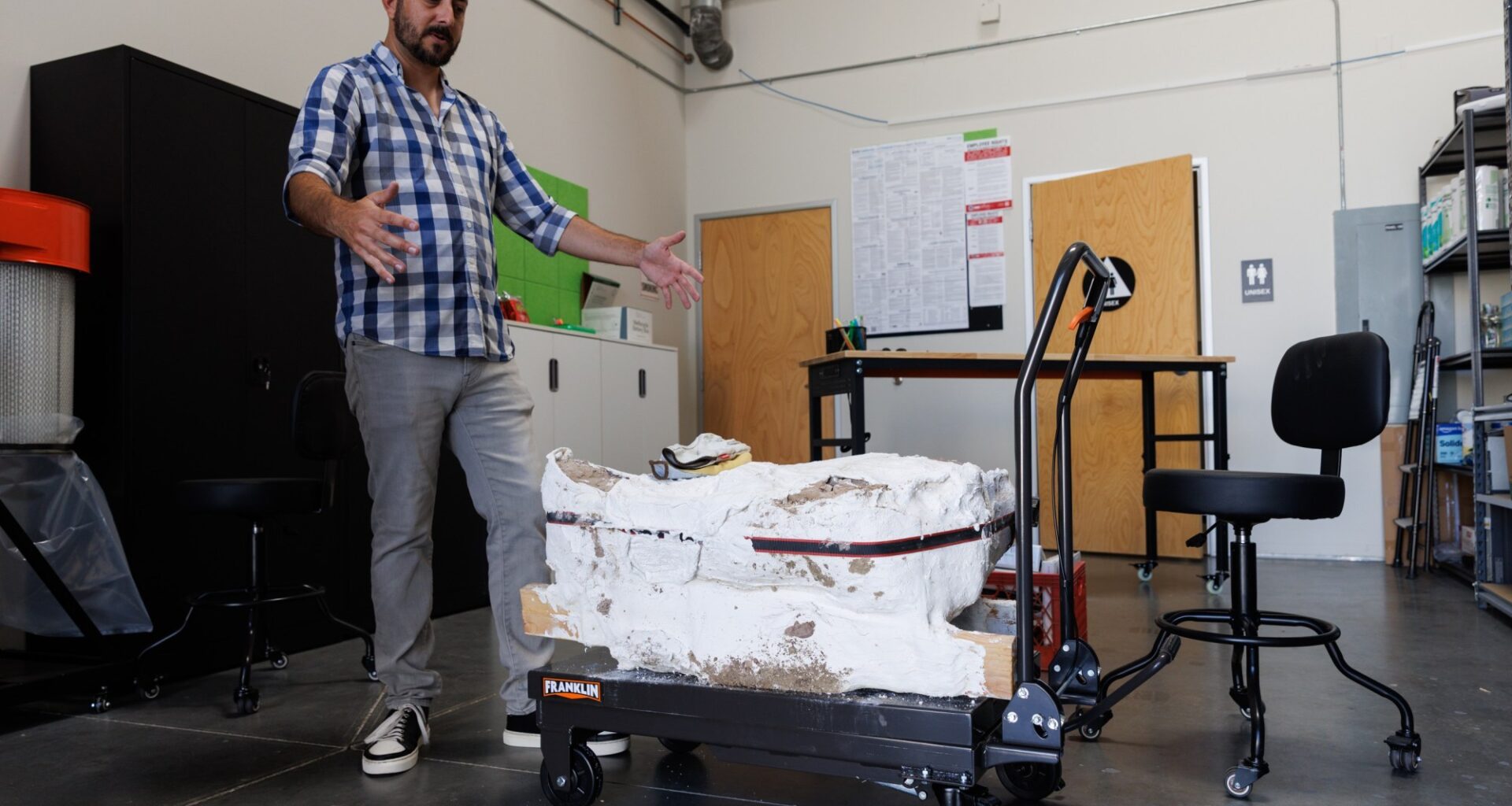
Construction crews working on an Oceanside water department project this month uncovered the fossilized remains of what could be a “thunder beast,” a large, hoofed mammal that lived about 45 million years ago.
Contract paleontologist Joseph El Adli had just walked onto the job because the project’s regular state-mandated archaeological monitor had called in sick for the day.
“I found this thing within five minutes of showing up,” said El Adli, who has 20 years’ experience in the field. He immediatedly noticed something interesting sticking out of a side wall near the bottom of an excavation about 15 feet deep.
“It is always exciting,” he said of his discovery. But he also knew it meant a lot of work ahead to examine the surrounding area for more fossils and to remove, study and preserve them.
The fossils turned up in what’s known as the Santiago formation, a layer of sedimentary rock near the surface of the ground or exposed in many parts of northwestern San Diego County. The animals lived in an age known as the Eocene Epoch, when the entire region was a green, steamy, tropical jungle.
The largest bone collected is about 2 1/2 to 3 feet long and appears to be a femur, part of a leg bone, El Adli said during an interview Tuesday at his office in Carlsbad.
The femur narrows the possibilities to one of the two biggest mammals in the region at the time — a brontothere, sometimes called the “thunder beast,” or an amynodont, which is nicknamed the “swamp rhinoceros.”
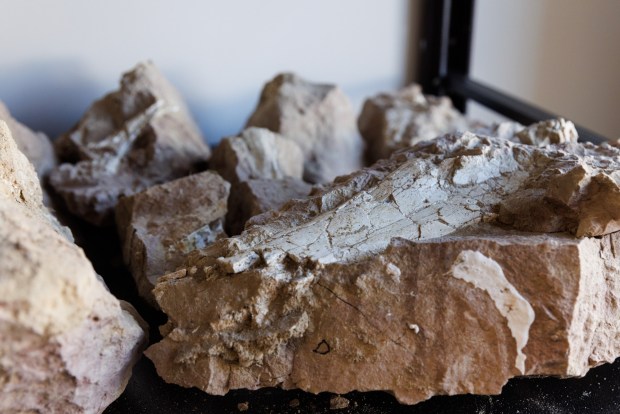 A fossilized limb of an odd-toed hoof animal, estimated to be around 40-45 million years old, was found in Oceanside at a city infrastructure project. (Kristian Carreon / The San Diego Union-Tribune)
Both beasts were plant eaters. The brontothere was a little more common, El Adli said, so the find is likely to be the thunder beast.
Most of the fossils appear to be pieces of limbs and ribs, he said. Some are still encased in blocks of mudstone wrapped in plaster and burlap for removal from the site. The wrapped packages and chunks of mudstone will be taken apart and examined more closely at El Adli’s workplace in the weeks ahead.
Fossils are a relatively common find at San Diego County construction sites and particularly in Oceanside.
A curious boy found the jawbone of a sabertooth carnivore about the size of a bobcat near College Boulevard during the widening of Interstate 5 in 1988. That long-extinct animal, known as a Diegoaelurus, lived about 42 million years ago.
The Eocene-era finds are some of the area’s oldest fossils. The animals lived after the time of the dinosaurs, which was the Mesozoic Era, and before the Ice Age, or Pleistocene Epoch.
Ice Age fossils of mammoths, horses, turtles and even a prehistoric bison — the second ever found in San Diego County — were unearthed in 2015 at the 60-acre Quarry Creek residential construction site just south of state Route 78 and west of College Boulevard. Those fossils were from 50,000 to 200,000 years old.
Lawrence Canyon, near the intersection of Interstate 5 and state Route 76, has produced many relatively young fossils such as sharks’ teeth and whales’ bones.
“There’s a lot of history in Oceanside for people like us to look at,” El Adli said
None of the fossils are actual bones. They are made mostly of minerals that seeped into the bones over the ages, slowly turning them to rock.
El Adli said the condition of the fossils he found show they are probably from an animal that died and laid on the ground for a time, exposed to the elements and predators, before a flood covered the carcass in mud and preserved it.
The bones were somewhat dried and scattered, and as they are studied further he will look for signs they may have been gnawed on by carnivors, he said. They all appear to be from the same animal. except for a small toe found nearby that could be from a deer-like creature.
So far, he has not found a skull to confirm the species, El Adli said, but there’s a chance it could be in the plaster-wrapped block of material taken from the site.
When El Adli’s work is complete and the fossils are prepared for long-term storage, they could go to the San Diego Natural History Museum or another museum for permanent preservation and further studies.
Oceanside city officials announced the discovery in a news release this week. They declined to reveal where the items were found in an effort to preserve the safety and integrity of the site.
“We dug in to build something for Oceanside’s future and came up with a piece of its ancient past,” City Manager Jonathan Borrego said in the release. “It’s a remarkable discovery and a chance to imagine the Oceanside environment in the pre-human era.”
“Oceanside is full of history, but apparently we’ve only been scratching the surface,” Mayor Esther Sanchez said in the release.
“Finding evidence of prehistoric life beneath our feet is an extraordinary reminder that this place has been telling its story for many millions of years,” Sanchez said. “I’m grateful to the team who recognized this exciting discovery for what it was and treated it with the care it deserves.”
California’s Environmental Quality Act requires all construction grading and earthmoving to be monitored for archaeological and cultural resources, and the preservation of those resources when found.