
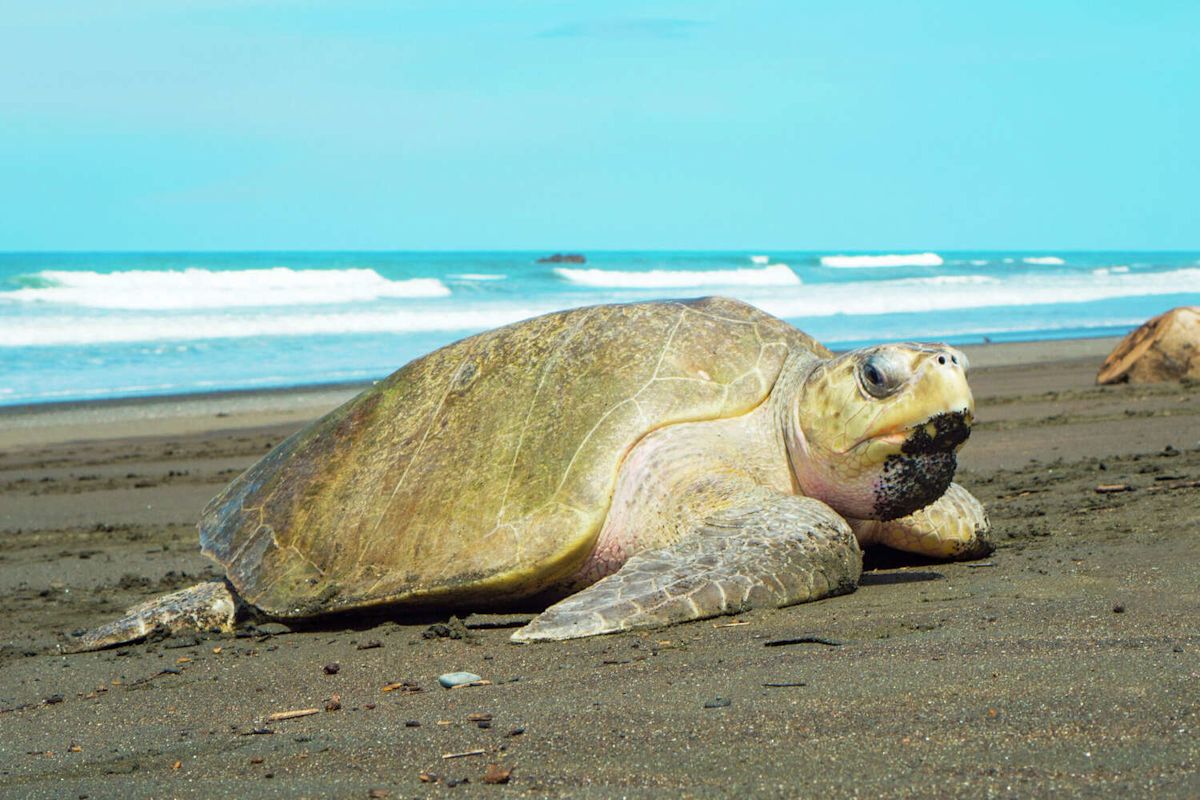
An endangered sea turtle made history when she lumbered her way from the ocean onto an Orange County beach last week.
On Wednesday, lifeguards spotted an olive ridley sea turtle digging a nest and laying her eggs near Seal Beach, Aquarium of the Pacific President Jeff Flocken told SFGATE. Three days later, visitors spotted an olive ridley sea turtle near the Huntington Beach Pier, though it’s unclear whether it was the same animal.
Flocken called the sightings “unprecedented.”
“What happened this week – and we’re very excited about – is there’s never been a recorded instance of any sea turtle nesting on a California beach,” he said. “And we’ve had two confirmed sightings of an olive ridley hauling up onto the beach and nesting – digging a hole.”

An olive ridley sea turtle was observed digging a nest and laying eggs on a beach in Orange County, Calif., on Sept. 16, 2026. (NOAA Fisheries West Coast)

An olive ridley sea turtle dug a nest and laid eggs in Orange County, Calif., on Sept. 16, 2026. (NOAA Fisheries West Coast)

Heidi Stephen and her 9-year-old son Jude from Rancho Santa Margarita came to see the second confirmed olive ridley sea turtle nesting site on the U.S. West Coast on Tuesday, Sept. 22, 2026, in Huntington Beach, Calif. (Mindy Schauer/MediaNews Group via Getty Images)
The National Oceanic and Atmospheric Administration first reported the nestling on Facebook on Monday. NOAA said both areas have been fenced and have clear signs for beachgoers. Along with local, state and federal partners, the agency will monitor both areas until the eggs hatch, which typically takes about 45-60 days.
Of the seven different species of sea turtles, the olive ridley is one of the smallest, according to NOAA. They generally weigh up to 100 pounds and grow up to 3 feet in length. The species is found in waters worldwide, but in the Pacific Ocean, the population typically frequents a long stretch of coastline between Mexico and Panama. Though the species occasionally extends up to Southern California when the water is warm, NOAA says it has never been spotted laying eggs on the state’s beaches.
“Typically the most north we know of any olive ridley or any sea turtle that nests are in Mexico, so this is quite a bit further north for them,” Flocken said.

An olive ridley sea turtle was observed digging a nest and laying eggs in Orange County, Calif., on Sept. 16, 2026. (NOAA Fisheries West Coast)
Flocken said that because there have been only two sightings so far, it’s unclear what brought the turtles, or turtle, to California’s shores. The species may be evolving naturally, choosing to nest farther up the coast where there’s less competition for nesting space, but other factors could be at play. Their usual beach may no longer be hospitable, for example, because of development or changing water patterns.
“Typically turtles return to where they were born to nest,” Flocken said. “And it’s just in these cases – either evolution, anomaly or adaptation – that they’re moving to new ones.”
This year’s extremely strong El Niño could also be the culprit. An unusually active September hurricane season in the Pacific could have blown the turtles off course, or the temperature of the water, which has also brought in various shark species to California, may have made Southern California beaches more attractive.
“Perhaps because of the El Niño and the dual heat waves happening right now in the Pacific off the coast of California, it has changed the way that this individual sea turtle is orienting and is now coming much farther north because the waters are so warm,” Flocken said. “And the beach will be warmer, and that it perhaps will provide a suitable habitat for nesting.”

Heidi Stephen and her 9-year-old son Jude from Rancho Santa Margarita came to see the second confirmed olive ridley sea turtle nesting site on the U.S. West Coast on Tuesday, Sept. 22, 2026, in Huntington Beach, Calif. (Mindy Schauer/MediaNews Group via Getty Images)
Even with all of the precautions put in place to protect the eggs, Flocken said there are many reasons an egg may not survive. Predators like coyotes or stray dogs might eat them while they’re still in the sand, and seabirds might want to eat them once they hatch. Only 1 out of every 1,000 sea turtle hatchlings make it to adulthood, according to the Olive Ridley Project, a sea turtle conservancy group. Ultimately, the goal is for the eggs to hatch naturally without interference.
“Of course, we have our fingers crossed and are hoping that it is.” Flocken said. “It would certainly be an exciting thing for California since it’s unprecedented.”
Visitors in the area should stay at least 30 feet away to allow the turtles to nest on their own and not touch the fencing or signs. If a nest is spotted, Flocken asks that viewers call the Aquarium of the Pacific or a local government agency and report it. The West Coast sea turtle stranding hotline is available 24 hours a day at 562-506-4315.
Most Read
Crime |
Infamous California serial killer dies in prison
Travel |
Airport warns SFO travelers to ask ‘friend with a truck’ for rides
News |
This San Francisco mansion has been vacant for 37 years
I found one of America’s best croissants in San Francisco
Read our stories ad-free on the new SFGATE app.
This article originally published at ‘Unprecedented’: Endangered sea turtle lays eggs on California beach for the first time.