
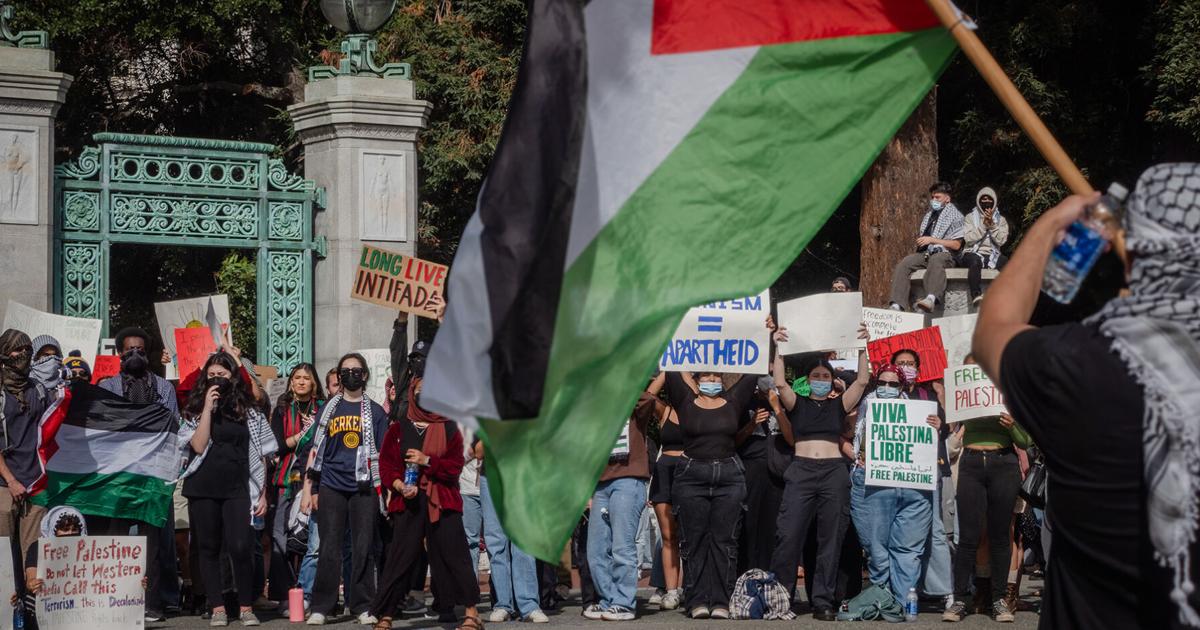
The American Civil Liberties Union and Amnesty International USA published a report Wednesday alleging that universities nationwide, including UC Berkeley, have disproportionately suppressed speech in support of Palestine.
The report, titled “Student Speech Under Attack: Suppression of Pro-Palestine Speech and Dissent on Campus,” claims that some universities have responded in an “excessive” and “heavy-handed” manner to campus protests relating to Israel’s genocide in Gaza. A September 2025 United Nations legal analysis found that Israel is committing a genocide against Palestinians in Gaza.
The report further alleges the federal government has retaliated with “McCarthyite censorship” against pro-Palestinian activists on university campuses. It also claims that President Donald Trump’s administration has targeted noncitizens on campuses as a direct result of pro-Palestinian advocacy.
As an example, the ACLU and AIUSA specifically cite a February 2025 announcement by the U.S. Department of Education’s Office of Civil Rights that opened investigations into antisemitic harassment at several universities, including UC Berkeley.
The report’s investigation, which took place over two years, analyzed events at 46 public and 34 private universities nationwide. The researchers reviewed media articles, reports, university policies, court rulings, legal filings, expert statements and other resources to come to these conclusions.
At UC Berkeley, the ACLU and AIUSA argue that campus’s consideration of the International Holocaust Remembrance Alliance’s controversial definition of antisemitism has limited criticism of Israeli policies.
The IHRA definition of antisemitism provides contemporary examples of antisemitic acts, which include assertions that the existence of the state of Israel is a racist endeavor. Critics say this equates criticism of Zionism with antisemitism.
UC Berkeley renewed its commitment to considering the IHRA definition when investigating claims of discrimination or harassment against Jewish or Israeli individuals following a settlement with the Louis D. Brandeis Center for Human Rights under Law in March. Students attempted to stop that settlement in court, alleging that its terms would chill students’ free speech. Their challenge ultimately failed.
UC Berkeley and universities nationwide have been considering the IHRA definition for more than five years, per guidance from the Department of Education, according to campus spokesperson Dan Mogulof.
AIUSA Deputy Director of Research Justin Mazzola criticized UC Berkeley’s consideration of the IHRA definition, writing in an email that it “creates a framework that has been used to silence criticism of Israeli government policies and to suppress the speech and activism of university students, professors, and organizers in support of Palestinian rights.”
Mogulof said “there has not been a single complaint or allegation that somehow that ‘consideration’ (of the IHRA definition) impeded or impacted anyone’s ability to engage in any form of expression or discourse.” He added that definitions “play no role whatsoever in the assessment, investigation or adjudication of harassment and/or discrimination allegations.”
The report also cites a February 2025 announcement from the federal government which claimed that the Federal Task Force to Combat Anti-Semitism would visit 10 university campuses with alleged incidents of antisemitism, including UC Berkeley.
No members or support staff from the federal task force have visited the Berkeley campus to date, according to Mogulof.
“UC Berkeley has and will maintain an unwavering commitment to protecting the First Amendment rights of its students, staff, and faculty in a completely viewpoint-neutral manner,” Mogulof said in an email. “Therefore, there are no policies or practices that apply to any particular viewpoint or cause.”
Mogulof said the ACLU or AIUSA did not reach out to UC Berkeley for information regarding the report.