

Google held a two-day pop-up, advertising its generative artificial intelligence model, Gemini, on San Diego State University’s Campanile Walkway this past Monday.
The pop-up included demonstrations of Gemini’s various study functions including 3-D modeling, coursework planning and creating study guides. Students who participated in the demonstrations received branded items and a free year of Gemini Pro.
Although the pop-up was not contracted by the university, SDSU is partnered with multiple companies to provide education-centered AI resources to students including ChatGPT Edu, Google Gemini for Education, Gemini Notebook and Microsoft Copilot.
Some students, like economics major Emmanuel Gutierrez, were pulled to the event by the clear branding and recognizing people waiting in line. Gutierrez said he uses AI such as Claude Code, Grok AI and Gemini frequently as an aide for his schoolwork.
As AI evolves rapidly, he believes the next generation will need to learn how to use it properly and ethically.
“AI is basically what you give it, so give it something critical,” Gutierrez said. “With critical thinking, you’ll get critical responses, something that can help you. I think what we can do is teach the next generation to learn how to prompt and learn how to talk to AI, and not let it take over their minds.”
 Emmanuel Gutierrez, a third-year economics major, looks into the free duffel bag given to participants of the Google Gemini pop-up, San Diego State University, San Diego, Calif., Monday, Sept. 21. (Roman Fong)
The California State University system, and specifically SDSU, have strived to become leaders in AI literacy over the last few years.
The CSU announced its AI Initiative last February, touting itself as the “Nation’s First and Largest AI-Empowered University System.”
CSU Chancellor Mildred Garcia wrote that the move would position the CSU as a “global leader” in the adoption of AI, and “help provide the highly educated workforce that will drive California’s future AI-driven economy.”
SDSU launched the Academic Applications of AI Micro-Credential in 2024, which has since amassed over 10,300 faculty and student participants. The Daily Aztec also reported on SDSU’s new AI and human responsibility bachelor’s degree, which launched this fall.
Integrated marketing communications major Landon Cuny worked the Gemini pop-up as a student ambassador after being reached out to by a recruiter on LinkedIn. He said he uses Gemini Notebook as an AI study tool.
With AI’s growing prevalence in the workforce, Cuny said it’s important to learn how to use it now rather than later. He said that AI works as “what you put into it is what you get out of it.”
“If you’re using it to cheat, obviously you’re gonna worsen yourself, and that’s not the way to go about it,” he said. “If you use it as a thought partner and as a tool, it’s really powerful. I think it’s honestly having a library at your fingertips.”
In some of his marketing classes, Cuny said that his teachers encourage the use of AI as a tool, but remind students not to use it to be creative for them. He said that teaching about ethical AI use is more effective than banning it altogether.
“The university should set guidelines, because when you put a ban on AI or using AI completely, it encourages students to do it more to really break that rule,” he said. “You know that their students are still going home and going to use it anyway. It’s about permitting what’s right and what’s wrong.”
 Third-year Landon Cuny speaks with other students waiting in line as a Google Gemini student ambassador, San Diego State University, San Diego, Calif., Monday, Sept. 21. (Roman Fong)
Last fall, The Daily Aztec spoke with President Adela de la Torre on the university’s eagerness to implement AI. She acknowledged that cheating using AI is inevitable, and pointed back to the AI micro-credential.
“Let’s be realistic. In any campus this size, you’re gonna have cheating,” she said.
On Sept. 21, the same day of Gemini’s arrival on campus, de la Torre’s office sent SDSU’s annual generative AI survey.
The university positioned SDSU AI Student Fellows next to the Gemini pop-up and they answered students’ questions about AI while promoting the university’s AI micro-credential and annual survey.
“There was a tangible benefit to SDSU: we leveraged industry interest and student excitement around AI to strengthen engagement with SDSU’s own AI initiatives, expand participation in our listening efforts, and ensure student voices help shape what comes next,” a university spokesperson said about the pop-up and SDSU’s survey.
Data from last year’s survey show the discrepancies between opinions and use of AI between SDSU’s students and faculty.
Out of nearly 14,000 students and 1,500 faculty, the vast majority of both groups said that they use AI in school and administrative work. Both groups also indicated major concern about ethical AI use and its long-term societal impact in areas like job security.
Similarly, both groups overwhelmingly said that AI use had positively affected their learning, teaching, researching or administrative experience.
The majority of students disagreed with the statement that “my professors teach me how to use AI.”
As for the Gemini pop-up, Gutierrez said that students will have to get used to AI’s presence.
“You can’t really resist it because it’s everywhere now,” he said. “We have to learn how to train it well and keep it in school parameters, because it can go any which way.”
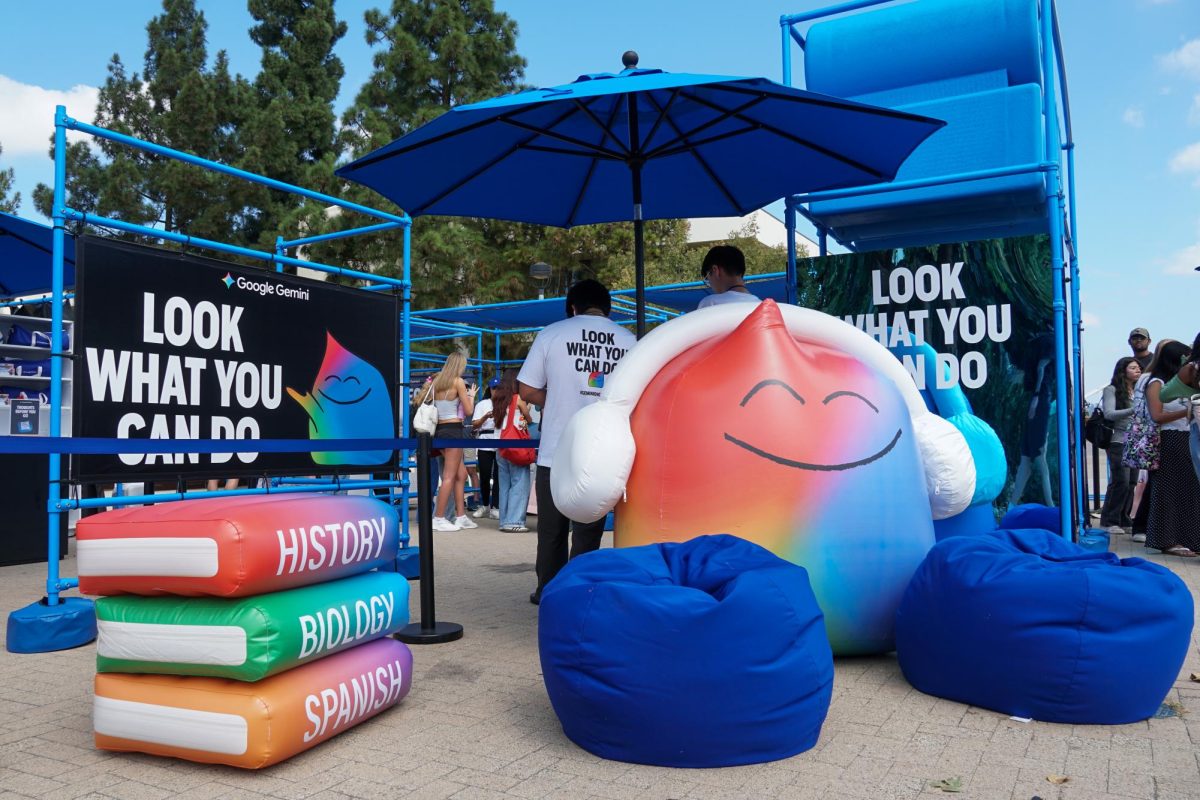
Google Gemini hosted a two-day pop-up on SDSU’s Campanile Walkway to demonstrate Gemini’s AI study tools, San Diego State University, San Diego, Calif., Monday, Sept. 21, 2026. Students who participated in the pop-up received branded items and a free year of Gemini Pro.