
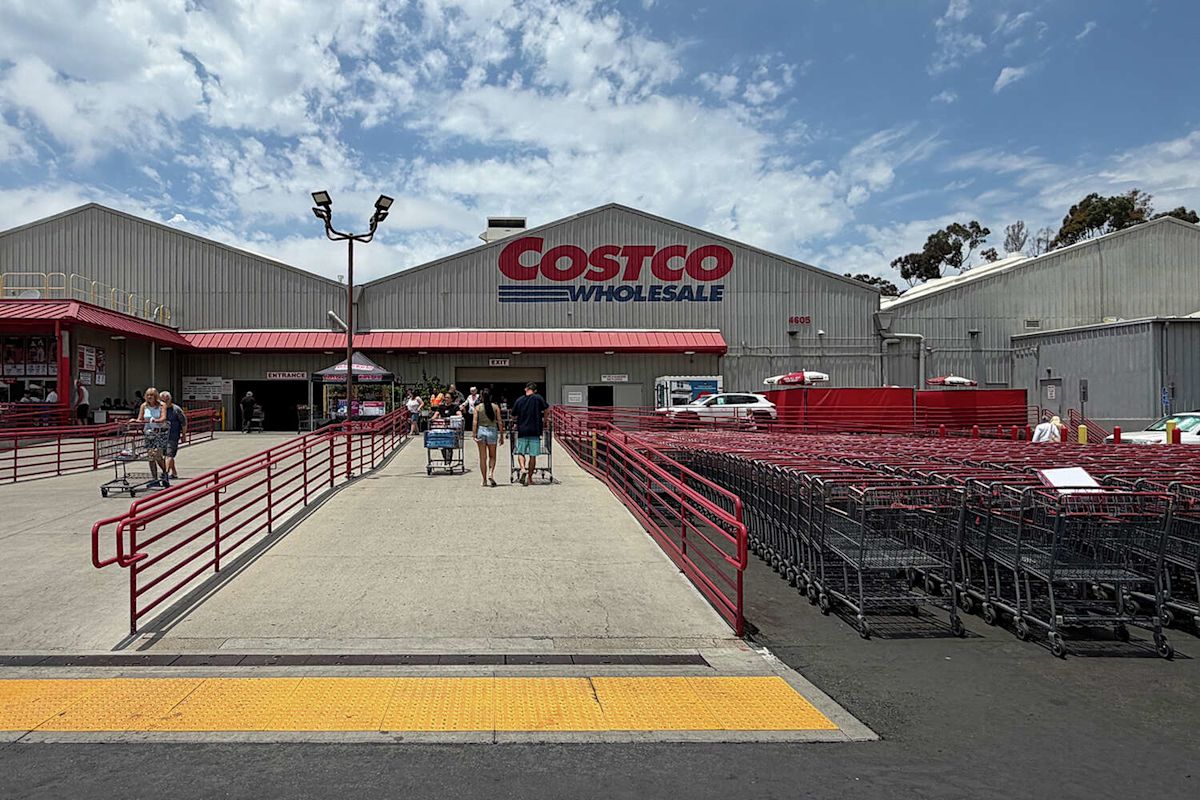
When most people think of Costco’s history, they probably recall its early days in Seattle, where founders Jim Sinegal and Jeffrey H. Brotman opened their first store in 1983. But the roots of Costco run much deeper, and much farther south, to a nondescript airplane hangar in Southern California.
Yes, before the $1.50 hot dog combo was a twinkle in the Costco founders’ eyes, an entrepreneurial father-son duo would open a members-only warehouse store selling bulk goods in San Diego, laying the groundwork for what is now the world’s third-largest retailer of any kind.
Price Club, which opened in 1976 in a former 102,000-square-foot airplane hangar near Interstate 5 that was once owned by business magnate and aviator Howard Hughes, was the vision of Sol and Robert Price. Of course, other members-only grocery stores existed at the time, including one founded by Sol Price called FedMart, but Price Club is widely considered the first members-only discount chain in America. The model – filling large, bare-bones spaces with bulk quantities of everyday items, most of them unwrapped and sold right off the pallets they arrived on – didn’t really exist in mainstream grocery culture at the time.

An interior shot of the original Price Club in San Diego, Calif. (Courtesy of Price Philanthropies)
Today, that very same Morena Boulevard location just east of La Jolla is a Costco, operating as warehouse #401. (Unlike Costco, Price Club wasn’t open to individuals; shoppers had to present resale certificates or professional licenses to purchase a $25 annual membership.)
According to a report by KFMB-TV the year the store opened, Price Club stocked some 4,000 items ranging from “automotive accessories to sundries,” and the products would stretch over 2 miles if the “shelves were laid end to end.”
“The small businessman needs a break,” Sol Price told the Imperial Beach Star-News in 1976. “The Price Club gives him at least two. First, what he buys for re-sale to his customers or for use in his own business will be purchased cheaper and in desired quantity.”
He continued, “Second, the substantial inventory … makes it possible for the small businessman to sell products and services that he cannot presently offer without expanding his own inventory or without a (significant) cash investment.”
Price Club would go on to launch an IPO in 1980, expanding to 24 locations and more than 1 million members in the Southwest by 1986. That same year, it opened its first Canadian outpost in Montreal.
By the mid-1980s, Costco was also in expansion mode, operating a handful of stores in the Pacific Northwest and going public in 1985. In 1993, the two companies merged after Price Club declined an offer from Walmart and its warehouse chain, Sam’s Club. The joint company operated as PriceCostco until 1997, when all remaining stores were rebranded as Costcos.
But that’s not where all of the ties end: Costco founder and longtime CEO Sinegal got his start in the wholesale game by working for Sol Price at FedMart. Even Costco’s current CEO Ron Vachris, who took over in 2024, started his career as a part-time forklift driver at a Price Club location, making $3 an hour before working his way up through various positions at the company.

Customers order hot dogs and pizza at a Costco in San Diego, Calif., on June 23, 2026. (Karen Palmer/SFGATE)
Today, Costco #401 in San Diego looks much like any other outpost of the warehouse chain from the inside. But outside, the uniqueness is still apparent – and not just because of its dramatic setting at the base of a mountain. The original hangar that gave rise to Price Club dates back to 1943, making it older than the end of World War II. The metal exterior, pointy peaks and weathered look are a far cry from the modern, glossy and entirely inoffensive warehouses that Costco makes today. While the world-famous brand is still notably cost-conscious, preferring mostly to open new stores of its own design on previously unused land, it’s nice to see the company keep an original relic around for decades.
Otherwise, it’s business as usual: folks enjoying hot dogs and pizza slices on the outdoor dining patio; inside, wide row after row stacked with bulk groceries and meat under the hangar’s impossibly high ceilings; the occasional surprising retail item, such as a standalone sauna.

A sauna for sale at a Costco in San Diego, Calif. (Karen Palmer/SFGATE)
Even Costco – which now has more than 800 locations globally – acknowledges its Price Club roots as the company’s founding date. This summer, it offered free slices of birthday cake at select locations, and die-hard fans can even purchase a commemorative Costco 50th anniversary silver round in a commemorative gift box for $339.
More LA Food Coverage
–This Calif. college’s little-known restaurant has no business being so good
–One of San Diego’s oldest restaurants is a sunny retreat from everyday life
–The lonely, luxurious life of LA’s many private chefs for billionaires
–ICE didn’t just raid this LA neighborhood. It dismantled its economy.
For more SFGATE LA stories, subscribe to our new weekly newsletter The Southland here.
This article originally published at Costco’s unlikely Calif. origin story includes a San Diego airplane hangar.