
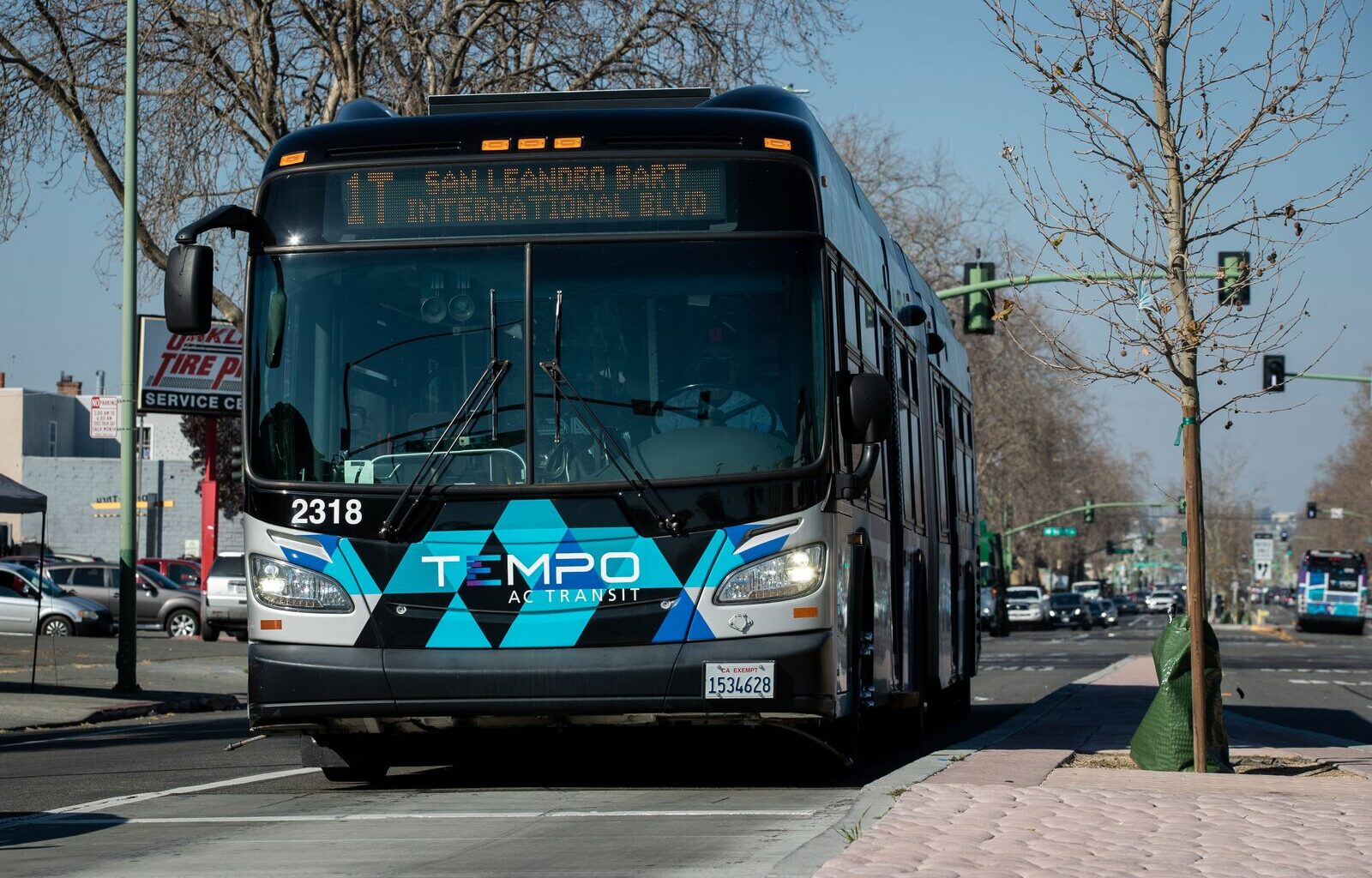
If you’ve spent time on social media lately, you may have noticed a spate of AC Transit bus riders, safe streets advocates, and other transit nerds posting about service delays and cancellations that are driving them crazy.
Alfred Twu, a Berkeley resident and transit advocate, recently experienced back-to-back canceled buses on two major bus lines. “A half-hour-plus wait for a bus that should come in 15 minutes is bad enough; a 1-hour wait gets a lot of people to stop riding entirely,” Twu wrote on Blue Sky.
A Reddit user complained that the 27 bus line, which he picks up at the Emeryville Amtrak, has been canceled multiple times in the last few weeks. Another Redditor said theyʻve experienced multiple canceled trips on the 57 and NL lines, with the 57, which is supposed to run every 10 minutes, becoming “basically a twice-an-hour line now.”
“It feels like several lines have been reduced without officially being reduced,” they said.
The complaints aren’t limited to the biggest East Bay cities. The 8 a.m. 211 line from Warm Springs’ BART station was canceled on Monday morning, according to a post by one rider, a computer science educator.
Ren Fitzgerald, a UC Berkeley college student and mass transit fan, said they were afraid that the system’s unreliability, which has made them late to class, would also affect the public’s willingness to give AC Transit more money through the tax measure on the November ballot. They said one day they woke up early to make sure they got to class on time, knowing a bus might be canceled, but consecutive no-shows on Line 6 still made them late.
“These services are so bad that planning for them and accounting for them in your scheduling no longer works,” Fitzgerald told The Oaklandside.
Priyanka Altman, a young Oakland musician, told us that bus delays are forcing her to consider buying a car.
 UC Berkeley student Ren Fitzgerald’s recent screenshots of canceled bus rides. Credit: Courtesy of Ren Fitzgerald
Many other riders were especially frustrated that their experience was the opposite of what the agency promised in 2025: that its Realign process would reduce service to 85% of pre-pandemic levels in order to make buses more dependable and on time.
Jean Walsh, an AC Transit board director who has represented Ward 2, which includes Berkeley and parts of Oakland, since 2020, has been vocal about the reliability issues at meetings and online. Last week, during morning commute hours, the 6, 57, F, 18, and 88 lines each had cancellations, she posted.
“These are all major lines that carry a lot of people,” she wrote. “AC Transit needs to get a handle on this unreliability problem ASAP.”
At a September 10 board meeting, Aaron Vogel, the agency’s chief operating officer, acknowledged the reliability failures and attributed them to “overlapping operational changes,” including “workforce fluctuation, ongoing realignment, network refinement.”
Vogel said the agency made 829,000 of 862,000 scheduled trips, or about 96%, from January to June, and during the same period, its buses were on time at a rate of 73.6%. The agency defines a bus as on time if it leaves a stop within one minute before and five minutes after the scheduled time. The agency’s current reliability goal, according to its KPI page, is a modest 75%.
Vogel said the on-time rate actually improved slightly over the first few months of the Realign campaign, rising from 72.9%.
An epidemic of missing drivers
The largest cause of missed trips was a lack of drivers, Vogel said, mostly due to insufficient staffing and driver callouts, leading to 14,000 trips missed from January to June.
In its September report and board presentation, AC Transit noted that the number of drivers on staff fell from 1,280 to 1,222 from July 2025 to June 2026, with 40 drivers departing, including 18 retirements.
AC Transit has also experienced a high number of unscheduled absences, according to a recent triennial performance audit prepared for the agency by management consulting firm Pierlott & Associates LLC for the MTC. The report found that over the last three years, unscheduled absences haven’t dropped below 22% and reached nearly 24% in the 2025-2026 fiscal year. The bump up in absences last year, the auditors found, was due in part to “greater use of long-term and protected leave.”
The agency told the auditors that it had worked with its bus driver union, Amalgamated Transit Union Local 192, on “schedule improvements, operator quality-of-life initiatives, and operational refinements” to reduce absences and better cover callouts. AC Transit also said it has adjusted the run time of some bus lines to allow for better compliance on meal breaks and rest periods for drivers.
“ The greatest challenge was unscheduled unavailability, which averaged 23.87% against the target of 14%,” Vogel said. “The district has resumed hiring, prioritized attendance management, and assigned new operators for divisions with the greatest need.”
One of the biggest lines affected by workforce availability is the 1T, or the BRT bus line on International Boulevard, according to AC Transit’s September presentation. The line has suffered cancellations because schedulers have pulled drivers from that route to fill other gaps in the system.
“ The bottom line is we need to get workforce,” Vogel said. “We need to get people in the seat.”
At an Oakland City Council–AC Transit interagency meeting in July, Metropolitan Transportation Commission staff explained that the key to successful regional transit was to “help transit riders get to where they want to go more quickly.”
Stephanie Hom, assistant director at the MTC, one of the bus system’s main funders, said the commission’s newly adopted transit priority policy for roadways recommended road projects that would improve reliability. One example she highlighted was the introduction of bus bulbs and boarding islands, including in Oakland, which have eliminated the need for buses to pull in and out of traffic.
AC Transit’s reliability is lower than similar-sized agencies
The triennial performance audit found that AC Transit’s on-time performance has been largely the same over the past six months as it has been in the previous three years.
That’s not a good thing.
From the 2023-2024 fiscal year to 2025-2026, the number of missed trips did fall from 5.5% of all trips to 4%. On-time performance for the same audit period — that window from one minute early to five minutes late — hovered around 74%.
Vogel described that as a “steady performance.”
But the Oaklandside found that compared with other bus agencies with similar trip counts, AC Transit’s on-time performance is dismal.
San Diego’s Metropolitan Transit System, for example, operates a similar number of annual trips as AC Transit, about 40 million. According to that agency’s three-year audit last year, its buses run on time 85% to 92% of the time, depending on the service, even with a tighter on-time definition of zero to plus-five minutes. TriMet in Portland, Ore., with about 42 million annual trips, had an on-time performance of 85% between July 2025 and July 2026, within the same on-time window as AC Transit. Long Beach, with half the annual boardings, comes in at 84% on-time performance in the same on-time window.
Diane Shaw, the AC Transit board president, said at the September board meeting that data in a six-month report covering January through June of this year exposed problems that needed to be corrected right away. One was the on-time departure rate. A late departure leaves a driver trying to catch up, and often falling behind, during the rest of the workday. For the most recent six-month period, AC Transit found that one of the on-time departure rate indicators — defined internally as a departure within 60 seconds of the scheduled time, called First Timepoint On-Time Performance internally — was 33%.
“ That is really horrendous,” Shaw said. “We need to really try to understand” what’s driving the lateness.
An advocate creates a real-time digital report card
 Oakland resident Kuan Butts created a site that grades AC Transit’s service and on-time performance using its raw data feed. Credit: Courtesy of Kuan Butts
Kuan Butts has lived in Oakland for more than 10 years, starting in North Oakland and recently moving to the Grand Lake district with his wife and young child. During that time, Butts has advocated for improved roads as a volunteer for Traffic Violence Rapid Response, a group of people who’ve sought to reduce lethal collisions through infrastructure redesigns.
As OakDOT has slowly been catching up on repaving and traffic-slowing projects, Butts has shifted his focus to improving Oakland’s bus service, especially the lines that run along Grand and Oakland avenues, which he frequently takes, using his skills as a developer who builds mapping software.
So far, he’s not impressed with AC Transit’s on-time performance, the agency’s recent scheduling decisions — or its data transparency.
“Realign replaced Line 33 with Line 88, a 20-minute headway with gaps approaching 30 minutes now,” he said at the September AC Transit board meeting. Headway is the frequency of service; he noted that a decade ago Line 33 arrived every 12 minutes. “This is the most sparse service schedule offered in over a decade.”
Riders, Butts said, “were asked to accept less frequency in exchange for reliability,” yet his own data analysis shows that service on all lines operated the expected number of trips about 98.5% of the time immediately before Realign’s implementation in 2025. By July 2026, reliability had dropped to 89.9% in both his reliability data — and AC Transit’s.
Butts said he generates his findings from AC Transit’s public vehicle-position data feed. The buses’ onboard sensors report locations approximately every 15 seconds to the agency’s transit management equipment, which enriches those locations with schedules, operator log-ons, trip assignments, geofences, and other operational information to produce arrival predictions and internal performance records. The agency also exports a less enriched, standardized data feed, which is the one Butts uses, as do third-party services such as Google Maps.
Vogel, the agency’s chief operating officer, said at the September meeting that the agency’s data has had some quality issues this year, including some “that caused some on-time performance to be recorded as late.” He said some were due to problems with the vendor, including improper geofencing. The September reliability report said that this led to some buses that left on time being incorrectly recorded as late.
Butts said even the underlying data coming from the buses can be inaccurate. Sometimes digital schedules aren’t properly loaded into buses, or the buses’ computers won’t work, or bus drivers don’t log into the system properly.
“When those inputs are misconfigured, the prediction system can produce false positives: confident arrival estimates for buses that are not actually coming,” Butts said. He said it can also produce false negatives: “a bus may be operating but missing from the feed.”
Butts says AC Transit’s Line U, which serves people riding from Fremont BART to Stanford University, is a “painfully extreme” example. In his archive of service from April 18 through September 9, there were 1,089 scheduled Line U trips, but zero were recognized in the vehicle feed. This doesn’t mean the buses didn’t actually run, but it’s an indication of how incomplete AC Transit’s underlying data can be.
The engineer said he believes the agency would face more public pressure on its reliability issues if it was able to disclose real-time data more routinely and more transparently. Currently, the agency provides reliability reports to the board every six months and has a public Key Performance Indicators page that offers monthly high-level data, including the agency’s overall on-time performance. But it lacks line-by-line on-time analysis — or daily data.
Other riders have expressed their frustration with the agency’s data. At the September board meeting, a rider who identified himself as Evan said that seeing stats 30 to 90 days after the fact didn’t help him keep the agency honest and made AC Transit, instead, feel like an “impenetrable” wall.
“Treat your riders like they are smart, intelligent people, telling them information,” they said.
To fill in the data transparency gap, Butts built his own reliability-reporting site pulling from the raw data feed.
The website, AC Transit Report Card, produces real-time grades of each line, with daily, weekly, monthly, and yearly reliability reports analyzing data at one-minute intervals. It’s also colorful and jam-packed with usable information that AC Transit has never made easily available, such as a graph that shows, for example, how many of each bus line’s rides are delayed, and by how much.
Butts’ visualizations let riders see which lines are experiencing the worst service on any given day or week, potentially allowing them to plan a new route — or choose a different form of transit — before they end up waiting a long time at a bus stop.
“ Reporting once or twice a year is not a functioning feedback loop,” he told The Oaklandside. “By the time the board sees six-month averages, riders have lived with the problem for months. Meanwhile, board response and subsequent staff planning work is only beginning to chase last year’s failures.”
‘We’re not stable right now’
Shaw, the board president, said at the September meeting that she was okay with the ridership report being produced every six months if the agency could achieve stable reliability. “But we’re not stable right now,” she said.
Butts said this data discrepancy is a symptom of incompetent data management.
“There’s no reason why they can’t have an automatic dashboard that updates every day,” he said. “I mean, literally it could update every hour, every minute, right? If they don’t have that internally after 10 years, that should be a red flag.”
At the September board meeting. Butts suggested to the board that it needs sharper accountability.
“Consider tying executive evaluations and any incentive compensation to timely rider-centered reliability outcomes,” he said. “Riders already paid for reliability with reduced frequency.”
Walsh, the board director, told us that she appreciated Butts’ data dashboard for bringing more attention to reliability. But she said it also highlighted an internal comms problem.
“We should not have to rely on a community member to provide the board and the public with clear, timely information about AC Transit’s reliability,” she said. “That information should be readily available from the agency itself.”
Robert Lyles, the agency’s communications director, told The Oaklandside that AC Transit is aware of Butts’ project and “welcomes innovation.” He noted that the agency is not a technology company and that its engineers’ primary responsibility “is to support the systems and operations required to deliver bus service every day.”
Lyles told us that building custom public-facing analytics requires staff time and resources that the agency doesn’t have but that, given the reliability issues riders are seeing every day, staff are working on providing “additional analytics and information” to the board.
In the meantime, AC Transit will focus its attention on the agency’s main reliability challenges: getting drivers in seats.
“That work includes rebuilding the Bus Operator workforce to the level needed to deliver scheduled service, maintaining an appropriate number of extra operators to cover absences, strengthening efforts to keep operators safe and healthy on the job, and improving workforce communication to support attendance,” he said. “Data helps us identify and understand service challenges. Our priority is turning that data into action.”
“*” indicates required fields