
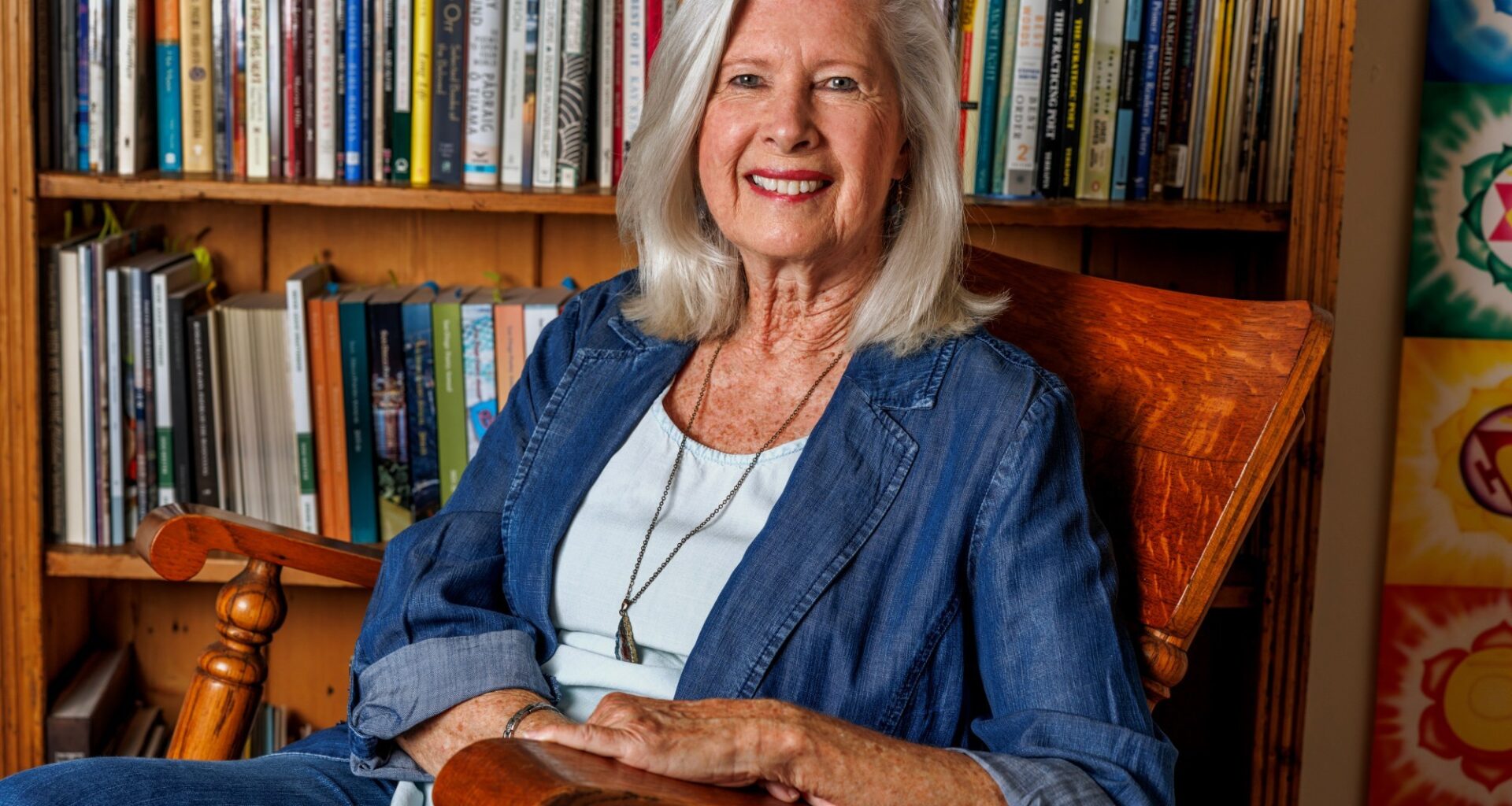
Winning this contest meant Kathy O’Fallon could breathe a little easier.
“Before I died, I wanted to get a book published. I wanted the acknowledgement that I had achieved that,” she says. “It’s easy to self-publish now, of course, and that’s fine. It’s just that I wanted the acknowledgement that somebody else thought it was worth seeing in print.”
She recently won the Henry Morgenthau III First Book Poetry Prize from Passager Books, a nonprofit independent publisher focused on sharing the work of writers over 50. The poetry prize is awarded every other year to a U.S. writer 70 or older who has not previously published a full-length book of poetry. O’Fallon’s book, “Proof of Life,” deals with themes of love, trauma, divorce, climate change, beauty, and music. The book is scheduled for release on Oct. 15, with an online launch party scheduled for 11 a.m. Oct. 18, and in-person appearances scheduled for 1 p.m. Nov. 8 at the Encinitas Library, and 4 p.m. Nov. 25 at Carlsbad Village Books.
She’s previously published a number of chapbooks, won other writing contests, and her poem “Listening for Tchaikovsky” received an honorable mention in Passager’s 2024 poetry contest, and her full-length manuscript of the same name was finalist for the Morgenthau Prize in 2024. She wanted to challenge herself, to really go for her dream and see if she could win the big prize and get a book of her poems published.
“It was a great relief after getting the news and it sinking in. I felt like pressure was off, but it also means that I am committed to myself and my journey as a poet,” she says. “It was a reminder to myself that, although many other people deserve the same award who don’t necessarily get it, there was a reason I got it. It wasn’t just that I got lucky.”
O’Fallon, 76, lives in Encinitas and is also a clinical psychologist who uses poetry as a therapeutic tool in her practice. She talks about “Proof of Life,” sharing a love of reading and writing with her mother, and the time a UCLA men’s basketball booster and former intelligence agent introduced her to the Russian national basketball team.
Q: What is “Proof of Life” about, and why did you choose this title?
A: The title has multiple meanings, and I chose that intentionally because it seemed that when I put my body of work together, it demonstrated my search for life, the ways in which I felt my life threatened, the ways in which I kind of felt held hostage—”proof of life” being the expression that’s used to for a kidnap victim to show the parents that the child is still alive, and “proof of life” in relation to beyond this life, and proof of life everywhere, especially in nature. That the cycle of life involves death, which is also a renewal and a new life. So, I think my way of relating to the world has a lot to do with how life expresses itself, or is suppressed.
Trauma is a psychic threat to life, whether it’s physical or sexual or emotional or verbal, so that theme comes up in the book—politically, with climate change, in numerous ways in which, every day, all of us live with the threat of life. We don’t know if we’re going to be alive from one day to the next, so the seeming randomness of that, as well as the obvious life cycle that the only guarantee we have in having been born is that we will die.
What I love about Encinitas…
I raised my kids here, mostly. I’ve been in various places around North County, but coming back here to settle, I really feel like I’m home again, which is lovely because I’m not somebody who’s rooted. So, this feels really good to be here.
Q: You’ve published chapbooks and won previous poetry awards; is there anything different for you about this one? What does it mean to you to be recognized for your writing in this way?
A: It’s very different. I was looking at the manuscript (recently) with fresh eyes, and I surprised myself because, as a writer, you just never know if something’s going to land with somebody else. Some days you think you don’t know what you’re doing and you always have to come to the page with a beginner’s mind. If you’re self-conscious when you’re writing, it’s not authentic and it doesn’t come across in a way that’s going to be taken in because it’s not authentic. To get rid of that self-consciousness and the editor in your head, you have to just sit down and, as Anne Lamott says, “Don’t take your pen off the page.”
Q: Before poetry, you were writing fiction; what kind of fiction were you writing and how did you get started on that path?
A: Number one, I had more time because my kids were in school by then and really getting to the point where they were more independent, headed toward college. And, my mom had written; I’d read stories that she’d written and I had seen her writing, so I think I had it in me to think that that was possible. I started writing and the first short story that I submitted to a local publication was called “Voices,” and I won the contest, so I thought, ‘Oh, OK, I’ll keep writing.’ I was in a local writers’ group that met for eight years every other week. When you’re in a writers’ group, you have to write in order to show up with something to get feedback, so I do much better with my writing when I have a group to go to, to show my work to. A lot of what I wrote, I was working on a memoir after initially just writing fiction. I got a number of those stories published as short stories that were chapters from the memoir, but I never got the entire memoir published. That all changed because I was going to writers’ conferences and just doing everything I could to learn the craft of writing. I’ve had lots of school, but I’d never been an English major or done a writing program, so while I knew I had to write, I didn’t really know how to write. I was at the Santa Barbara Writers’ Conference when I wandered into Perie Longo’s workshop because she was a poetry therapist, and I was curious about what that was. That’s when I started writing poetry, and I think that had a lot to do with the timing because my mom had died three months earlier, and the group just happened to be at least three sets of mothers and their adult children. So, I think I was drawn to it emotionally, and then I just fell in love with it.
Q: You grew up in Long Island and New Jersey, the oldest of nine children. How would you describe your relationship to literature and poetry when you were growing up? Were there a lot of books and a lot of reading in your home?
A: Yes, my parents were both great readers. My mother shared lots of novels with me, she turned me on to Nancy Drew and those kinds of books; “The Secret Garden” was probably my favorite book in elementary school. Then, she and I had similar taste in fiction, so I read pretty much read everything she read. Plus, she was also very interested in the afterlife, and she read Edgar Cayce and things like that, so I became interested in in that also, but I think I had a natural interest. My grandfather died when I was 9, and he came to me just before he died—not in a dream, but in a vision—and I knew he was going to die. And, my mom had ESP experiences also, and one morning she opened up the newspaper and she turned white. She was reading an article about a plane crash in Africa, and she said, “I just had this dream last night,” so things like that would happen to her. But, books were definitely popular in my home.
My mom had a poem on her bureau, Elizabeth Barrett Browning’s poem, “How Do I Love Thee?” It was typed up and in a frame, and I read that poem over and over again, and I just didn’t understand why she had it there because I didn’t think that she was in a happy marriage, and it’s a love poem. So, I was not interested in poetry at all, except that particular choice she made did fascinate me. I took a poetry class in college, and it was really a negative experience; I didn’t think the teacher was good. She wanted us to interpret the poems, and if we didn’t interpret them in the way that she thought they should be interpreted, then you got a bad grade. Poetry is such a subjective experience; it doesn’t belong to the poet anymore, it belongs to the reader once it’s out there in the world, so I was really turned off by poetry after that. I thought, ‘Well, I guess I just don’t understand poetry,’ so that’s why it wasn’t until 1998 that I started writing poetry.
Q: What would 35-year-old Kathy say about the perspectives you’re sharing in “Proof of Life”?
A: Oh my gosh, it would save her life because, at 35, I was going through a divorce, and I think it was a desperate time for me. To know how she turned out would make her very, very happy and hopeful.
Q: Thinking back on what younger you was navigating at that time, what advice would you give that version of yourself?
A: That all things are temporary, but that if you show up for it, there will be another day. That means showing up for it makes it a better day because you’re in it because you matter.
Q: What are you currently reading?
A: Right now, I’m reading lots of poetry. I recently finished Ann Patchett’s latest book, “Whistler.” I read a lot of literary fiction, but I’m in a poetry group that meets monthly, and we choose a book each month. I recommended the book written by the poet laureate of Orange County, Gustavo Hernandez; the name of it is, “Flower Grand First.”
Q: Who are some of your favorite poets/writers?
A: Marie Howe, for sure; she’s just an amazing poet. I can’t begin to write like her, but I just find the way she writes fascinating and I learn so much. And, Dorianne Laux; there’s something about the way in which both of them express themselves with such depth and such deftness. They’re both wonderfully skilled poets. And, Julia B. Levine, she’s among my top three. She’s a Northern California poet who actually wrote one of the blurbs for my book. I was so grateful to her that she was willing to do that, and she’s just a brilliant poet and very lyrical, a gorgeous poet. Those three are probably my top three favorites, but it’s hard to say because there are just so many good ones.
Q: What is the best advice you’ve ever received?
A: “Don’t believe everything you think.”
Q: What is one thing people would be surprised to find out about you?
A: I like to mention this because I think it’s funny, and this was long before I started writing. (In the 1970s), I was quoted in Sports Illustrated and it had nothing to do with being athletic. I was at an event where the Russian national basketball team was playing an exhibition match with UCLA, and my brother-in-law was Bill Walton. He was on the team, so we got to go to the game, and afterward there was a reception. The Russian team was sequestered in the corner with the KGB around them—and I grew up praying that (Nikita) Khrushchev wouldn’t kill us all, we had a fallout shelter in my home, so it was really a watershed moment to me. One of the UCLA boosters, a man named Sam Gilbert, had been a spy and spoke Russian during the war. (A 1990 Los Angeles Times story says that Gilbert was born to Lithuanian immigrants and “claimed to speak French, Russian and German fluently and served in the OSS during World War II.”) He was a bigshot in L.A. and in real estate, and he said, “Come on, I’ll take you over. I’ll introduce you.” So, he took me over there, and they were just kids like me. Sam translated for us and we had a conversation, they gave me pins from Leningrad. They were just sweet boys and all of my nightmares, all of my fears, washed away like, “Oh yes, they’re people just like us.” Curry Kirkpatrick, who was a very famous sportswriter for Sports Illustrated for years, came up to me afterward because, of course, he couldn’t get an interview. So, he asked me what they said and he quoted me about what the Russians said.
The other thing I’d say is that I went to every Beatles concert in New York, as a teenager. I crashed their hotel room the first year they were there and took all the memorabilia I could get.
Q: Please describe your ideal San Diego weekend.
A: Hanging out with my family, for sure. I have four wonderful granddaughters and two wonderful children, so playing games with them. I have a back disability, so I can’t participate in the physical games, but I can play a mean game of cards. Spending time with them is my ideal time, so it can be anywhere.
To suggest a notable San Diegan for the One-on-One series, contact Lisa Deaderick at lisa.deaderick@sduniontribune.com.