
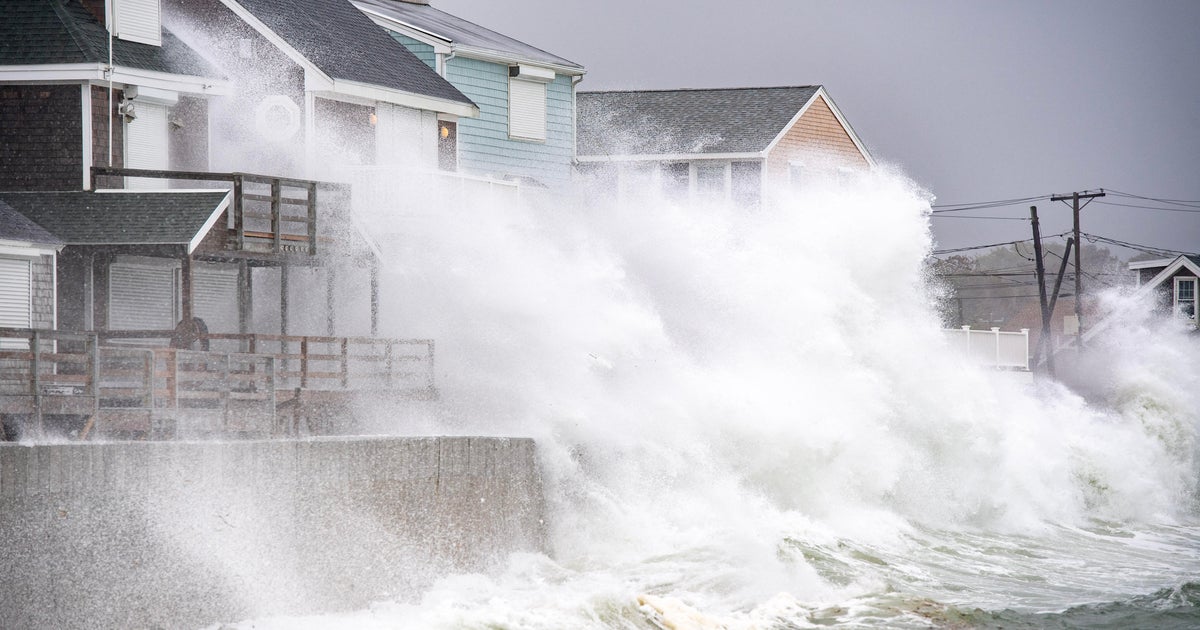
Millions of people are under weather warnings or alerts as a powerful nor’easter makes its way up the coast of New England this weekend. The storm has already caused severe flooding, tens of thousands of power outages and led to event and flight cancellations.
Dangerous flooding is expected along the Mid-Atlantic coast, particularly near New Jersey and Delaware, according to the National Weather Service. More than 31 million people are under a coastal flood alert, and 3.6 million people are under a high wind warning. Fifteen million people are under a beach hazard or rip current advisory, and nine million people are under a high surf advisory.
More than 70,000 customers were without electricity Saturday, and forecasters were warning of gale-force winds that could down trees. Rainfall totals of 1 to 3 inches are expected from the Philadelphia region into eastern New Jersey, and portions of Long Island and southern New England could see 3 to 5 inches of rain.
The nor’easter is rapidly intensifying and is expected to make a sharp turn back toward the New Jersey coast Saturday night into Sunday. It may stall or meander nearby through Monday, prolonging the rain, wind and coastal impacts before finally departing on Tuesday.

The East Coast is under several weather alerts from this weekend’s nor’easter. Sept. 25, 2026.
CBS News
Beach towns see severe flooding
Widespread coastal flooding has been reported along the New Jersey and Delaware coasts and portions of Delaware Bay. Many roads in the affected areas are completely covered in water and impassable as of Saturday morning.
In the beachfront borough of Manasquan, New Jersey, Mayor Mike Mangan said he expected “a lot of water in the streets for a long time.” A voluntary evacuation was issued earlier in some low-lying areas of the community.
Some roads on Long Beach Island were submerged. In the borough of Ship Bottom, some drivers could be seen trying to push through rising floodwaters, while other residents fled to higher ground on foot. In nearby Surf City, water rushed through streets and inundated homes. The town reported wind gusts of up to 74 miles per hour.
In Sea Bright, New Jersey, homeowners and businesses were preparing for the worst. Mayor Brian Kelly said the borough is bracing for winds of up to 50 mph and flooding that could reach up to six feet on some streets. The flooding is expected to worsen by midday Saturday, and Kelly said he hoped residents living in low-lying areas would consider evacuating. The town’s recreation center will be open for evacuees, he said.

A car is seen submerged in water on a flooded road during a nor’easter storm on September 26, 2026 in Point Pleasant, New Jersey.
Ryan Murphy / Getty Images
“It’s going to be worse than average. We do have probably one or two flooding events a year, sometimes more, sometimes less, but I think this one will be closer to an Irene-scale flooding event,” Kelly said, referencing the 2011 storm that caused major flooding in the Northeast. “I hope I’m wrong, but that’s my gut feeling.”
However, Michael Cardelfe, owner of Donovan’s Reef Beach Bar, said his doors would stay open, telling CBS News that the bar is “like the local watering hub” and “the kind of place” where “when we have a storm, we get busier.”
In Ocean County, New Jersey, the storm system was kicking up high surf and causing beach erosion. Block after block was underwater.
The flooding impacts are expected to continue. Even before the storm hit, days of persistent northeast winds had pushed water into back bays and tidal waterways. The full moon is expected to raise astronomical tides even further.
Robert Kennedy, the mayor of the Long Island village of Freeport, said the flooding would be dependent on the tides. Crews in the area were building a wall of sand along the beach to keep the rising tide away from residential homes.
“If the tide goes out, we don’t expect to have such bad flooding,” Kennedy told CBS News. “If the tide stays in, it could increase the flooding in the village.”

Forecasted rainfall totals from this weekend’s nor’easter. Sept. 25, 2026.
CBS News
Wind gusts may cause damage, increase flooding
The New Jersey and Delaware coasts could see wind gusts of about 60 miles per hour, though meteorologists have already seen reports of winds over 70 miles per hour. Inland, residents could see wind gusts of 40 to 50 mph.
Eastern Long Island and southeastern New England could see gusts of 45 to 65 mph.
Residents of the islands near Cape Cod, Massachusetts, headed to the mainland to wait out the storm. Peak wind gusts for Cape Cod, Martha’s Vineyard and Nantucket could approach 60 to 65 miph on Friday night and Saturday, NWS meteorologist Matthew Belk said.
Inland residents will see wind gusts of about 50 to 55 mph, Belk said.
“It’s definitely going to be a case of the closer to the coast you are, the more impacts from the storm you’re likely to see,” Belk said.

WBZ-TV weather graphic.
CBS Boston
The early timing of the nor’easter in the season could lead to even more damaging effects. Because trees are still fully leafed, they will have more wind resistance, Belk said. That could increase the risk of downed limbs, which, combined with the saturated ground caused by heavy rain, could cause power outages, leave debris on roads and lead to other property damage.
Strong winds could also push ocean waves over seawalls, creating flooding. Large waves and elevated water levels could also lead to beach erosion and sand dune breaches.
On Massachusetts’ South Shore, the towns of Cohasset and Scituate sit right in the bullseye of the storm. While parts of the coastline are protected by seawalls, some of those seawalls are in the middle of repair projects or have seen those projects stall due to federal funding cuts.
“So the waves hit the seawall and they go straight up about 60, 70, 80 feet, and the wind hits it from the northeast and every wave ends up hitting the house,” Kevin Gill, owner of an oceanfront Scituate home, told CBS News Boston on Thursday.
Waves pound the coast as the tide comes in during a Nor’Easter storm in Scituate, Massachusetts on September 26, 2026.
Joseph Prezioso /AFP via Getty Images
Storm leads to event cancellations and travel disruptions
Major sports and entertainment events were cancelled across New England. The Boston Red Sox announced their weekend series against the Chicago Cubs would be adjusted. The team moved the Sunday afternoon game to Friday to create a split doubleheader. Separately, Ed Sheeran announced that his high-profile Friday and Saturday shows at Gillette Stadium in Foxborough, Massachusetts, would be canceled due to the storm.
In New York City, the Global Citizens Festival and All Things Go NYC were canceled ahead of the storm.
The nor’easter also caused dozens of flight cancellations and delays. Boston flights were particularly affected. The flight-tracking service FlightAware reported 39 cancellations at Boston Logan International Airport between 6 a.m. and 10 a.m. Saturday, compared with 22 at New York’s John F. Kennedy International Airport. Another 12 flights were delayed at Logan.

John Garrisi, left, and Gaige Graf move an outdoor table away from the shorefront during the early stages of a nor’easter storm, on Sept. 25, 2026, in Gloucester, Massachusetts.
AP Photo/Robert F. Bukaty
Meanwhile, the public ferry service connecting Cape Cod with the islands of Nantucket and Martha’s Vineyard was experiencing widespread cancellations Friday due to strong winds and choppy water. Several flights to the islands were also canceled.
Over in Rhode Island, ferries were also canceled for Block Island. The disrupted ferry service was also expected to spill into Saturday.
For people who regularly travel to and from the islands, the possibility of getting stuck on one side or the other is “part of life,” said Sean Driscoll, a spokesperson for the Woods Hole, Martha’s Vineyard and Nantucket Steamship Authority. Most people have backup plans in place for when boats are canceled.
“It’s a nuisance, but you know, we know what to do with this kind of stuff at this point,” he said. “This is not out of the realm of ordinary. Part of living in this region is just kind of knowing how to deal with this stuff.”
More from CBS News
Go deeper with The Free Press