
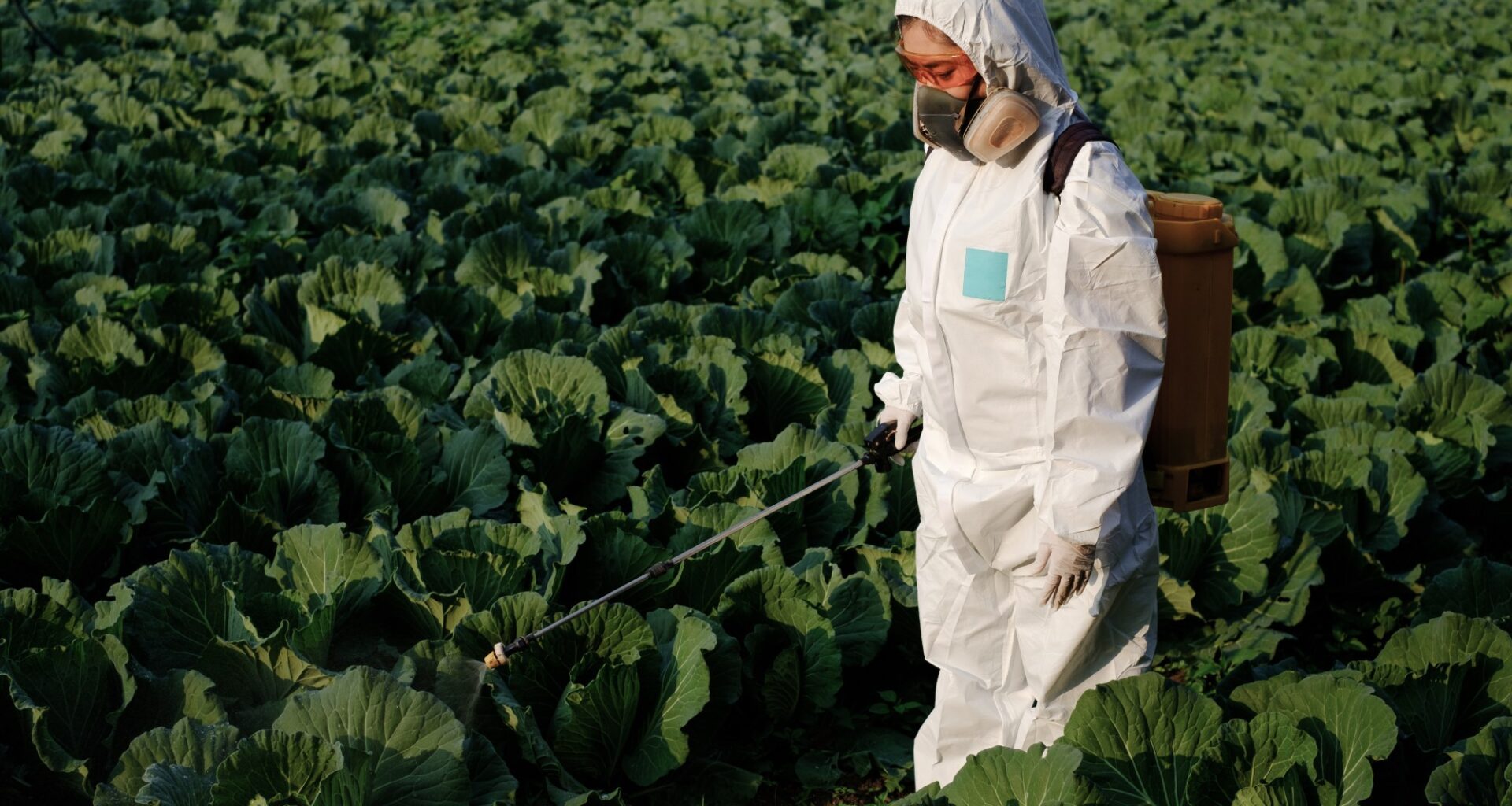
When it gets sizzling hot outside, no harm comes from watering plants in the middle of the day. One of the most enduring horticultural misconceptions is that “water droplets on leaves act as tiny magnifying glasses, leading to burnt foliage.” The only disadvantage in watering when it’s hot is rapid evaporation, as water is wasted compared to early morning irrigation. Early morning is the best time to work in the garden anyway. Not only do cooler temperatures mean garden tasks are more easily accomplished, but fruits and vegetables are more hydrated at that time, so it’s best to pick them then. The same thing goes for cut flowers. This will last longer in a vase when cut in the early part of the day.
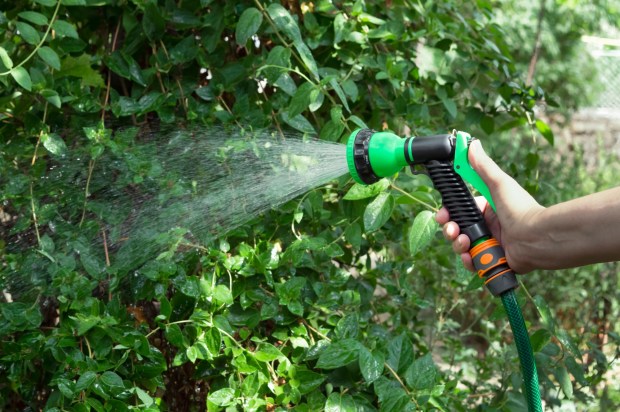 Watering plants in the garden with a spray gun. (Getty Images)
I was first made aware that overhead watering in hot weather did not cause leaf damage from testimony at gardenprofessors.com. This is a website that casts a critical eye on accepted wisdom regarding a wide variety of horticultural subjects. The website was created by four professors of horticulture, and I was motivated to check it for an informed response to the following email from Florence West, who gardens in Mission Viejo: “I have heard that organically grown fruits and vegetables are no healthier than inorganic ones since they are heavily sprayed with pesticides. What can you tell me about this?” At gardenprofessors.com, under the title “Dirty Dozen?” — referencing a study of the 12 most heavily sprayed crops, celery first among them — Dr. Jeff Gillman, one of the aforementioned professors, wrote as follows: “I have a major problem with the idea that organically produced fruits and veggies are necessarily safer than those produced with synthetics. You see, organically produced food is not tested for residues of potentially damaging organic pesticides, and those same foods that are slathered with synthetic pesticides in non-organic growing systems are typically slathered with organic pesticides in organic systems, particularly if you’re dealing with foods produced using what has become known as ‘industrial organic production,’ which fill most of our large grocery stores with USDA Certified Organic Produce nowadays. These organic pesticides may be present at higher concentrations than synthetic pesticides and may have similar effects on humans, and even worse effects on the environment than synthetics (though it depends on the exact pesticides used and how often they are used, of course).” Furthermore, it has also been shown that even where certain organic pesticides are effective at curbing insect pest outbreaks, they can be damaging to beneficial insect populations as well.
When it comes to fertilization, however, there is a distinct advantage in applying organic as opposed to synthetic products. This advantage concerns soil health since the populations of earthworms as well as the proliferation of beneficial aerobic soil bacteria and fungi (mycorrhizae) are increased by application of the following organic materials: composted barnyard manure, blood meal, bone meal, cottonseed meal, kelp or seaweed meal, worm castings, bat guano, fish emulsion, rock phosphate, greensand (containing potassium, iron, and trace minerals), and others. Synthetic fertilizers, on the other hand, can be toxic to soil life.
Inge Pelzer, who gardens in Riverside near the Canyon Crest Country Club, wrote: “I bought a Norfolk Island pine at a local Kmart thirty years ago. It was about one-and-a-half feet tall, and today it has grown up over the roof of my two-story house.” Pelzer’s tree was leaning, and she wanted to know if any sort of seal needed to be applied where its branches were cut. Yet another horticultural myth concerns the practice of applying substances to cut tree branches to hasten healing; no such substances should ever be applied since they may actually hinder the healing process by slowing natural growth of callus (protective wound tissue) on the periphery of the cut.
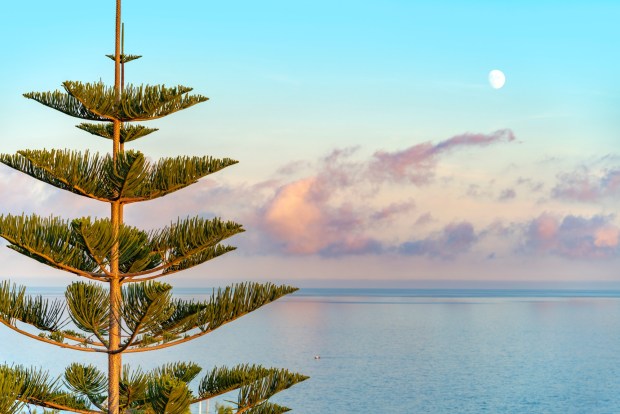 Coastal scenery showing a Norfolk Island pine. (Getty Images)
Ralph Ruffalo, who resides in Buena Park, reminisced as follows: “Your article on Norfolk Island pines (Araucaria heterophylla) and related species brought back some memories: In the 1970’s, I was part of a tree crew at Knott’s Berry Farm. In the parking lot on the north side of La Palma Avenue, there was an entire row of monkey puzzle trees (Araucaria araucana). We had to climb those trees to dislodge their huge cones (weighing up to 15 pounds) because of several incidents of cones dropping that resulted in broken car windshields. You are correct about the sharply pointed leaves. There are also sharp protrusions from the trunk. Our protection consisted of a feather cap, goggles, thick gloves, and a leather motorcycle jacket. We also procured leather chaps from the stagecoach barn for leg protection! Walter Knott was big on having a variety of trees at the park and was protective of them. While he was alive, any tree removal would not occur without his personal approval. I was young and impressionable. I interacted with older men in the grounds department who had come to California from all over the country — during the Depression — looking for work. Their stories and commitment to putting in an honest day’s work had an impact on my life. I still think about them often and how it was a privilege to know them.”
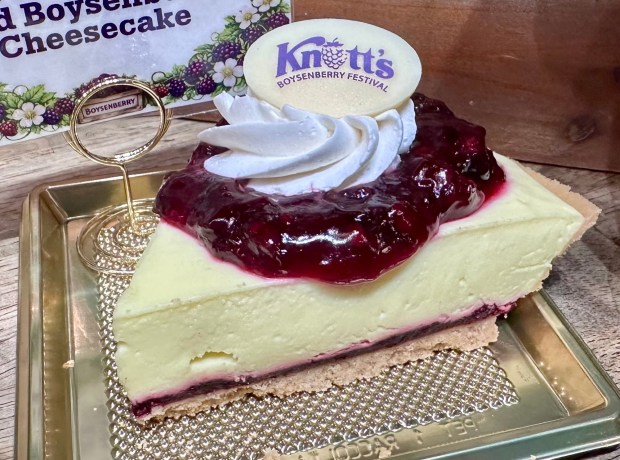 No-Bake Lemon and Boysenberry Cheesecake available during the Knott’s Boysenberry Festival. (Photo by Brady MacDonald, Orange County Register/SCNG)
Any mention of Walter Knott evokes the boysenberry, which was responsible, in large part, for Knott’s success. The boysenberry is widely considered the tastiest of bramble fruits due to the combination of flavors found in its four progenitors: European blackberry, European raspberry, loganberry (a blackberry-raspberry hybrid), and dewberry, a kind of blackberry native to the central and southern United States. The boysenberry was developed by Rudolf Boysen on a farm in Anaheim. After the farm was sold, rumors of this special berry’s presence there aroused the curiosity of Walter Knott. Knott tracked down a couple of the struggling vines on Boysen’s by-then weed-infested farm and propagated them on his own farm in Buena Park. When he began selling them in 1932 and was asked what they were called, he named them boysenberries in honor of their developer. Knott eventually planted 2,400 acres of boysenberries, which became the signature berry of what was to become Knott’s Berry Farm.
Do you have memories of a special plant that you would like to share? If so, send them along to joshuas@perfectplants.com. Your questions and comments, as well as gardening conundrums and successes, are always welcome.
California native of the week: Lavatera ‘Purissima’ is a hybrid of Lavatera assurgentiflora, endemic to the Channel Islands (located off the coast of Southern California) and Lavatera venosa, endemic to San Benito Islands (located off the coast of Baja California, southwest of Ensenada). Lavatera ‘Purissima’ has silky, five-petaled flowers of an iridescent violet hue. Although the plant may eventually reach ten feet in height and has the common name of Purissima tree mallow, it would really rather sprawl without restraint. By the same token, ‘Purissima’ can be trained into an informal hedge or grown as a small tree.