
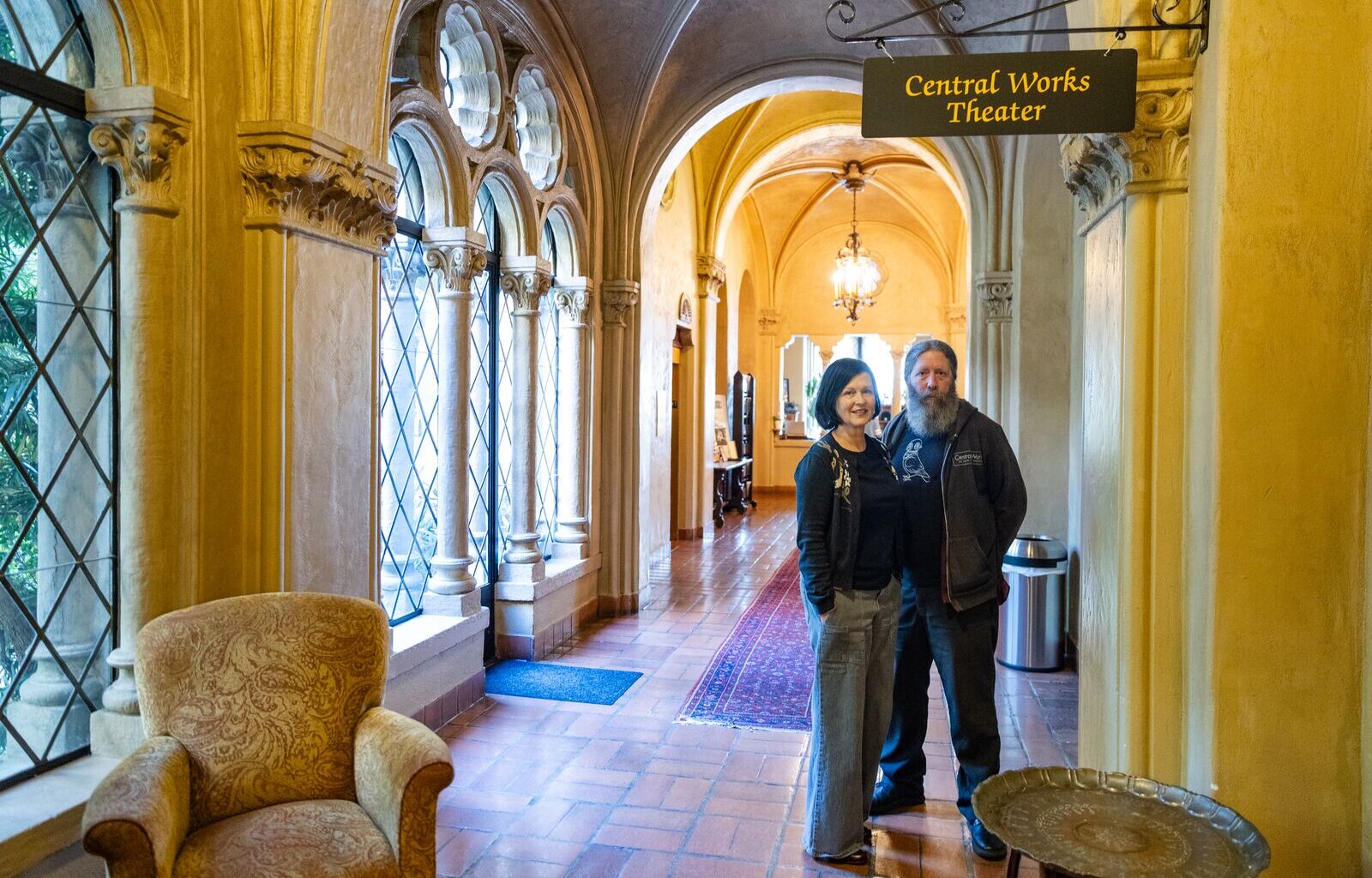
On a recent Sunday, as a line of ticket holders made its way into the Berkeley City Club to see “The Prince Parts One and Two,” two original 3-act plays inspired by Niccoló Machiavelli’s “Handbook for Tyrants,” a number of them stopped to affectionately greet Jan Zvaifler, Central Work’s co-director and an actress, when they reached the ticket counter. There were hugs across the table and plans made to stay in touch.
It was Sept. 6, the company’s last day as a theater company. After 36 years — 24 of them operating out of the Julia Morgan-designed “Little Castle” — and 81 original plays, Central Works was exiting the stage for the last time.
Everyone who works at Central Works is a “something-slash-something.” More often, it’s a “something-slash-something-slash-something.” That night, Zvaifler was checking in ticket-holders while Gary Graves, who wrote and directed the play, and was, with Zvaifler, co-director of Central Works, ushered them to their seats.
 Like each member of its core team, Jan Zvaifler, Central Work’s co-director and an actress, played many roles at the company. Courtesy of Central Works
“Both Gary and I have worked very hard for a very long time and it gets to a point where you go, you know what? It’s enough,” said Zvaifler in an interview with Berkeleyside, adding that Graves had told her several years ago that he wanted to retire when he turned 70, which he now is.
The closure marks the latest of many in the Berkeley theater world. In 2023, both TheaterFirst and the Bay Area Children’s Theater closed their doors, followed by CalShakes in 2024, and then the Aurora Theatre in 2025 (Aurora currently has plans to resurrect itself). The usual suspects are cited as the cause: rising costs, cultural shifts in entertainment, a sluggish return of audiences following the pandemic, shrinking institutional funding, and a lack of arts philanthropy in the Bay Area.
For Central Works, hurdles were also opportunities
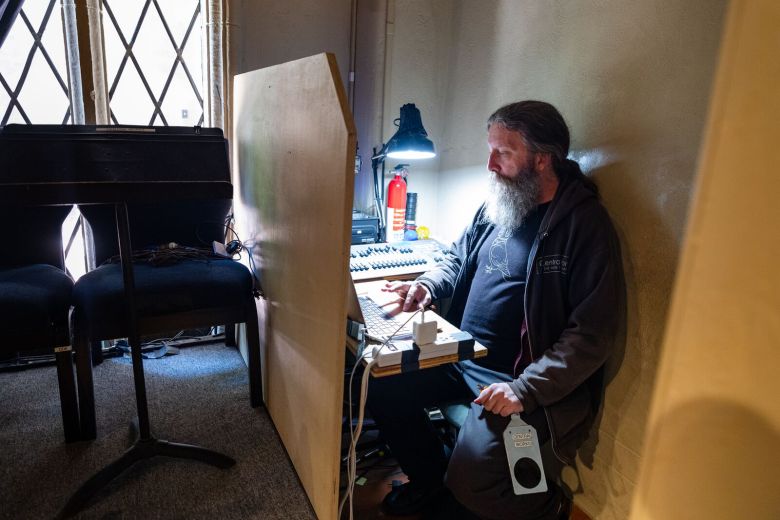 Gregory Scharpen, sound designer for Central Works, sits inside the company’s tiny sound booth in its performance space. Credit: Estefany Gonzales for Berkeleyside
Some of Central Works’ greatest operational hurdles over the years have, however, also contributed to its formula for success. Operating a small, 50-seat theater more or less guaranteed that ticket sales would never be able to provide the lion’s share of their revenue, but it also meant that audiences were treated to a delightfully intimate experience. In a space of this size, the fourth wall between actor and audience all but disappears.
“Our backstage is also our green room and is also the lobby of the Berkeley City Club,” Zvaifler said. “You’ve got to keep it really minimal, which is great because we’re interested in the value of the words and the acting.”
The absence of stage wings meant that there can be no elaborate set-dressing on stage, creating imaginative possibilities for the resident designers. With the audience close enough to register a bead of sweat or a flaring nostril, even the smallest details matter, unlike large stage productions where you are limited to the design choices that will read at a distance.
“You can say a lot with a tiny detail and, believe you me, we think about every single one of those details,” said Tammy Berlin, who has been Central Works’ resident costume designer since 2003.
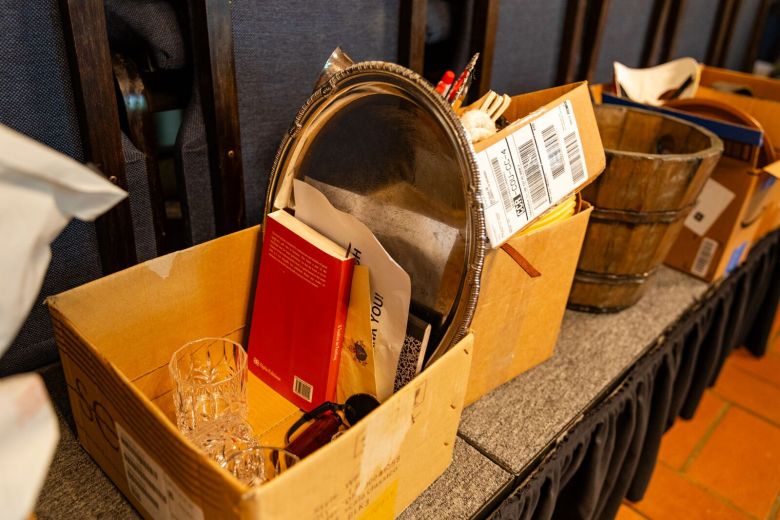 Boxed-up props at Central Works theater on Saturday Sept. 16, 2026. Credit: Estefany Gonzales for Berkeleyside
As an example, Berlin cites the time the company was putting on “The Inspector General,” and they wanted to have a crack in the [main character’s] armor. “So we had this trench coat and I ripped the pocket. Then the question was, how does he fix the pocket? We went through different things — one night I stapled it, one night I safety-pinned it, one night I duct taped it — until we figured out which was the effect that we wanted.”
With the exception of occasional special challenges, like tripping over the outstretched legs of a patron who has fallen asleep in the front row, actors have embraced the benefits working on such an intimate stage as well.
“The type of acting that you get to do in that space is much more akin to film acting. A raised eyebrow can speak volumes in that space,” said resident sound designer Gregory Scharpen.
A nomadic existence before Berkeley City Club
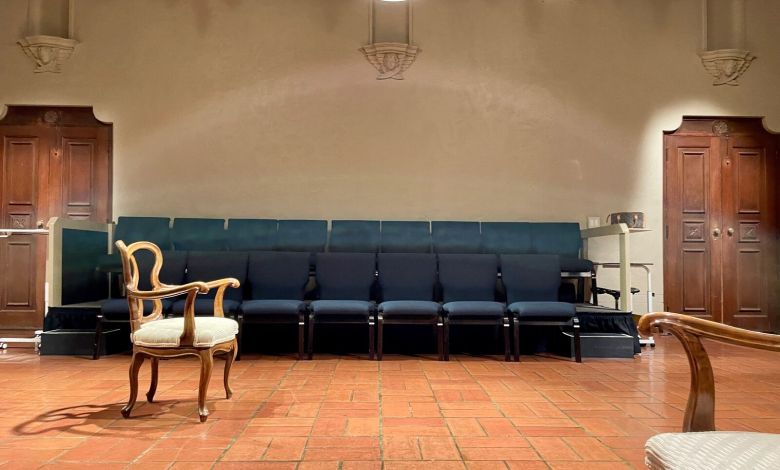 Audiences at Central Works’ productions were treated to a delightfully intimate experience. Credit: Estefany Gonzales for Berkeleyside
Before setting up shop at the Berkeley City Club, Central Works operated as a nomadic theater company for 12 years, flitting between impermanent locations including the northside La Val’s Pizza basement and a stint in the sunroom at Berkeley’s famed Santa Fe Bar and Grill. When they heard word that the Aurora Theatre Company was vacating its space at the Berkeley City Club in 2002, they quickly filled the vacancy. It has been their home ever since.
Set in a hallway near the reception desk, the theater is only identifiable on non-performance days by an inconspicuous placard hung outside the door. Inside, the 600-sq-ft room boasts the same medieval details as the rest of the club, which has serendipitously provided an ideal aesthetic backdrop for some of the period pieces the company has produced over the years. There are ornate niches set in one wall facing tall leaded glass doors with heavy curtains that open onto a courtyard on the opposite side of the room. Double rows of seats are arranged in a horseshoe formation along three walls of the small space. Actors enter and exit through the same doors as the audience.
Anna Ishida is a bi-coastal actress who’s appeared in multiple plays at Central Works, including 2013’s “Red Virgin: Louise Michel and the Paris Commune of 1871” and 2024’s “Boss McGreedy.” She cites Central Works as one of her favorite places to perform in the Bay Area.
“They demand the actor to tap into an authenticity in performance because of the proximity to the audience,” she said. “Gary has a very specific theatrical style. It’s like a meta theatrical actor narration of the action happening that requires the actor to completely serve the text. I think that is the ethos of Central Works. We’re here to serve the work”.
Central Works only ever produced new plays
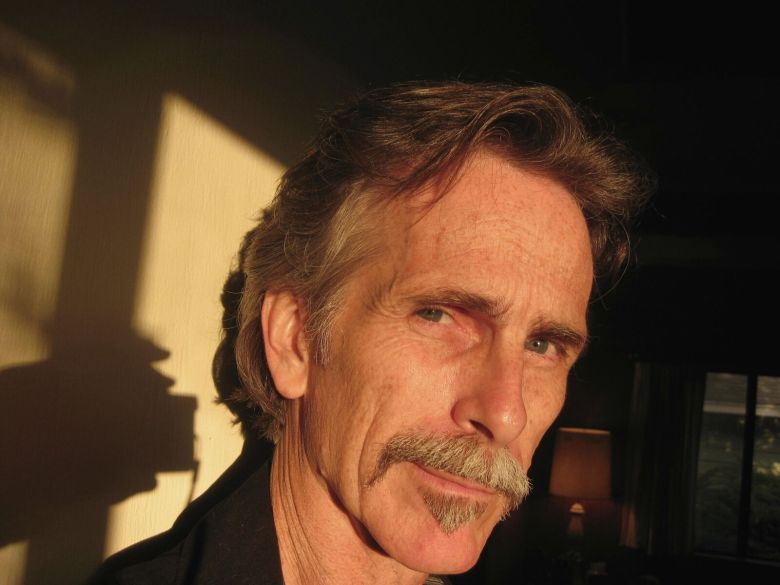 “Doing all new plays is maybe the most difficult way to go in the theater because that’s not the way theater works,” said playwright Gary Graves, also Central Works’ co-director. Courtesy of Central Works
Serving the work looked a little different at Central Works than at many other theater companies. Aside from performing in a small room inside a castle, Central Works also differentiated itself by only producing brand new plays. That’s 81 world premieres, most of which were developed in-house.
“Doing all new plays is maybe the most difficult way to go in the theater because that’s not the way theater works,” said Graves. “Plays get approved and anointed in New York and London as the popular new plays and then they disseminate out across the country. Everyone will go see “Hamilton” because it’s a hit in New York. There’s a logic to that that’s fine with me. It’s just not what we liked doing.”
Though it has proven to be artistically rewarding, creating a brand new play three or four times a year is a hard row to hoe. It’s also a gamble because audiences are being asked to take a chance on an unvetted play — and there is no roadmap for the cast and crew.
“If you do a show like ‘You’re a Good Man, Charlie Brown,’ there’s not a lot for me to do. You’re not going to put Charlie Brown in a tuxedo,” said Berlin. “But with Central Works, because it’s a new play, there’s no reference. You can’t go online and look up what they did in the Broadway production.”
In-house development through two approaches
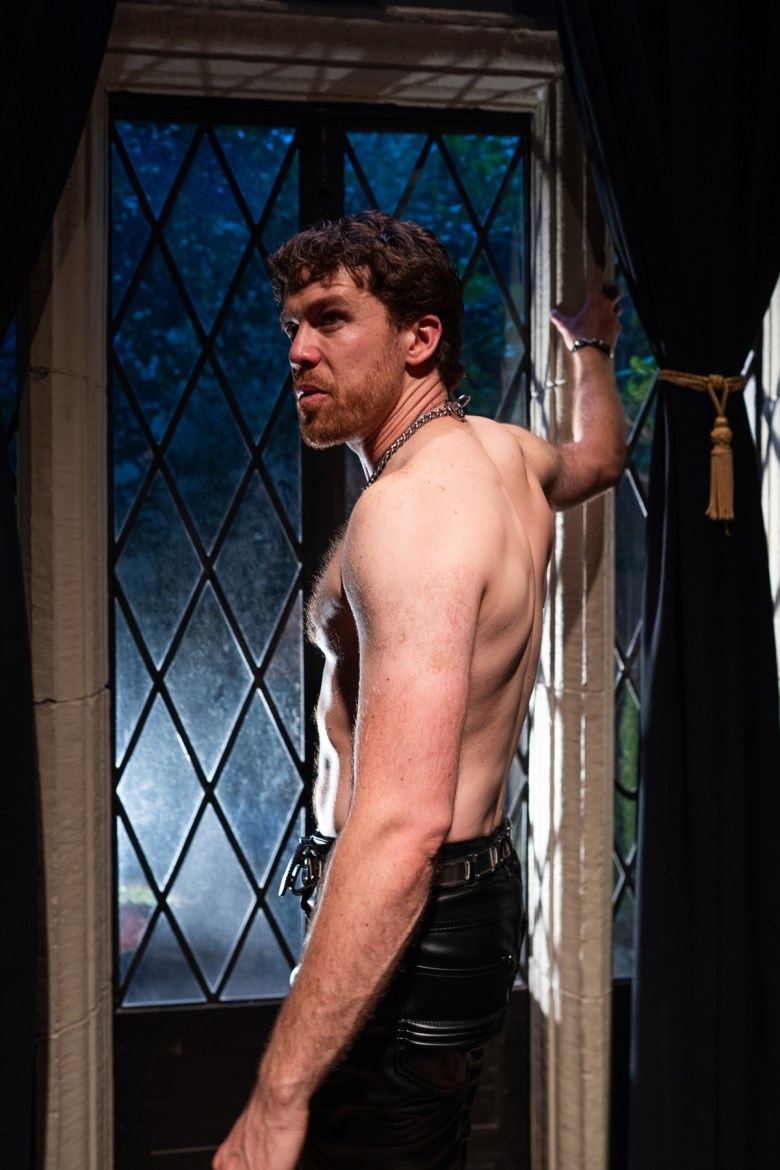 Brennan Pickman-Thoon, playing Duke Cesare Borgia, stands next to a leaded window at the Berkeley City Club which was standing in for Castle Sant’ Angelo in Part 1 of “The Prince”” two original 3-act plays inspired by Niccoló Machiavelli’s “Handbook for Tyrants,” Central Works’ last production. Credit: Courtesy Central Works
With few exceptions, each original script was the result of months of rigorous in-house development, either through the Central Works Writers’ Workshop or a process known as the Central Works Method.
The Central Works Method was inspired by Graves’ experience working with playwright Caryl Churchill and director Mark Wing-Davey at Berkeley Rep in 1992. Both were part of Joint Stock, a British theater company that had a collective approach to writing plays.
“I was just a couple of years into my involvement with Central Works and I said, why don’t we try something like that?” Graves recalls. “We did it on a much smaller scale and we began to make refinements and adjustments to that method.”
With the Central Works Method, the playwright ultimately writes the script, but the director, actors and other key creative stakeholders (like sound designer Scharpen) all contribute to the brainstorming, research and development that informs the writing.
Playwright Patricia Milton had a positive experience when she went through this method for her 2011 play “Reduction in Force.” “They bring their ideas, they become deeply invested, and what’s really wonderful about that is that the actors develop ownership of their characters,” she said.
Working collaboratively comes with its own set of challenges, as most group projects do. “Every actor wants their character to be the main character,” Milton said with a chuckle. But being open to input can yield unexpected cultural perspectives and first-hand experiences a writer might not find through conventional solo research.
“In the case of ‘Reduction of Force,’ the source material was the 2008 financial meltdown. One of the actors had worked for a big financial firm in New York and was able to bring all his knowledge of that experience to the table. I had worked for a bank, so I had that. Everybody who had worked for a corporation in any kind of capacity could bring that experience. That was all very, very helpful,” said Milton.
Berlin recalled a time when she was working on a previous Graves-penned Machiavelli play, “The Lion and the Fox.” A younger assistant designer asked what the show was about and when she told him it was based on Cesare Borgia and Niccolò Machiavelli, he remarked, ‘Oh, you mean the guys from ‘Assassin’s Creed’?
“I was like, ‘what?” said Berlin. “He says, ‘It’s a video game. Those are two of the characters in ‘Assassin’s Creed.’ I went and looked at what this game looked like and they actually had super cool costumes. I went to Jan and Gary and asked, ‘Can we do the ‘Assassin’s Creed’ version?’ and they said, ‘Yeah, sure.’ And so that show then became this really stylized fantasy.”
A special fellowship at the company’s core
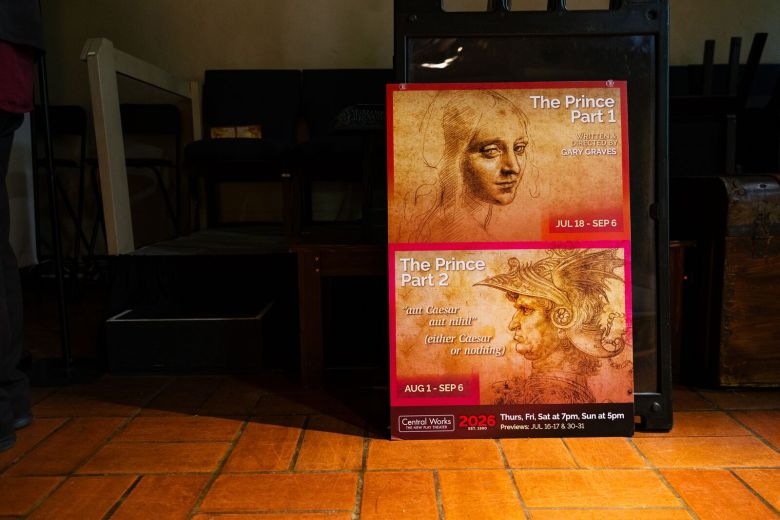 A sign for Central Works Theater Company’s last production before it closed for good. Credit: Estefany Gonzales for Berkeleyside
Though the new blood that flowed through the theater with each production undoubtedly left its mark, Graves, Zvaifler, Scharpen and Berlin worked in such close and often unusual circumstances for decades that they formed a special fellowship. They developed a shorthand of familiarity which Scharpen deemed “irreplaceable.”
“I’ve known [the end] was coming, but the fact that it is now literally at our doorstep has caused me to stare at the ceiling at night, thinking, ‘Oh my God, it’s here, and I’m not ready for this,” Scharpen laments. “Over half of my life has been spent with this company.”
Each member of the core group would go to laborious lengths to achieve the collective vision. For instance, Scharpen described how he would roam the streets in search of interesting sounds to incorporate into his soundscapes and musiques concrètes.
“I tend to walk around with my ears open. Especially during COVID, I did a lot of [field] recordings. ‘Oh, that sounds interesting. Oh, there’s a fan blade that has completely busted. I’ll take a recording of that’ or ‘Oh, this drain here in the street is making a really interesting bubbling sound.” Scharpen said. “There have been times when I found the sounds late at night while walking home. I’ll run home, grab my recorder, and then run back out to the drain.”
Measure Y could prove a lifeline for some arts groups
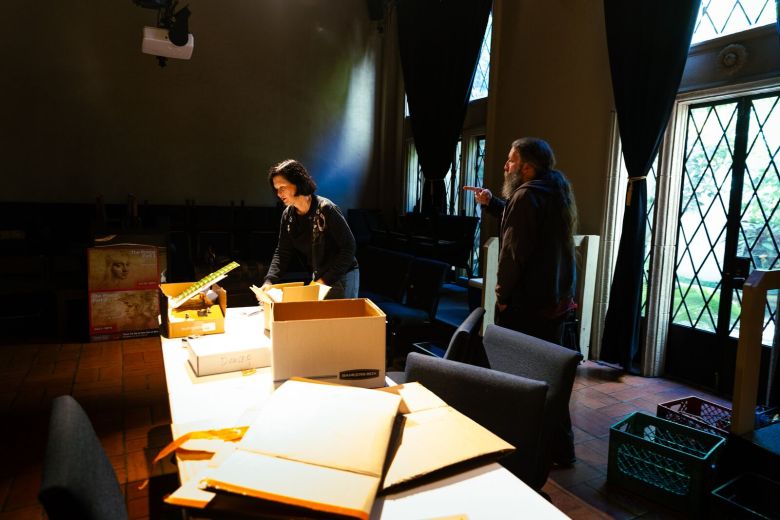 Tammy Berlin, costumer for Central Works (left), and sound designer Gregory Scharpen next to boxed-up props at Central Works theater on Saturday Sept. 16, 2026. Credit: Estefany Gonzales for Berkeleyside
As many theater companies continue to struggle six years after shelter-in-place orders, the question on the minds of many is whether there is a solution to sustain live theater in Berkeley. Dwindling attendance and reduced federal funding mean arts leaders are looking elsewhere for financial support.
The Berkeley Arts Coalition, which is made up of Berkeley Playhouse, Berkeley Rep, Berkeley Symphony Orchestra, The Freight, Korsa Musical Theater, Shotgun Players and the UC Theatre, and by local supporters of the arts, successfully campaigned to get a measure on the ballot for the Nov. 3 election. The initiative proposes creating a parcel tax amounting to 7 cents per square foot (about $105 for the average Berkeley home per year) to help fund local arts. If it’s successful, Measure Y would generate $6 million annually to be dispersed through the Civic Arts Commission.
Should the measure pass, the funding could help keep the doors open for some. It might also lead to more accessible pricing so new and younger audiences can discover the theater, and it might offer the safety net needed to allow theaters to feel secure enough to explore more experimentation.
“People are terrified to take risks now. Since the pandemic, especially, it’s like, oh boy, we better do Noël Coward,” said Milton.
On the subject of programming old chestnuts, Zvaifler concurs.
“I’ve reached a point in my life when there’s very little Shakespeare that I want to sit through. It’s enough already, I know how it’s going to end,” she said. “That doesn’t mean that they don’t deserve to continue being done, but you’ve got to create a new legacy. You have to keep it moving forward.”
As the Central Works company faces the end of an era, its core team is in a reflective mood.
“Central Works was never really a foundational pillar of my finances,” said Scharpen. “You don’t go into the theater for the bucks. The importance of Central Works for me was always the artistic importance of it, not the financial importance of it.”
And Zvaifler noted: “The reason that I have done this for as long as I have is obviously not for the glamour of ironing costumes and cleaning the toilets. It’s because I have been able to do my work on my own terms. That’s something that very few can say.”
“*” indicates required fields