
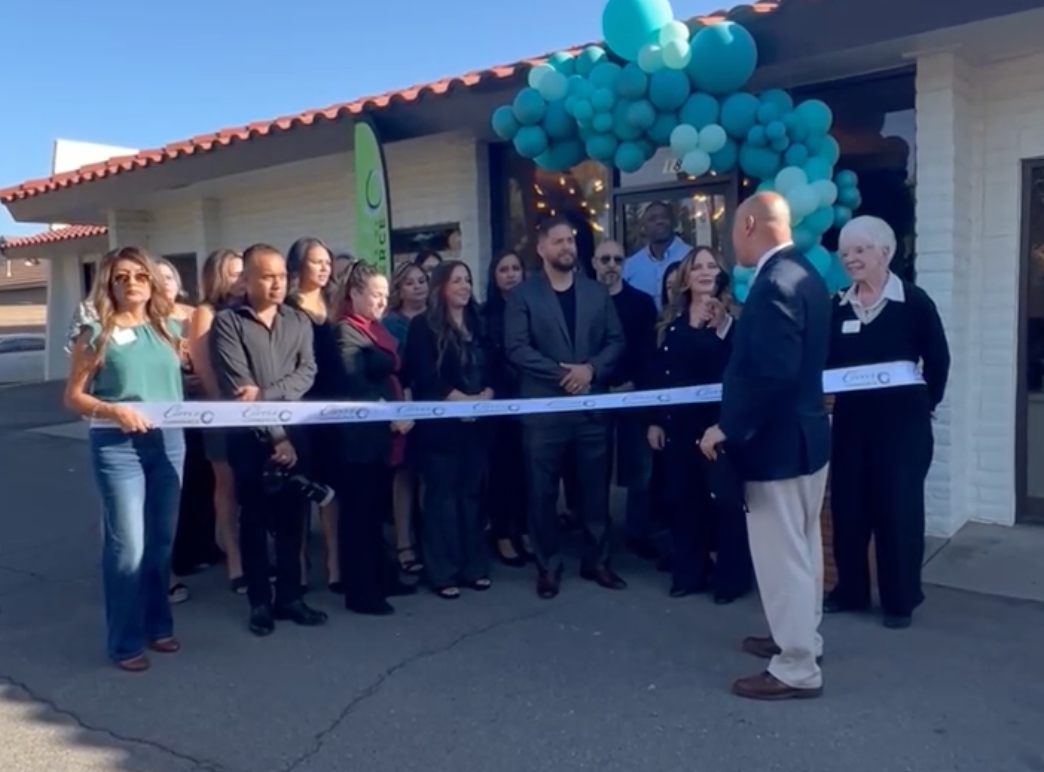
Clovis Mayor Vong Mouanoutoua, right, speaks during a ribbon cutting for Mind Divers’ office at 180 W. Bullard Ave. in Clovis in August 2025. Courtesy of Clovis Chamber
Mind Divers is adding office space in Bakersfield and expanding its nonprofit outreach arm into new communities as the Central Valley mental health provider continues to grow along Highway 99.
The company is converting a duplex on the property of its downtown Bakersfield office into additional office space, CEO Debra Winegarden said. The Bakersfield office itself is open and fully operational.
Its nonprofit arm, Mind Cure, is also growing into areas where Mind Divers does not operate traditional clinics, including Salinas, Modesto and the west side of the Valley.
The expansion follows the August 2025 opening of a Mind Divers office at 180 W. Bullard Ave. in Clovis.
Expansion, Winegarden said, is focused on building a consistent presence in communities where mental health services remain limited.
“We just keep trying to go and have clinics and resources in places where other companies are afraid to go,” Winegarden said.
Mind Divers plans to continue expanding farther north and west while maintaining its focus on rural and underserved areas, she said.
Winegarden founded Mind Divers as a solo practice in 2012. It has since grown into a multidisciplinary mental health provider offering therapy and psychiatric services in Fresno, Kings, Tulare and Madera counties, as well as in Bakersfield.
Winegarden said Mind Divers has become the largest privately owned mental health company in the Central Valley. Last year, the company employed about 80 therapists and more than 120 employees, with offices stretching from Bakersfield to Madera.
Mind Cure grows beyond clinic network
As Mind Cure moves into new communities, it is establishing relationships with hospitals and other community organizations, Winegarden said.
The nonprofit provides enhanced care management services. It connects clients with resources including mental health and medical care, dental services, food assistance and housing.
Caseworkers can also meet clients outside traditional offices, including in their homes or in places where people experiencing homelessness may be staying.
“We can meet people where they’re at, whether it’s at their homes or under the bridge or they live in a parking lot,” Winegarden said.
Keeping care accessible
Accessibility remains one of the company’s biggest priorities, Winegarden said, and the Clovis location has allowed Mind Divers to connect more patients with providers.
“We’re able to see a lot more patients and take care of a lot more people in the Clovis area,” Winegarden said.
Mind Divers accepts Medi-Cal along with numerous commercial insurance plans offered through Valley employers.
“That’s one of our biggest things — our accessibility,” Winegarden said. “There’s other private companies, but they may not take Medi-Cal or they may not take many insurances.”
Mind Divers has also built a multilingual network that goes beyond English and Spanish to include clinicians who speak languages including Punjabi and Vietnamese.
The company continues to prioritize services for veterans. Winegarden, a veteran herself, said Mind Divers accepts multiple health plans that serve veterans, including TRICARE, and works with Veterans Affairs contacts to help patients obtain required authorizations.
“We’ve really simplified and worked very hard to get the veterans in as quickly as possible,” she said.
Competing for clinicians
As the company has grown, Winegarden said, its size has given it more negotiating power with insurance companies. That leverage is increasingly important as brick-and-mortar providers compete with large online therapy companies for licensed clinicians, she said.
Some telehealth companies can offer therapists compensation that exceeds what Mind Divers receives in reimbursement for providing care, Winegarden said.
“We’ve had to fight as hard as we can to get as big a payout as possible for them so that I can pay employees a competitive rate to what they could do online,” Winegarden said.
Pairing clinic-based care with field outreach lets Mind Divers and Mind Cure reach patients who might otherwise struggle to access services, she said.
“That’s our main thing we try to do,” Winegarden said. “It’s worked really well in the Valley here with the kind of population, so we don’t leave anyone out.”
Related story: When veterans make entrepreneurship their next mission