
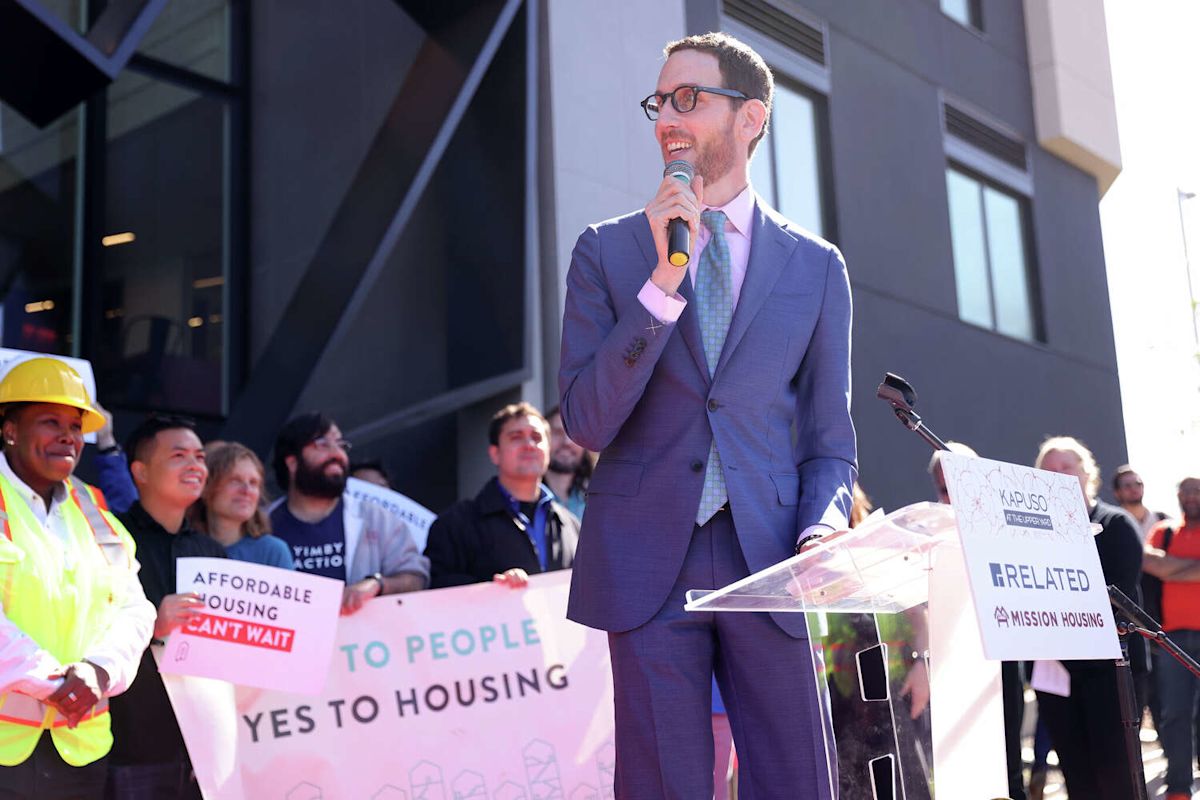
When one of state Sen. Scott Wiener’s first major housing bills died in its first committee hearing in 2018, the logical option would have been for the lawmaker to retreat after such a resounding loss.
But Wiener couldn’t help himself.
“I’m like the moth to the flame sometimes,” Wiener told the Chronicle in a recent interview in Balboa Park at Kapuso at the Upper Yard, a 131-unit affordable housing project one of his laws helped get built. “I am like, OK, the bill that required upzoning around transit failed in the first committee. Let’s bring it back in a bigger form.”
That bill also failed.
It took Wiener seven years to finally pass legislation that cleared the way for more housing near transit hubs. Senate Bill 79, which went into effect in July, requires cities in a handful of counties, including San Francisco, to allow larger apartment buildings near train stations, ferry terminals and bus stops.
Wiener has made housing his defining cause over a 10-year tenure in Sacramento, where he has repeatedly pushed new laws to wrest control from local governments over how and where new homes get built. Wiener has either authored or had a direct hand in passing close to a dozen consequential bills to tackle California’s housing crisis since he took office.
Some of that work has produced major results, with one law in particular credited for leading to an estimated tens of thousands of new housing units across the state, the vast majority affordable.
But it’s also true some of Wiener’s bills that once inspired major fights in the state Capitol have since created little to no housing. Meanwhile, San Francisco’s notorious housing crunch is getting worse – a point Wiener’s critics have seized on in his bid this year to represent the city in Congress.
“If he’s such a champion of housing, why are we here?” Wiener’s opponent in the race, Supervisor Connie Chan, said in a recent interview with the Chronicle. She and Wiener have routinely been on opposing sides of San Francisco’s housing policy debates, and she has led some local efforts to resist state legislation he passed.
In the 15 years since Wiener first started working on housing policy, stretching back to his time on the Board of Supervisors, home prices have only skyrocketed across the state. The trend is even more pronounced in San Francisco, where an AI boom has attracted a new wave of wealthy tech workers. Rents and evictions are way up, heightening concerns that the expensive city is becoming unaffordable to all but the uber wealthy.
“Why they boast about his record on housing is kind of beyond me, because things have gotten nothing but worse since he’s been working on it,” said Mike Casey, president of the San Francisco Labor Council, which supports Chan. “That points to the fact that he’s working with the wrong people – namely the real estate and tech industries – and not thinking about what it really means to build sustainable housing that is affordable.”
Wiener’s supporters see that criticism as disingenuous. They say Wiener’s efforts in the state Legislature have spawned California’s YIMBY movement and that his legislation has added much-needed affordable and market-rate housing to finally start making dents in a decades-old crisis that has caused an estimated 2.5 million-unit shortage. Any expectation that a single lawmaker’s work over the last few years could solve the problem so soon is comical, they contend.
“I would file that under ‘Scott didn’t cure cancer, so Scott is pro-cancer,'” said Jay Bradshaw, executive officer of the North Coast States Carpenters Union and a Wiener ally. “I find those arguments very shallow.”
Wiener argued that several of his more sweeping bills, including SB79, have only recently gone into effect and that it will take time for changes to play out in the market. And while he understands the impatience with the slow pace of new construction, he also argues some factors holding back housing are out of his control: President Donald Trump’s tariffs war, surging inflation and entrenched NIMBYism.
Despite those persistent challenges, early data show that some of Wiener’s efforts have already paid off.
The first bill Wiener ever introduced after getting elected in 2016, Senate Bill 35, has proven particularly successful. The law allows developers to fast-track projects in cities that haven’t met their state-mandated housing targets through a streamlined approval process, which effectively stops city officials and neighbors from blocking denser housing.
A 2023 UC Berkeley Terner Center for Housing Innovation report found that SB35 led to more than 150 approved projects between 2018 and 2021, accounting for more than 18,000 new housing units throughout the state. The report noted that most of the projects were “100% affordable developments.” More recent city data show that nearly 2,300 San Francisco homes have been built using SB35, including the Kapuso project.
“It’s interesting that he has this reputation as maybe not being as concerned about affordable housing as some others, but I don’t think that’s actually fair,” said Shane Phillips, the housing initiative manager at UCLA’s Lewis Center for Regional Policy Studies and a Wiener supporter.
More recent state data show that more than 1,300 projects have been approved under SB35 and a follow-up bill that expanded and extended the original law, though it doesn’t note how many units that represents or how many are affordable.
Phillips said Californians will soon see the impact of some of Wiener’s most important legislation, including SB79, which he anticipates could add “at least tens of thousands of units over the next decade.” Though early data is limited on how many projects have been proposed in the roughly three months since it took effect, there are already several examples of developers seizing on the law.
That includes a 30-unit proposal in Atherton, home to the nation’s wealthiest ZIP code, with six units set aside for lower-income tenants. A proposal in Palo Alto would add six condominiums to the market, while another in San Mateo would develop 20 studio rentals with bicycle parking.
“There’s not a bill on housing that has passed in the past five years that Scott hasn’t had a huge impact on,” said Laura Foote, executive director of YIMBY Action. “Scott is generating the momentum in the state Legislature to be passing high-impact, pro-housing legislation.”
One often overlooked measure from 2018, for example, forced cities to plan for more housing by overhauling the methodology that determines how many homes are needed. Another one, passed in 2025 and co-authored with Assembly Member Buffy Wicks, D-Oakland, made it easier to circumvent the California Environmental Quality Act, a decades-old law that critics say has evolved into a tool to stall or block housing development.
During a signing ceremony, Gov. Gavin Newsom called the legislation “the most consequential housing reform that we’ve seen in modern history in the state of California.”
Others have proved far less effective than expected.
That includes a 2021 law that gave local jurisdictions the power to upzone certain neighborhoods for 10-unit apartment buildings, which has produced very little, if any, housing. (It’s unclear whether the state has tracked how cities are using the law, and Wiener’s team said they are unaware of any examples of housing built under SB10.)
YIMBY groups were particularly disappointed with a 2023 bill that allows churches and other faith organizations to build affordable housing on their excess land (dubbed the “Yes in God’s Backyard” bill). Fewer than 100 units have been permitted statewide under the law so far.
Wiener’s critics point to those numbers as evidence that the lawmaker’s emphasis on expanding supply hasn’t worked to solve an exploding affordability crisis.
“It has done the exact opposite,” Casey said. “Being a toady to the real estate and tech industries has resulted in nothing but failed policies for San Francisco families in general and especially working and lower-income families.”
Wiener said it was always likely that some measures would fall flat.
Wiener and his allies also contend some of his loudest critics are themselves frequently standing in the way of solutions. To get some of his most sweeping measures through the Legislature, Wiener has frequently added amendments to appease local officials and labor unions.
YIMBY groups this year filed a lawsuit that contested a San Francisco ordinance, which received broad support from city supervisors and Mayor Daniel Lurie, to exempt 1,900 parcels in SoMa, Bayview and Bayshore from Wiener’s SB79. Before that, Chan unsuccessfully urged the city attorney in 2024 to sue the state over a provision Wiener added to a bill that makes it even easier to streamline new housing in San Francisco.
“At the state level, Sen. Wiener can only do so much,” said Supervisor Bilal Mahmood, who has endorsed Wiener’s House bid. “We have to have a commensurate effort locally to implement those laws.”
The bitter congressional race has divided the city’s political figures and advocacy groups to become the most closely watched contest on the Nov. 3 ballot, in large part because the competition is to fill Speaker Emerita Nancy Pelosi’s seat.
Pelosi endorsed Chan, as have two former mayors – Willie Brown and Art Agnos – and a host of labor unions. Wiener is backed by a long list of political supporters, including a majority of the city’s Board of Supervisors, the California Democratic Party and some unions such as the carpenters’ group led by Bradshaw.
Though Wiener entered the race favored to win, Chan’s campaign has made the competition closer than expected. And as Election Day grows nearer, Chan and her political allies have tried to turn Wiener’s own record on housing against him.
Wiener said Chan’s criticism of his record is “straight up propaganda.”
“Connie Chan can make up whatever falsehood she wants to make up,” Wiener said, describing his opponent’s record on housing as “atrocious.”
But Wiener’s approach has lost him some friends along the way, chief among them various unions that represent construction workers.
Years ago, Wiener and Wicks negotiated a deal with the California Council of Carpenters to axe the “skilled and trained” workforce requirement favored by unions like the State Building and Construction Trades Council, and replaced it with a “prevailing wage” standard that still guaranteed union-level pay and healthcare benefits on projects. The change sparked a years-long war between the carpenters and building trades, which divided their Democratic allies in the Legislature.
Lorena Gonzalez, president of the California Federation of Labor Unions, which endorsed Chan, said she voted for at least one of Wiener’s housing bills when she served in the Assembly. At the time, Gonzalez said she exchanged her vote for a guarantee on certain labor terms.
“And then he just kept coming back and taking away more from organized labor,” Gonzalez said. “With every bill, everything got worse.”
Wiener disputed that characterization, arguing that he has worked “very, very hard to make sure that when we build housing, that construction workers are paid good wages with healthcare and that they’re protected against wage theft.”
Wiener’s approach has similarly rankled environmentalists, tenants’ rights activists and neighborhood preservationists who feel he often disregards their concerns with climate harms or gentrification.
Shanti Singh, legislative and communications director for Tenants Together, said her organization has in the past had issues with Wiener’s rezoning bills. Singh said it often felt like Wiener and his YIMBY allies failed to consider how massive development might create a domino effect of displacement for low-income renters.
“I think Sen. Wiener and YIMBYs around him don’t want to acknowledge that that can happen,” Singh said. And when they raise those concerns, Singh added, they are often shrugged off as “NIMBYs.”
“Which is offensive and logically absurd,” Singh said.
Numerous studies and analyses have shown, however, that building market-rate housing does benefit low-income tenants.
“Considerable evidence suggests that construction of market-rate housing reduces housing costs for low–income households and, consequently, helps to mitigate displacement in many cases,” the nonpartisan Legislative Analyst’s Office wrote in a 2016 analysis.
Wicks defended Wiener’s record, arguing that he’s not afraid to make tough decisions – even if it loses him some friends.
“He’s just dogged. There’s no harder worker in the Legislature than him,” Wicks said. “He’s going to do the right thing. And sometimes when you do that you have enemies.”
Wiener promised to take his same boundary-pushing approach on housing to Congress, where he said he would push a plan to build 8 million homes in the next decade. Among his proposals: paying cities $10,000 for every home they build, standing up more mixed-income social housing programs and stabilizing the construction workforce so it isn’t as disrupted by the boom-and-bust housing cycles.
But after a decade in Sacramento, where Democrats control a supermajority in both chambers of the statehouse, can Wiener pull off the same winning streak in a Republican-dominated Washington?
“When I was running for state Senate, they said the same thing: ‘You can’t do anything in Sacramento. It’s a gridlock there, you can’t get anything done,'” Wiener said. “I think we’ve proven them wrong.”
Subscribe
There’s more to San Francisco with the Chronicle. Subscribe today for just 25¢.
This article originally published at Has Wiener’s avalanche of housing bills actually led to more homes? Here’s what we know.