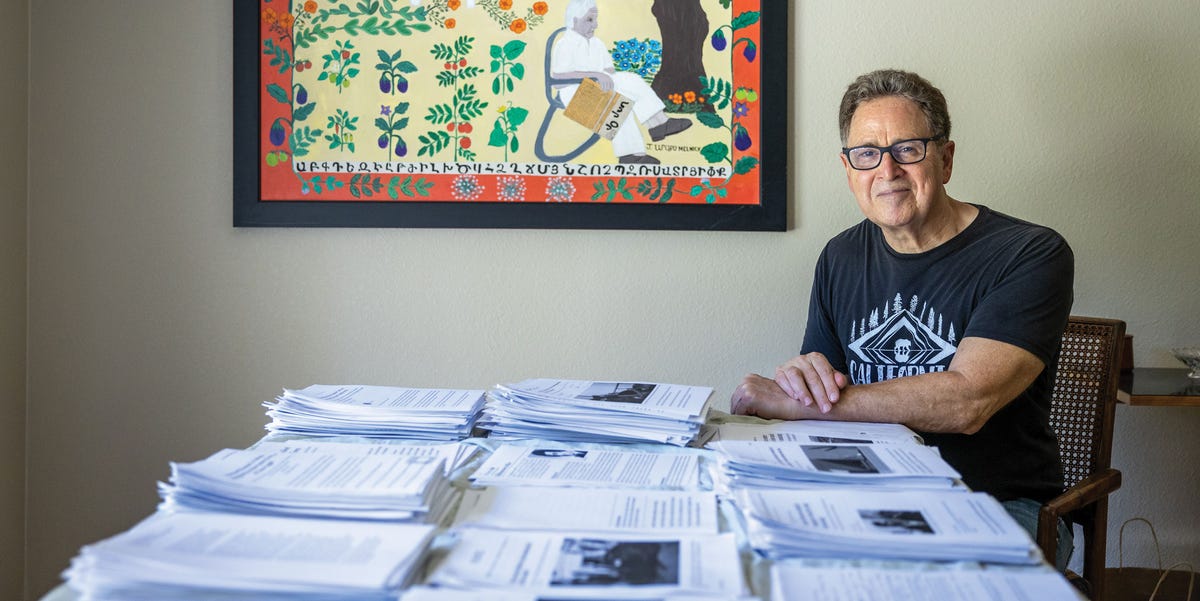
Write about what you know in the language that you know it,” the late Pulitzer Prize–winning playwright and novelist William Saroyan advised the journalist Mark Arax when Arax was young. Saroyan was a friend of Arax’s grandfather, a poet who had survived the Armenian genocide, which started in 1915, by hiding out in a Constantinople attic with books by Baudelaire and Verlaine. “What are the chances of a kid growing up in Fresno becoming a writer?” Arax says over Zoom from his home office in Fresno. “Not very good at all, but I had these examples. My grandfather, then Saroyan.”
This article appears in Issue 37 of Alta Journal.
SUBSCRIBE
Arax showed a talent for investigation early on. After being forbidden from attending a Chuck Berry concert at the club his father owned (the first integrated nightclub in the San Joaquin Valley), he reconstructed a narrative of the evening for himself from pills, joints, $20 bills, and napkins on which women and men had traded numbers. When Arax was 15, he asked his grandfather about the Armenian genocide and tape-recorded it. Later, over decades, he used three Sony handheld recorders to collect more than 1,000 hours of oral histories from a wide range of farmworkers who had migrated to the valley from the 1920s to the 1970s. Arax’s penchant for gathering information led to his working for the Los Angeles Times as a reporter from 1985 to 2007.
In 1972, Arax’s father had been murdered, and Arax, who grew up amid rumors about the circumstances, always wondered if his father had a secret side and believes that a hit may have been ordered. His memoir, In My Father’s Name (1996), concerns his search for the truth and the killers. He went on to publish three other powerful books: The King of California (2003), cowritten with Rick Wartzman, which considers secretive cotton magnate J.G. Boswell; West of the West (2009), essays and reportage about the state’s complicated mythos and identity; and The Dreamt Land, a tremendous 2019 exploration of California water history and politics. In some sense, he says, each of his books has expanded outward from the last.
The idea for The Dreamt Land, which features nuanced portraits, including of billionaires Stewart and Lynda Resnick, the owners of the Wonderful Company (Pom, Fiji Water), came to Arax during the worst known drought in California history, from 2012 to 2016. Farmers had planted hundreds of thousands of acres of new almond trees and needed thousands of new wells to be dug. Arax, who had spent childhood summers weeding sugar beet crops and boxing plums and peaches, began thinking about what it meant to increase agriculture under conditions in which farmers couldn’t water. He thought, “This is a story of people; it’s a story of resources; it’s a story of extraction and greed. What’s at the heart of it?” It’s a narrative, Arax acknowledges, that most people want to sleep on.
Arax partly attributes his preoccupation with public and private power to his lefty grandfather poet. The throughline in his most recent work is the extractions that have defined California history. The lives of the Indigenous inhabitants, in Arax’s view, were a first extraction, and from that came water extraction, which allowed for the control of rivers and agriculture. He says that California’s latest extraction, which he is currently writing about, in addition to a work blending fact and fiction, is the “mining of our minds” for AI.
He has no interest in telling stories beyond the state. “California is such an incredible canvas. So much is going on here, good and bad. It’s a very paradoxical place,” he muses. “We regard ourselves as a leader in social justice movements, the recognition of gay rights, the continuing project to stitch together a tapestry of people from so many different lands, the fight against Trumpism. And yet we cannot rid ourselves of a hypercapitalism that feeds on itself. From the gold rush to the mining of our minds, the story of California is the story of plunder.” Arax says that Governor Gavin Newsom captures that paradox. (Writing his own memoir years before helped Arax ghostwrite Newsom’s Young Man in a Hurry, which came out earlier this year, but he is done with this type of assignment; it cost him time—four years.)
Extraction may be the tension line, but Arax regards the land itself as a character, both acting and acted upon. Proximity to his native soil matters greatly to him. “To write about your place is a challenge, and sometimes you bring too much heat to the language, and the question is, Do you back off or not?” he says. “And I always fight that. I probably err on the side of, No, let the heat be there.”
Arax has thought about leaving Fresno, but at 69, he still calls it home. Why has he stayed all these years? “There’s something about it. Your family is here. Your backyard is full of fruit trees and vines. Fresno. You love it. You hate it. This is your place.”•
THE DREAMT LAND: CHASING WATER AND DUST ACROSS CALIFORNIA, BY MARK ARAX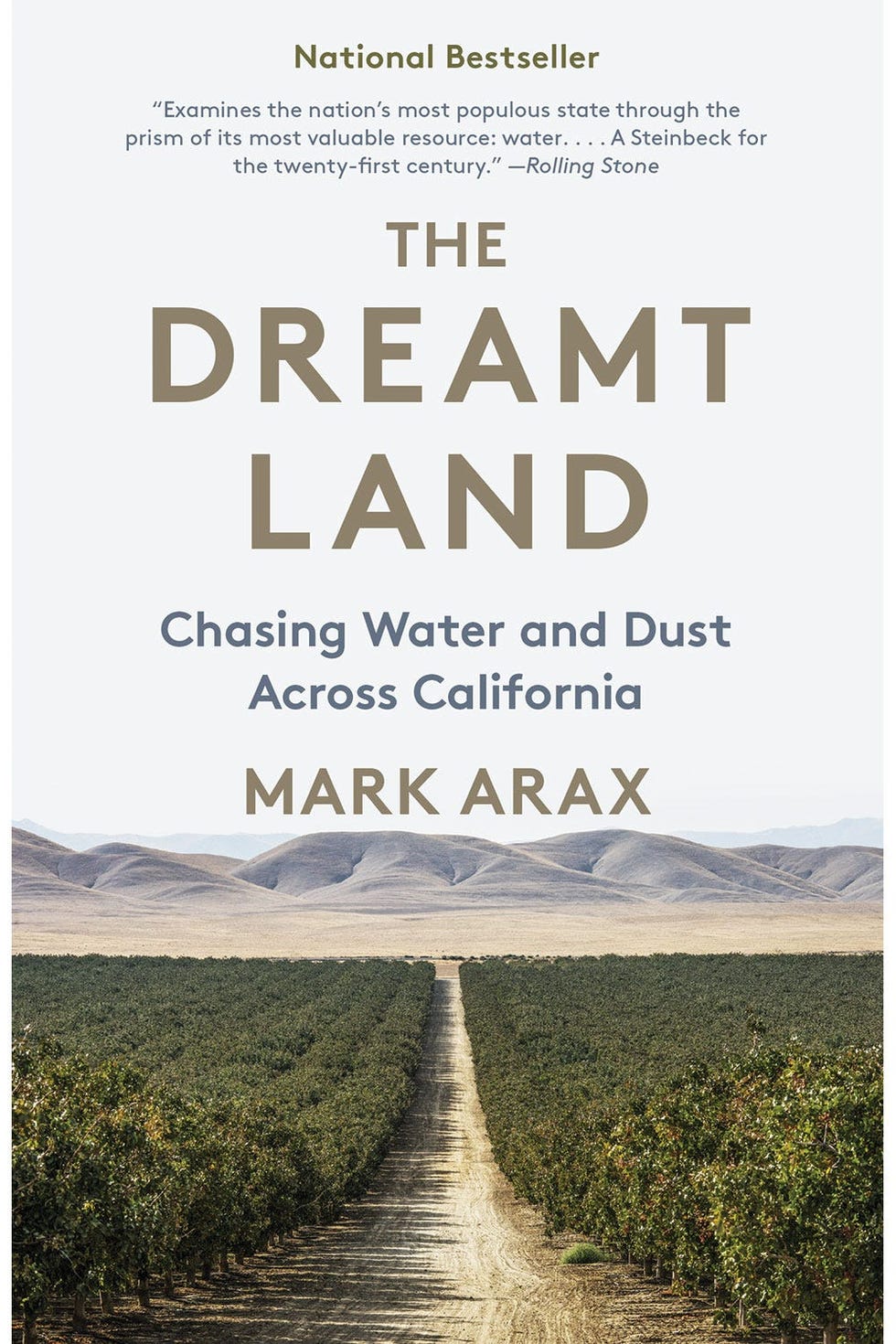 THE DREAMT LAND: CHASING WATER AND DUST ACROSS CALIFORNIA, BY MARK ARAXCredit: Vintage