
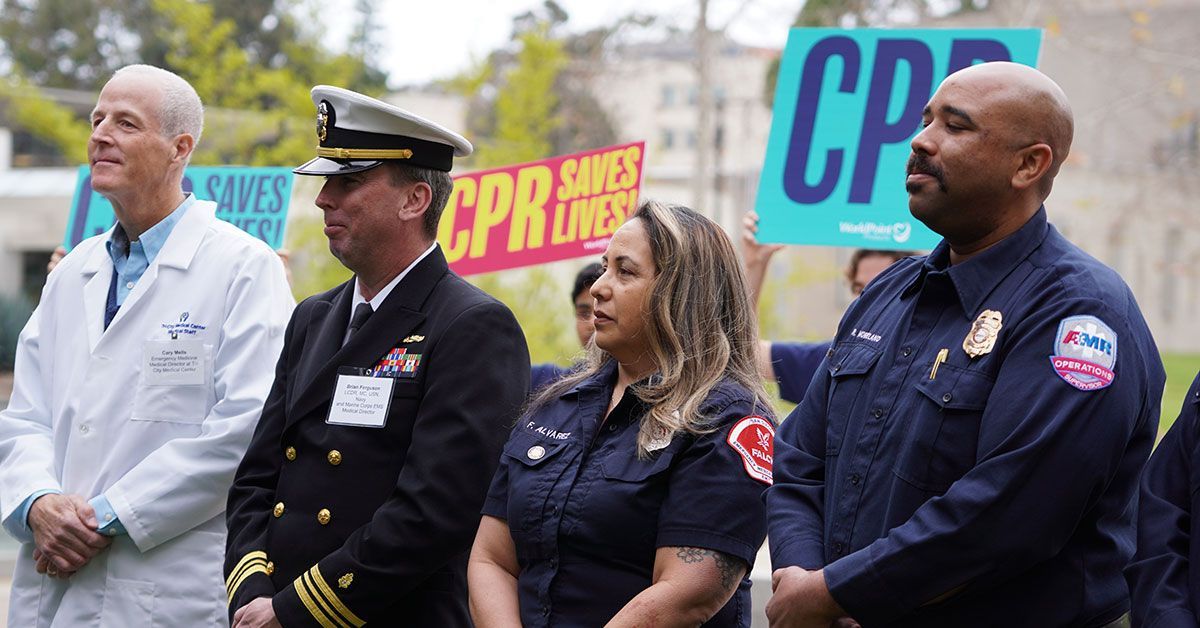
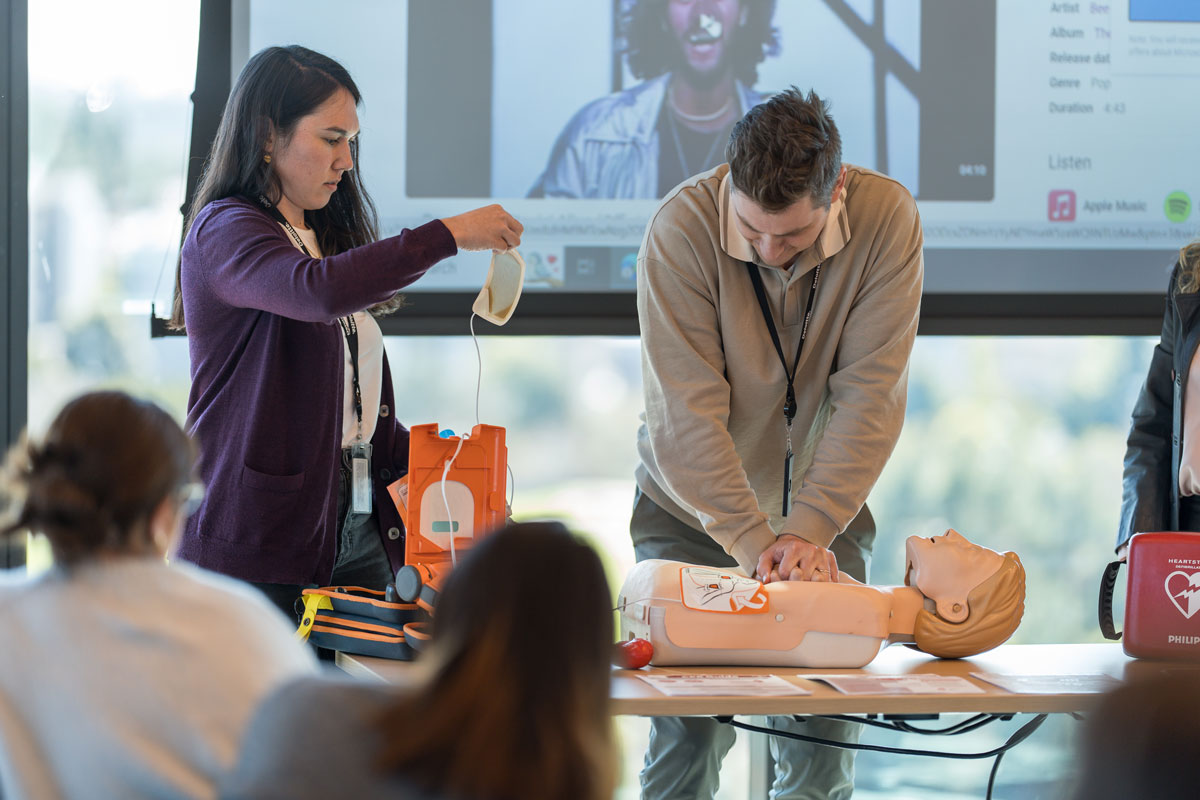
A local company invited Revive & Survive San Diego partners to train employees in hands-only CPR and automated external defibrillator (AED) skills to respond faster in an emergency.
Using simulation modeling, Natasha Martin, DPhil, professor of medicine at UC San Diego School of Medicine, estimates that in a five-year period the training provided by Revive & Survive San Diego could lead to over 1,600 more individuals performing bystander CPR (a 40% increase), saving an additional 400 lives, and improving quality of life for survivors.
Including the 15 minutes of CPR performed by Inskeep on the street, Winter underwent a total of 72 minutes of CPR before being placed on an extracorporeal membrane oxygenation (ECMO) machine to help pump and oxygenate his blood. This allows the overworked heart and lungs to rest and heal while being treated.
He remained in a medically induced coma for two weeks.
After recovering, Winter and his wife took a CPR training course with Inskeep, his wife, Audrey, and their 13-year-old daughter. Inspired by their experience, they all want to be ready should someone else need help.
“The goal isn’t to become a hero,” said Winter. “The goal is to save someone’s life.”
About hands-only CPR
Hands-only CPR requires only two steps. First, call 911. Second, perform chest compressions on a bare chest at 100 to 120 beats per minute without mouth-to-mouth breathing. Visit revivesurvive.ucsd.edu to find an event and get trained.