
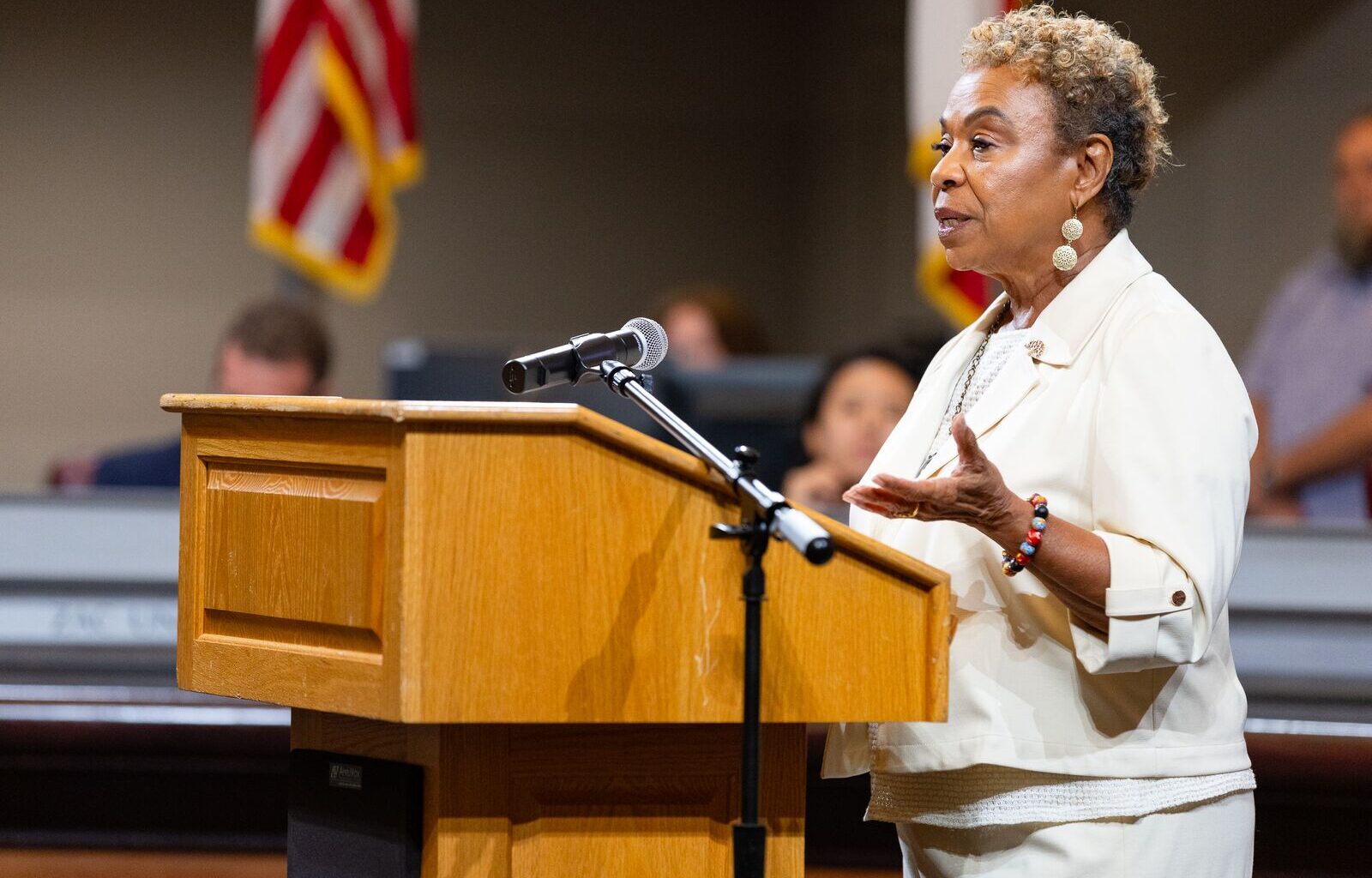
When Barbara Lee ran for mayor in 2025, she faced a crowd of challengers, including one well-known rival with a flush war chest and motivated supporters. That made for a close contest. This year, Lee faces three competitors, none of whom have comparable money, name recognition, or endorsements.
Even so, Lee says she’s not taking any chances.
“I don’t accept it’s not a competitive race,” Lee said in an interview with The Oaklandside. “I’ve had a lot of campaigns, and I run to win. And I’m sure everyone else is doing that.”
There’s a lot Lee can point to to persuade residents to give her a second term.
When Lee was sworn into office, Oakland was still reeling from crime, budget crises, and a federal corruption investigation of the former mayor.
Over the past 18 months, Lee has introduced balanced budgets, leveraged philanthropic dollars, and stood up to President Donald Trump.
She also enjoys the endorsements of major institutions, labor unions, and political figures in Oakland, including groups that opposed her in the last election.
But it hasn’t been entirely smooth sailing.
In the spring, the city auditor issued a report describing all the ways that Oakland’s strategy to combat illegal dumping is a failure. Lee lost her city administrator to a texting scandal. And even now, civilian city workers are gearing up for a potential strike as their contract negotiations grind on.
In the run-up to the June Primary Election, Lee tried to persuade voters to approve a new parcel tax to help pay for critical public safety services and to close the city’s structural deficit. Voters said no, which set back Lee’s plan to use tens of millions of dollars to pay for police, fire, and illegal dumping services. And while Lee has boasted that crime has dropped during her administration, it remains higher than in other cities and is a significant concern for many residents.
To help readers as they prepare their ballots, we’ve tried to summarize what Lee has done for Oakland; whether she has kept her campaign promises; and the challenges and opportunities she will face if she wins another term.
Did Lee keep her campaign promises?
One benchmark for evaluating Lee is the 10-point plan she released shortly after her election in April 2025. These were her goals for her first 100 days. Lee accomplished a lot of what was on the list:
Earlier this year, the city secured $53 million from Alameda County from Measure W to pay for affordable housing. This accomplished part of Lee’s goal, item 2 on her list, of “securing Oakland’s fair share” of money from the county for homelessness services.
Lee appointed a task force of experts who crafted a proposal to reform the City Charter, which residents will vote on in November. This was item five on her list.
Lee announced several changes to Oakland’s permitting system. This was item six on her list.
She successfully raised millions of dollars in philanthropic investments to combat illegal dumping, hold celebratory rallies, and hire staff for her office. This aligns with item seven: “Generate entrepreneurial and philanthropic investment in Oakland by convening local, state, and national civic leaders.”
The City Council approved Lee’s proposed budgets in 2025 and 2026 without significant changes. These financial plans maintained funding for public safety programs and other critical city services. That was item 9.
Work crews cleared dried vegetation from hundreds of acres in the Oakland Hills and removed dead trees in Joaquin Miller Park to reduce fire hazards. Lee also helped secure a $1.5 million CAL FIRE grant, both of which addressed item 4.
The City Auditor is in the process of auditing Oakland’s contracting process, item 10 on Lee’s list.
There was one big miss, however. Lee said she would partner with the Alameda County District Attorney’s office to prosecute illegal dumping. While Lee has focused heavily on this issue, we haven’t seen evidence that anybody is being criminally charged for dumping.
Lee told us last week that her office has been working with the district attorney. She said one problem is the DA needs more evidence, including proof of hazardous waste, to pursue criminal charges.
“We have not had enough staff to be able to do the work to bring the cases that require felony convictions to the DA,” Lee said. “But we’re working very hard to get that done.”
We also looked back at Lee’s responses to a questionnaire The Oaklandside sent her in February 2025, before she was elected.
The mayor has followed through on a lot of what she said she’d do, including avoiding layoffs of city employees to balance the budget, and using her networks to drive outside investments to Oakland. She also kept her promise to maintain police patrols and support programs designed to reduce crime. But she missed her goal of increasing the number of police officers. Since taking office last May, the number of filled OPD positions has dropped.
Lee made good on her vow to not cooperate with federal immigration raids: In January, she issued executive orders barring ICE agents from staging raids or operating on city-owned property, and she has affirmed Oakland’s status as a sanctuary city.
In the questionnaire, Lee promised to help get Oakland’s budget back on track “by increasing revenue without burdening residents or small businesses.” But within a few months of making that promise, Lee urged residents to approve a new parcel tax.
She also promised to strengthen the city’s long-term financial stability, but the Finance Department’s long-term fiscal forecast projects deficits through 2030, and suggests that Oakland will need to take “more aggressive fiscal policies” to increase funding and make sure the city meets its financial obligations.
Lee promised to create an office of public and private partnerships. That hasn’t happened as far as we can tell, but Lee has been aggressive at securing philanthropic contributions. Lee campaigned on her ability to get federal and state resources. But she also acknowledged in her budget message this year that Oakland has experienced $24 million in lost or delayed federal funding, and that federal and state funding is “uncertain, shrinking, and unreliable.” Recently, Lee celebrated the fact that Oakland is receiving over $14 million in state funding for small businesses, public safety, and other services.
On ethics and transparency, Lee also raised concerns about Oakland’s current prohibition on gifts to elected officials being “too loosely worded; and she said there should be a user-friendly portal where residents can view details about city contracts. She hasn’t done anything to address either of these issues.
Has Mayor Lee made Oakland safer?
Before Lee took office, Oakland was experiencing a significant decrease in crime. That has continued under her watch.
So far in 2026, violent crime is down 18% compared to the same period last year, according to the most recent data from OPD. Homicides reached a nearly 60-year low in 2025, and they have continued to drop this year. To date, there have been 35 homicides in Oakland in 2026, compared to 42 for the same period last year. Oakland also cleared 95% of homicide cases last year, which is significantly better than previous years.
Lee has credited the decline in crime to the successful reimplementation of the anti-gun violence program, Ceasefire. She has also cited funding for new police academies, funding to prevent sideshows and human trafficking, the reactivation of the cadet program, among other things.
But it’s not clear how much credit Lee can take. Violent crime has declined in other cities across the country over the past several years, and there’s no clear single cause to explain it. Some experts have suggested that the widespread fall in homicides may be partly the result of communities recovering from disruptive changes that happened during the COVID-19 pandemic.
Even while safety improves, crime remains a pressing issue for residents, especially in neighborhoods that have experienced high-profile incidents. Oakland also still experiences far more homicides than the Bay Area’s other big cities.
Lee said she is committed to staffing OPD with 700 officers as required by Measure NN, a voter-approved ballot measure that calls for meeting this benchmark. She also wants to figure out new strategies to attract more candidates to OPD.
“We just can’t keep the police recruiting the way it has been in the past,” Lee said.
Even with new recruiting strategies, it’s unclear how Lee can meet the staffing goal set by Measure NN.
The city is currently budgeted for 678 officers with 601 positions filled. 61 officers are out on leave, and the department says it actually only has 530 officers in the field.
It takes millions of dollars and several months to train new officers. It’s also common for academies to shed recruits. For example, the 195th academy started in July 2025 with 22 trainees. When the academy graduated six months later, there were only 14 left. OPD currently loses about six officers per month to retirements and other separations, according to data that OPD shares with the Oakland Police Commission.
One of Lee’s biggest whiffs on public safety was Measure E. She championed the proposed parcel tax, which would have raised $34 million in additional money each year, as a way to fund police, fire, and illegal dumping programs sorely needed across the city. But voters rejected the measure. This may have been a sign of tax fatigue or a response to reports that Oakland has not met the spending requirements of previous tax measures.
“I think it’s the lack of trust in elected officials and government in general,” Lee told The Oaklandside.
Asked if she plans to propose tax measures in the future, Lee said she couldn’t say for certain.
“We have to do more, and that’s about raising revenue, and we have to look at how we raise revenue,” Lee said. She added that she spends half of her time raising philanthropic dollars “because we’re short on tax dollars.”
The City Council approved a budget this year that didn’t rely on Measure E funds, so Oakland didn’t experience the political upheaval that happened in 2024 when city leaders approved a budget that counted on money from the still-unrealized Coliseum sale.
Shortly after Lee took office, Oakland’s relatively new police chief, Floyd Mitchell, announced his departure (he later took a job as Fremont’s chief). In November, Lee appointed Assistant Chief James Beere interim chief while the city conducted a nationwide search for someone to permanently fill the position. Beere has since gotten the permanent job.
The city has also edged closer to completing its 23-year-old police oversight program. But the police department has been dogged by recent problems that could delay or derail that progress. Last year, Lee announced the creation of a constitutional policing administrator position, which she argues will help the city make permanent its police reforms. Some police accountability activists think this is a bad idea, however, because the new administrator could conflict with the role of the voter-created Police Commission.
Lee secured millions of dollars to fight illegal dumping
A high-profile audit published this spring revealed that Oakland’s strategy for combating illegal dumping isn’t working. Lee has taken several steps to address this problem.
Arguably her biggest contribution to date was persuading Crankstart, a San Francisco foundation, to donate over $9 million to the city to help clean up trash and enforce illegal dumping laws over the next three years.
Lee co-sponsored legislation to increase fines in Oakland for people caught dumping. She also supported a state bill that will let local authorities clamp boots on cars that have unpaid tickets for illegal dumping. And she encouraged the City Council to approve a contract with Aerbits, a company that uses drones to locate illegally dumped trash on the street.
Lee’s office launched a “Keep the Town Clean” program that has removed scores of tons of trash from schools and small businesses.
Lee launched a new office to tackle homelessness, but it’s unclear if it’s working
Last year, Lee’s office created a new Office of Homelessness Solutions, which oversees work on encampments and shelters. The office is supposed to carry out a multi-pronged plan to keep renters housed, conduct street outreach, get people housed, and build more housing. The office aims to reduce unsheltered homelessness in Oakland by 50% over the next five years, but acknowledged it is short hundreds of millions of dollars to accomplish this goal.
In a draft plan, the office noted that the pace of encampment closures substantially increased in 2025, but reported encampments still rose. According to the report, Oakland lacks the shelter and housing to meet the needs of unhoused people. Without shelter, most individuals whose camps are closed relocate their tents, RVs, and belongings to other parts of the city, the report said.
Lee has also stressed the importance of wresting money from Alameda County through Measure W, a sales tax approved by county voters in 2020 that was held up by a lawsuit for several years. County officials agreed last year to use 80% of the funds on homeless programs and housing. Over the past year, Oakland has secured tens of millions of dollars to support various housing projects. But there have been concerns that it’s happening too slowly.
Oakland experienced a 20% decrease in its homeless population over the past two years, according to the most recent point-in-time count, dropping from about 5,485 to roughly 4,410. Staff in the new homelessness office created by Lee attributed the change to an increase in supportive housing options. Other conditions, including changes in the housing market, may also be responsible for this dip.
Lee has also touted her work with the city administration to go to market and sell about $334 million worth of bonds last December. This money pays for all kinds of infrastructure projects, including affordable housing.
“That was a major accomplishment that we did together,” Lee said, referring to the city council and residents.
Oakland voters may grant the mayor more power. What might Lee do with it?
In July, Lee cast the tie-breaking vote to advance a ballot measure that could significantly increase the mayor’s power relative to the City Council.
Voters will decide on the measure in November. If it’s approved, the city government would change to a “strong mayor” system where Lee would have the power to veto legislation and pieces of the city budget. The mayor would also be able to direct the day-to-day operations of the city administration. The council would get some new powers too, like a veto override and an independent analyst to help them dig into city finances.
This proposal has had a polarizing effect on Oakland’s power brokers. Supporters claim that it will clarify responsibility and accountability in Oakland’s government, which they say is better than the city’s current system, where the mayor, city council, and city administrator share power in a sometimes blurry way.
Opponents of the measure have expressed concerns about how it might change the power dynamic between the mayor and the council, transforming the latter into mere “punching bags” for constituents because they’ll have even less power to get things done. Some critics have been even more blunt, calling the measure a power grab.
According to Lee, the strong mayor system will help her make Oakland’s government more efficient. She said she will use her new authority to bring departments together to collaborate on projects. She also plans to consolidate the city’s various communication organs to ensure that Oakland speaks “with one voice.” Lee said she wants the City Auditor to conduct several new audits, but she didn’t have any examples to share during our interview.
Lee has leaned on philanthropists to help boost Oakland’s economy
Earlier this year, Lee persuaded several companies to pay for a Super Bowl watch party outside the Henry J. Kaiser Center. She has relied heavily on behested payments to pay for other city services. According to the mayor’s office, Oakland approved 25% more special events permits in 2025 than 2024, possibly a sign of stronger economic activity.
The mayor has also worked with influential local businesses to drive investment downtown. Last year, Lee heralded the opening of North Lake, a small lot that several companies are hoping to anchor a new business district around. Her office also coordinated with a developer to launch a downtown development corporation for Oakland. And Lee launched a task force that is currently trying to recruit a historically Black college or university to come to Oakland.
But the mayor has struggled to persuade companies to fill Oakland’s vacant downtown commercial spaces. Earlier this year, a commercial real estate report found that nearly 38% of the city’s downtown office space was empty in the first quarter of 2025. The city has also seen a rash of skyscrapers and commercial buildings go into foreclosure or default on loans as businesses struggle to make ends meet.
One area the mayor is focusing on is tech. Last year, Lee helped launch Oakland Tech Week, which is happening again this October, and her office obtained money to hire a staffer who will partly focus on cutting red tape for tech companies. She recently appeared at the grand opening of a robot manufacturer, Formic, in West Oakland. During her tenure, Tesla and a company formed by Amazon founder Jeff Bezos recently signed leases for warehouses in Oakland. Companies coming to Oakland can benefit from tax breaks voters approved earlier this year with Measure C, which Lee and two councilmembers sponsored.
But the mayor has been politically sensitive to popular feelings and fears around the economy. Lee recently announced her support of a temporary moratorium on building data centers in Oakland. She told The Oaklandside that community engagement is key for determining how companies establish themselves in the city.
“I understand very well the language of the business community,” Lee said. “I’m very comfortable with talking to businesses and trying to support them, while at the same time making sure our residents benefit from business activity in the city.”
One of the big open questions this year is whether Lee will be able to boast that Oakland has finally sold the Coliseum property. The transaction has made some gains, but the city hasn’t received any payments since an initial deposit in August 2024. Earlier this summer, city officials and the developers signed a new agreement that could see Oakland receive tens of millions of dollars by January.
How does Lee stack up against her opponents?
Lee faces three challengers in November: Brenda Grisham, Mindy Pechenuk, and Julius Robinson. We’ll be covering these candidates in more depth soon, but here’s a quick rundown.
Grisham is an Oakland business owner and anti-gun violence advocate. She has worked extensively to support federal legislation that bans assault weapons, mandates enhanced background checks, and ensures funding for community violence intervention programs. She has also worked with victims of sex trafficking in Oakland.
Grisham was a leader in the successful campaign to recall Alameda County District Attorney Pamela Price. Her campaign website is light on details about her vision for the city, but she has previously stated her intention to assemble experts who can help her address Oakland’s thorniest problems.
Pechenuk, a Republican who admires Donald Trump, has been one of Lee’s most vocal detractors. In recent press releases, Pechenuk has attacked the mayor for her support of the Measure E parcel tax and the “strong mayor” charter reform ballot measure. She has also criticized Lee for her opposition to the proposed coal export terminal in West Oakland. Pechenuk has previously run for local office unsuccessfully.
According to his campaign website, Robinson worked as the executive vice president of corporate social responsibility for MUFG Union Bank. In his plans for the city, Robinson writes that he wants to review and improve Oakland’s legal cannabis industry; use AI to improve some city services; and create an “Oakland Opportunity Fund,” among other things.
In terms of campaign cash, Lee is far ahead of her competition.
So far this year, Lee’s campaign has received over $315,000 from supporters. By comparison, Grisham and Pechenuk raised $12,035 and $18,566, respectively, in the first six months of 2026. Robinson hasn’t filed any financial disclosures.
“*” indicates required fields