
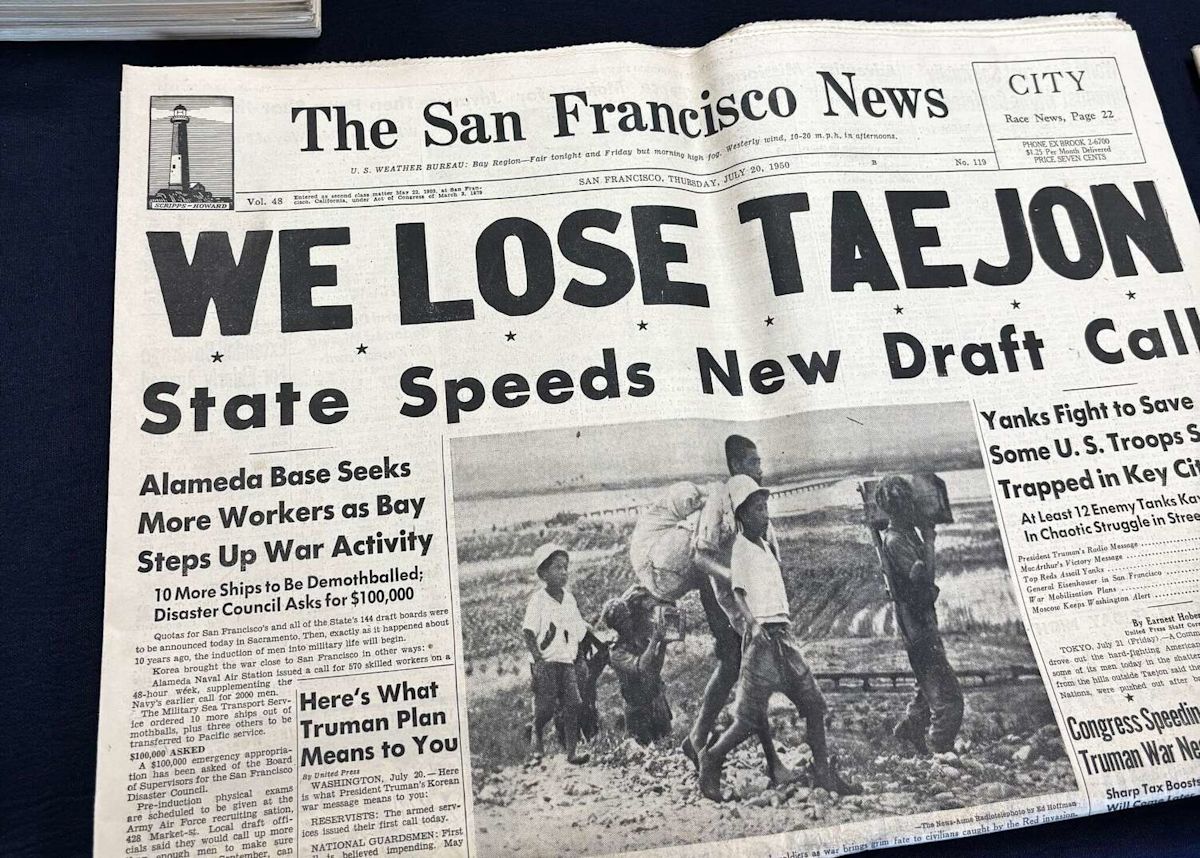
A president seeking billions for a far away war. A Tenderloin gambling den raided. A subway bond measure facing dim prospects at the ballot box. Inflation driving up the cost of everything from gas to steel to aluminum.
There were plenty of familiar and unfamiliar themes found in 76-year-old San Francisco newspapers pulled from a time capsule opened Monday at the International School of San Francisco.
The capsule was buried on July 20, 1950, at a ceremonial ribbon cutting for a new office building constructed to house the Division Four of Highways of the Department of Public Works, now part of Caltrans.
“As we stand before this magnificent new office building constructed to house the Division of Highways of The Department of Public Works,” said C.H Purcell, director the state department of public work, on that day in a speech that was part of the capsule.

A newspaper was found in a time capsule that was buried on July 20, 1950, in San Francisco. (J.K. Dineen / S.F. Chronicle)
At the time the United States were at war in Korea and President Harry Truman was seeking $10 billion in funds for the effort – a fraction of the $40 billion Trump has spent on the six-month old war in Iran. The Chronicle reported that the war was causing shortages and price gouging. A West Los Angeles hosiery manufacturer said that women were rushing to get nylon stockings with sales about 400% above normal. The Michigan Liquor Commission ordered $2.5 million of hard-to-find whiskey “to forestall any scarcity.”
The headline in the Examiner screamed “Reds lost chance to win war,” and “Yanks smash 8 tanks.” The food section had a feature on canning summer fruits and veggies and another one on “six uses of cabbage.” Labor leader Harry Bridges was in jail after a federal judge ruled that public opposition to the Korean War made him a threat to national security.
On Monday, Caltrans workers joined students and administrators from the International School of San Francisco to explore the capsule’s contests. In addition to newspapers, including copies of the Chronicle, Examiner and Call Bulletin, the capsule contained enough highway and traffic reports and data to satiate the transit enthusiasts of the day.
There was a 1949 annual traffic count showing a 7.4% year-over-year increase on state highways. There were payroll reports showing what all the Caltran employees earned – the district’s chief engineer made $712 a month.
The capsule was discovered by Daniel Klingebiel, the school’s director of operations, who said he had long suspected that there was a capsule buried in the building’s foundation because he saw drawings for it on a set of blueprints Caltran handed over when the school purchased the building in 1995. This past summer the school renovated the building and Klingebiel knew that there would not be another opportunity to locate the time capsule.

Maxwell Ginsburg, a student at the International School of San Francsico, holds a photo from a 1950 time capsule that was opened on Monday. Daniel Klingebiel, executive director of the National Center for International Schools, stands next to Ginsburg. (J.K. Dineen / S.F. Chronicle)
The ceremony was something of a homecoming for senior Caltrans officials, some of whom had worked in the building before the 1993 move to Oakland. Caltrans Acting District 4 Director Doanh Nguyen said he had started his career in the basement of the Oak Street building 38 years ago.
Nguyen called the capsule “both a treasure and a gift.”
“It represents a connection between people of the 1950s, all of us today and the generations yet to come,” he said. “It represents transformation of this building from Caltrans D4 headquarters into the International School of San Francisco, from building infrastructure to building minds.”
The capsule, he said, contains “inside information about our transportation system, our communities and our region.”
“The people who placed those items in the capsule could not have known when it would be opened, who would open it or what the Bay area would look like on that day,” he said. “Yet they were thinking about the future and sharing what they valued, what they experienced, and what they hoped the future might become.”
One by one, International student Maxwell Ginsburg pulled the items out of the capsule and read aloud what he found: newspapers, business cards, transportation industry publications.
“I invite you to consider two questions. If you had lived in 1950 what would you have placed inside to tell future generations about your time? Standing here today, what would you hope to find in that box so you could better understand San Francisco, the Bay Area and California three quarters of a century ago,” Nguyen said.

Newspapers were found in a time capsule that was buried on July 20, 1950, in San Francisco. The capsule was excavated on Monday, Sept. 28, 2026, at the location of the Division Four of Highways of the Department of Public Works for Caltrans. (J.K. Dineen / S.F. Chronicle)
He told the students to “fill your own time capsule with curiosity and learning.”
“Fill it with love and family, fill it with service and compassion. Fill it with progress on climate action, fill it with contribution to our region’s prosperity,” he said.
The items in the time capsule are well-preserved, head of school Eric Thuau pointed out.
“The time capsule did a fantastic job keeping these documents in very good shape,” he said. “It will be shared broadly in our school community and also in the broader community.”
Subscribe
There’s more to San Francisco with the Chronicle. Subscribe today for just 25¢.
This article originally published at A San Francisco time capsule held 1950 newspapers. Their headlines feel surprisingly current.