
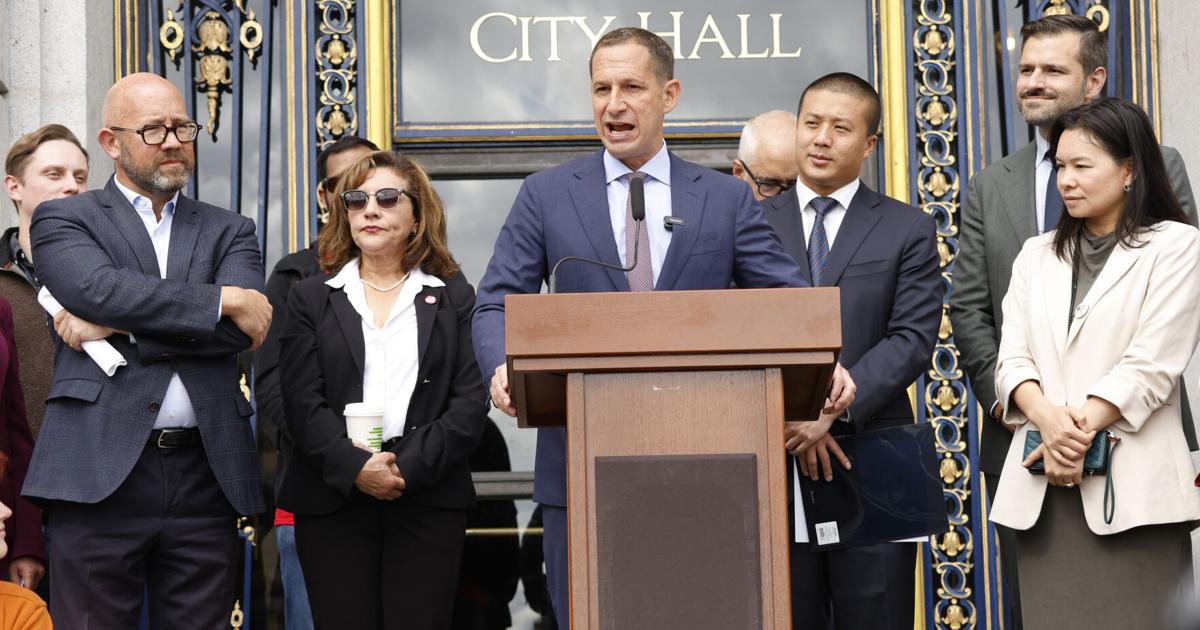
It was a lovefest outside San Francisco City Hall on May 19 when Mayor Daniel Lurie and other elected officials joined with nonprofit housing, labor union, development and tenant representatives to celebrate their support for a November ballot measure that aims to expand The City’s Housing Trust Fund.
“We’re going to work together and have an effective, thriving city government that takes good ideas and coalitions to the ballot and lets voters actually participate in their democracy, as opposed to the ballot being something that is weaponized against our own citizens,” said Rudy Gonzalez, secretary-treasurer of the San Francisco Building and Construction Trades Council.
But that moment of good feeling has since been heavily supplemented with acrimony.
Lurie and others are battling against some housing advocates over Proposition I, another November ballot measure that would take nearly $120 million of transfer-tax money out of The City’s general fund each year to support housing-related programs.
Advocates say that’s what voters wanted in 2020, when they doubled transfer-tax rates on properties valued at more than $10 million.
Lurie — who is also championing Proposition D, which would to make it harder to qualify propositions — said he did not believe Prop. I “will lead to any affordable housing being built” and that others should not be “fooled by yet another intentionally misleading ballot measure …”
In addition to warning that Prop. I would blow a hole in the city budget, Lurie — along with the city police and fire unions — said it would create “an unaccountable slush fund” for the groups that wrote it, a charge that Prop. I supporters have vigorously denied.
A committee sponsored by the Building and Construction Trades Council and the San Francisco Chamber of Commerce had disclosed raising about $314,100 and spent $28,000 as of Sept. 24 to fight Prop. I and support Proposition C, the Housing Trust Fund measure.
Meanwhile, supporters of Prop. I — which has been endorsed by the city worker-heavy unions Service Employees International Union Local 1021 and International Federation of Professional & Technical Engineers Local 21, among others — had disclosed raising more than $604,407 since May, though they had already spent $325,000 of that, including on gathering qualification signatures.
“Prop. I is one of the most deceptively written measures in recent memory,” said John Doherty, a Building and Construction Trades Council vice president of subcrafts and business manager-financial secretary for the International Brotherhood of Electrical Workers Local 6, in a statement.
“Unlike other housing funds, Prop I is so narrowly written that it locks in hundreds of millions of dollars that can only be used by one or two nonprofits — the same nonprofits that support this measure,” Doherty said.
He also said Prop. I doesn’t “require a single new unit of housing to be built” in The City, and that 70% of Prop. I money “CANT be spent by City Hall on building housing even if they wanted to.”
But Prop. I’s backers deny the charges, saying the no on I camp is spreading misinformation about what is in the measure, which would create a new House SF Fund.
Called the Affordable Housing Guarantee Act by proponents, Prop. I carries the ballot title “Changes to Real Property Transfer Tax.” Its legal text promises “protection, preservation, and production of affordable housing in San Francisco.”
“They don’t have a plan to address affordability so instead they attack ours by lying,” said Quintin Mecke, executive director of the Council of Community Housing Organizations.
The no campaign “can’t win an honest argument about whether the biggest real-estate deals in San Francisco should help fund affordable housing during a rent emergency, so it’s trying to scare voters with things the measure doesn’t say,” he said.
Mecke said the “slush fund” charge suggests self-dealing, and it’s “dangerous” to the public perception of nonprofit housing organizations.
He said it’s also factually untrue. He said the money would be awarded through competitive processes managed by the Mayor’s Office of Housing and Community Development, which also helps administer the Housing Trust Fund that Prop. C seeks to augment.
Prop. I’s proponents say it would further require the city Controller’s Office to file annual audits with the Board of Supervisors. The say the measure would not raise taxes and would encourage new construction by halving transfer taxes on sales of properties with four or more units when they are sold for the first time within five years of completion.
The no on I campaign insists Prop. I is “deceptively written” in part because the text requires that 30% of annual proceeds — perhaps almost $36 million — go to “Social Housing.”
They say the measure adds a new requirement on top of The City’s definition of social housing by stating that “residents shall have the right to participate directly and meaningfully in decision-making concerning the operation and management of the project.”
Further, the measure says where “feasible and desirable,” projects shall include resident ownership, including but not limited to limited-equity housing cooperatives.
“Prop. I forces The City to spend millions every year on collectively-owned or communally managed housing,” Doherty said. “Residents would need to get approval from committees to make decisions in their own homes.”
A no on I campaign spokesperson asserted that virtually no entities in San Francisco currently provide publicly funded, communally run social housing in San Francisco, and Prop. I does not make clear to voters that that is a goal.
“We should be putting housing dollars where they can produce the most homes, not locking The City into one approach forever,” Doherty said.
Doherty also faulted the measure for supporting nonprofits in buying apartments and taking them “out of rent control and off the rental market” and for backing programs — such as tenant education — that have “nothing to do with building new homes.”
Mecke strongly disputed Doherty’s claims. He said that similar to other housing financing measures, Prop. I does not set numbers of housing units but instead identifies categories for spending.
Of Prop. I proceeds, 30% would go to building multifamily housing, while the 30% allocated to social housing could also be used for new construction, he said.
The city controller reported that Prop. I would require that no less than 60% of tax proceeds must be spent on affordable-housing production programs; no less than 25% must be spent on preservation or acquisition programs; no less than 10% must be spent on tenant-stabilization or homelessness-prevention programs; and no more than 5% may be spent on departmental administration of the fund and administration of the tax.
Mecke said Prop. I doesn’t hide the social-housing language, and it shouldn’t be shocking. He likened resident governance to a condominium homeowners association.
He said there are multiple examples of resident-governed, permanently affordable housing sites in The City, including about a dozen limited-equity housing cooperatives in the Western Addition, Bayview, Diamond Heights and Chinatown.
“Tenants having a voice in their own homes isn’t radical — it’s overdue,” he said.
The Mayor’s Office of Housing and Community Development provided a statement saying that Prop. I would “introduce a different approach by requiring fixed, formulaic percentages for how dedicated transfer‑tax revenue must be spent.”


The fight over Proposition 40 and two related measures is now the second most expensive ballot-measure battle in state history, thanks largely to the ultrarich

The dish, a San Francisco signature, uses a deceptively simple recipe that is found throughout The City

This week, The City will honor the life and legacy of Michael Tilson Thomas, hold a free Golden Gate Park music festival, and adapt an Alfred Hitchcock film
“While the funds themselves would be administered in accordance with MOHCD’s existing open and competitive procurement processes and on-going fiscal monitoring, these mandated allocations may significantly limit The City’s ability to build more affordable housing,” the statement said.
The statement also said Prop. I establishes a new definition of “social housing” that goes beyond what is included in the current administrative code, “including new requirements regarding the operation, management, and ownership of the property,” and how those would function in practice has not yet been determined.
The statement said The City “does not have a regulatory framework for co‑ops,” as only a very small number have received city financial support.
Resident‑governed co‑ops exist in The City, but are generally not part of The City’s affordable-housing portfolio, the statement said. It said The City did make a $3.9 million seismic-safety loan to a co-op in Chinatown, and a single co-op, in the Fillmore District, receives operating support.
Mecke said the lack of city money going to co-ops highlights an opportunity for The City to do more with dedicated funding. Regarding social housing models, Mecke said The City can adopt new standards.
He said the measure’s social-housing allocation could fund construction, acquisition, rehabilitation, adaptive reuse and operations for limited-equity co-ops, community land trusts, tenants buying their own buildings, nonprofit developers building mixed-income housing with resident governance, and public housing The City owns.
Regarding the purchasing of rental units, Mecke said San Francisco has already provided financial support to nonprofits to buy rent-controlled buildings to ensure affordability. He said The City also funds eviction defense and rental assistance, including by providing counsel to people facing eviction.
Rather than voting for Prop. I, Doherty urged voters to back Prop. C, which was unanimously approved by the Board of Supervisors. He said it would increase city contributions to the Housing Trust Fund from about $52 million to $125 million over time.
“Prop. C gives San Francisco the flexibility to invest in the housing models that are actually working, including building new housing, and to press pause when the City is facing a bad budget year,” Doherty said.
Support for the Housing Trust Fund measure remains broad-based despite the conflict over Prop. I, and Mecke and other Prop. I supporters say both measures are needed.
Mecke said he helped craft Prop. C, and The City needs much more money just to build the thousands of affordable homes that have been approved but not built.
The Affordable Housing Guarantee Act first emerged in April after Mecke and a staffer at another housing organization submitted paperwork to start gathering signatures.
The proposal was part of a package of initiatives aimed at accelerating housing construction and stimulating economic activity.
A March 31 city report estimated that the transfer-tax proposal would have cost The City more than $390 million over four years. Lurie and Mahmood in June at least temporarily shelved their proposal — which had been supported by business, builders unions and others — in the face of massive budget deficits.
Prop. I would remove the existing authority of the Board of Supervisors to reduce, suspend or repeal the tax without voter approval, other than to exempt rent-restricted affordable housing or to make certain other changes. Currently, voters must approve transfer-tax increases.
Proponents say voters meant for the tax increase they approved in 2020 to go to housing-related programs, but its proceeds have been siphoned for other uses in recent years.
The 2020 measure was written so that its proceeds went into the general fund, meaning they could be used for general purposes — a structure that allowed the measure to win with a simple majority vote. It passed with more than 57% of the vote.
At the time, the supervisors unanimously passed a resolution stating their intent to appropriate revenue from such a tax “to a COVID-19 Rent Resolution and Relief Fund and a Social Housing Program Fund.”
They also created a board to advise on spending, though the supervisors eliminated that body in June.
Housing advocates say that in the beginning, The City used more than $200 million of the money for housing-related programs, but then the money went elsewhere. Through February, the tax had generated a total of $504.6 million, according to the Controller’s Office.
The sponsor of the 2020 tax measure was Dean Preston, a Democratic Socialists of America member and former District 5 Supervisor who has been advocating for Prop. I. City records show he had given about $118,000 to the yes campaign.
Saikat Chakrabarti — a progressive centimillionaire and former Stripe LLC software engineer who in the June primary was knocked out of the race to succeed Rep. Nancy Pelosi in Congress — also gave $150,000.
Mecke said he and his Prop. I co-signer withdrew the measure from circulation on May 4 for lack of signature-gathering funds.
But Democratic Socialists of America members resubmitted the measure the same day, and a coalition of organizations then collected more than 20,000 signatures by July 2.
Even as Lurie and others were touting the Housing Trust Fund measure on the steps of City Hall, people were nearby gathering signatures for the Affordable Housing Guarantee Act.
On Aug. 12, Lurie — along with leaders of the San Francisco Police Officers Association and San Francisco Firefighters Local 798 — came out against Prop. I with guns blazing.
What verdict the voters will render on Prop. I remains to be seen, but on the “slush fund” charge, Prop. I proponents received some support from the public policy nonprofit SPUR — even though SPUR opposes the measure.
“We heard the argument, but we did not in any way agree with that argument,” said Sean Elsbernd, SPUR’s president and CEO.
Elsbernd said the grounds for his organization’s opposition included the belief that Prop. I’s formulation could inhibit city policymakers from responding to changing circumstances, such as budget deficits.
He also said that requiring an election to cut transfer taxes would run counter to empowering elected officials to perform their jobs.
“The slush-fund argument, we think, is campaign rhetoric, and we just want to stick with the pure policy reasons, not campaign hyperbole,” Elsbernd said.