
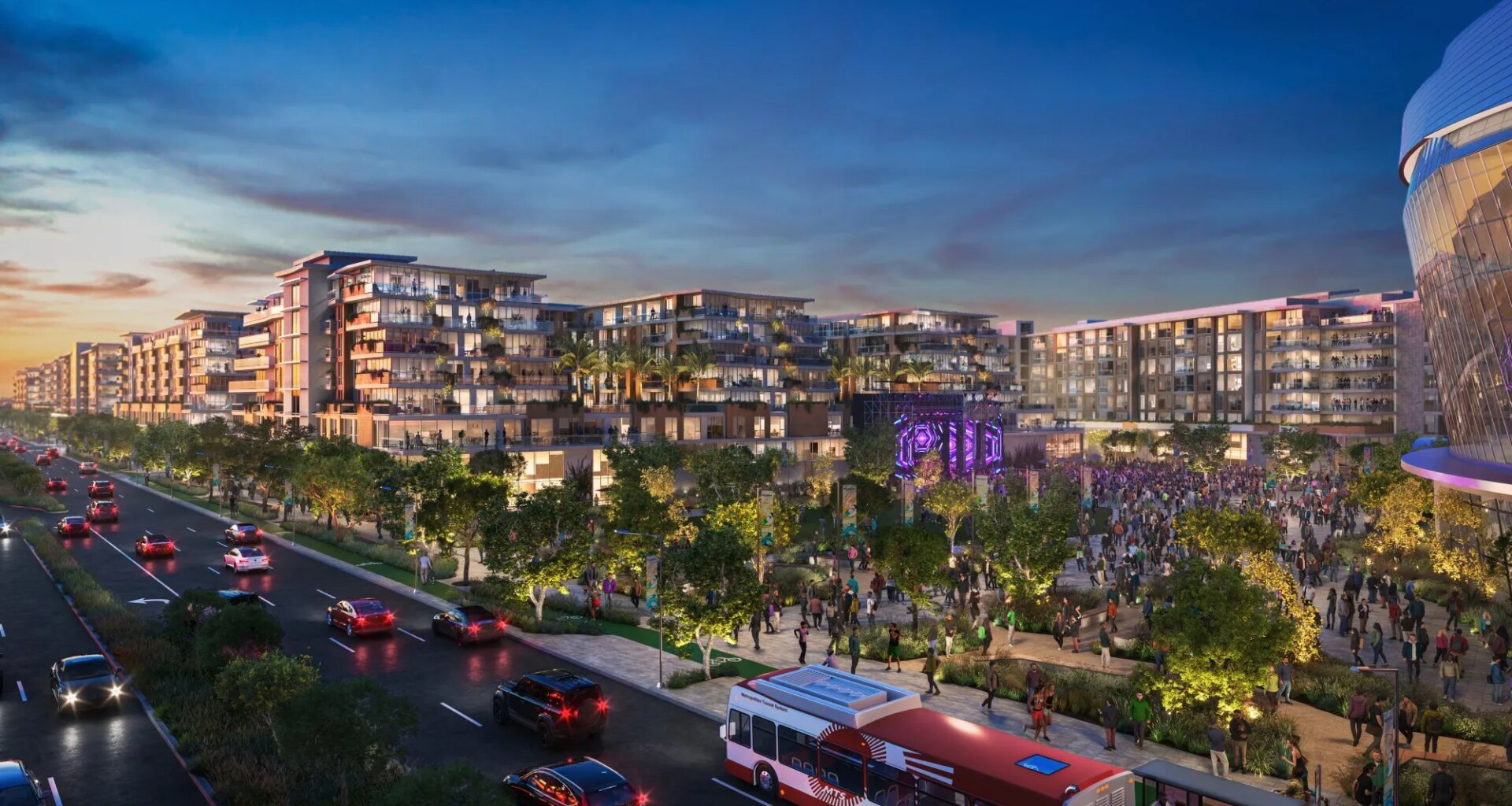
The longstanding Midway Rising project got a major jumpstart Tuesday, with the signing of two state bills that will effectively remove legal obstacles that had dogged the multibillion-dollar development.
Gov. Gavin Newsom signed Senate bills 344 and 958, both designed to blunt the impact of the California Environmental Quality Act on the project.
Both bills were authored by state Sen. Akilah Weber Pierson, D-La Mesa, and sponsored by San Diego Mayor Todd Gloria, who has pushed for the project for years. He said in a statement Tuesday that the legislation would allow the city to transform an underused public property into housing and a modern arena.
“This is an important step toward turning decades of discussion into action,” Gloria said in a statement, “building thousands of new homes and finally delivering the world-class arena and revitalized Midway District San Diegans have been promised.
Specifically, SB 344 will create a special statute specific to Midway Rising and establishes that the project, upon certification of its environmental impact report, will have fully satisfied the requirements of the state’s environmental law. It includes an urgency clause, meaning its protections will take effect immediately.
The companion bill, SB 958, prevents increased building heights from being considered as significant impacts under California environmental law. In October 2025, California’s Fourth District Court of Appeal had ruled that San Diego illegally asked voters to remove the 30-foot height limit from the city’s the Midway-Pacific Highway Community Plan area without adequately studying the effects of increased building heights. The appellate court not only ordered the Midway District’s height limit restored, but published its decision as a binding precedent on CEQA case law for lower courts.
SB 958 does not revive the invalidated San Diego ballot measure. City leaders have formally reinstated the 30-foot height limit in San Diego’s Midway District. And the Midway Rising development believes that it can legally breach the height limit with the help of other state housing laws.
Instead, SB 958 could clear the way for the city to advance another measure to lift the Midway District’s height limit. It also seeks to protect other projects across the state from CEQA-related lawsuits pertaining to building heights.
The mega 49.2-acre Midway Rising plan calls for a 16,000-seat sports arena, 4,254 residential units, 14.5 acres of parks and open space, as well as 130,000 square feet of commercial space. It would replace the aging Pechanga Arena in San Diego. Midway Rising has been in the works since 2022 but has faced various legal challenges and other issues.
The Kroenke Group, a subsidiary of billionaire Stan Kroenke’s real estate firm, is the entity’s lead investor and limited partner. Kroenke, who recently purchased the Los Angeles Angels, also owns the Denver Nuggets, Los Angeles Rams and Colorado Avalanche.
Brad Termini, CEO of developer Zephyr, said that after the laws’ passage, the goal was to break ground on the project next year.
Gloria’s state legislative win comes as the city and the Midway Rising development team prepare to wrap up a four-year negotiation period with a long-term ground lease for the city’s real estate at 3220, 3240, 3250 and 3500 Sports Arena Blvd. in the Midway District. The proposed real estate terms for the development deal are expected to be discussed publicly for the first time at a City Council committee on Oct. 8.
San Diego City Council must still grant final approval, likely at a meeting in a few weeks.
The Midway Rising development team, in addition to The Kroenke Group and Zephyr, includes sports-and-entertainment venue operator Legends and low-income housing builder Chelsea Investment Corp.
Plans call for 2,000 apartments for households earning 80% or less of the area median income ($97,950 annually for an individual), making it the largest affordable housing project in San Diego County history.
Chris Cate, CEO of the San Diego Regional Chamber of Commerce, said the project would be a boost to the local economy.
“When we build housing and welcome private investment,” he said, “we give employers a reason to grow here and families a reason to stay.”