
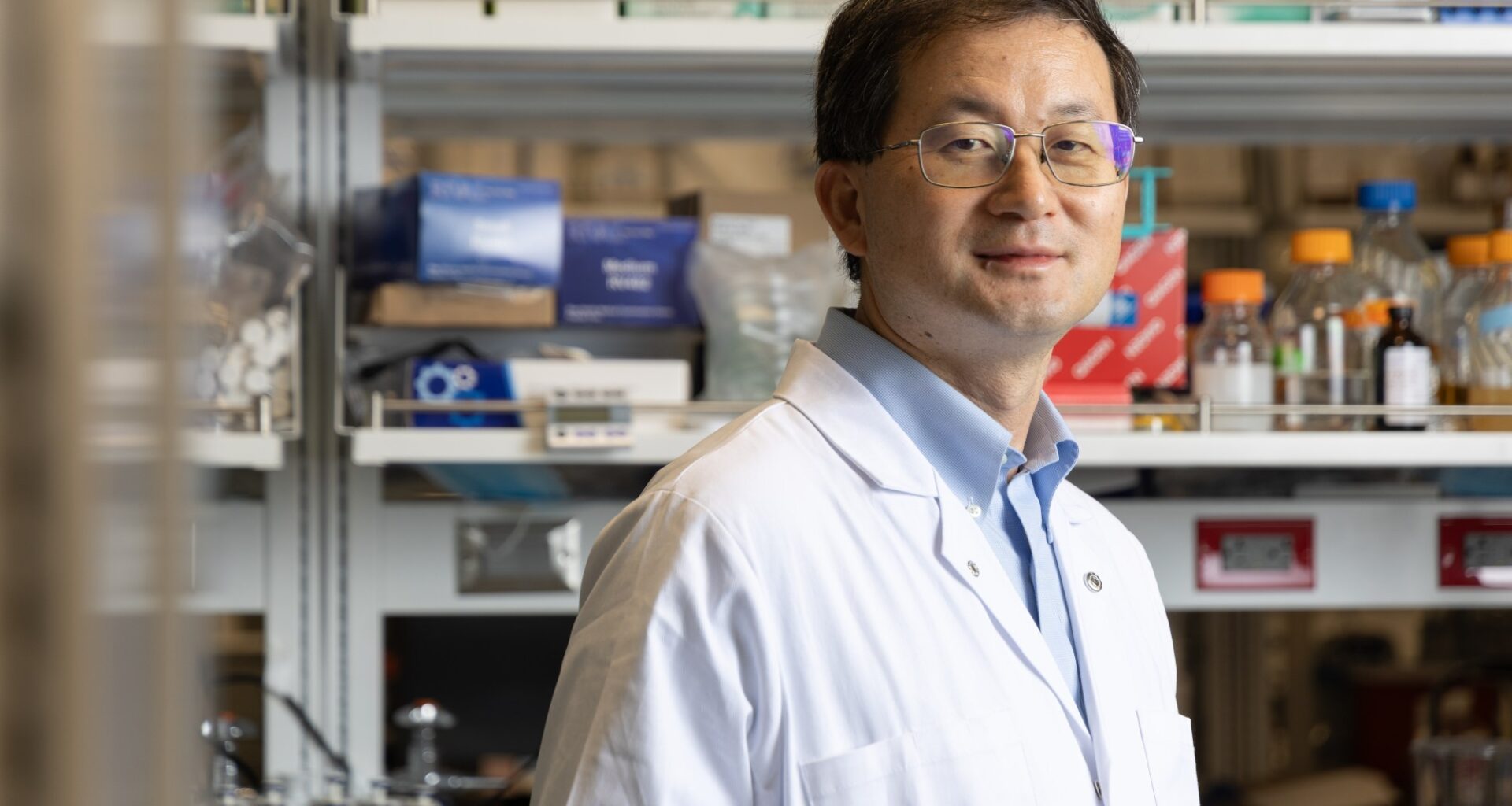
As a chemical engineer, UC San Diego professor Liangfang Zhang could have opted for career paths that had nothing to do with medicine or the greater human good. Yet for more than 15 years, Zhang has used his expertise to figure out how to disguise microscopic nanoparticles that can bypass the human immune system and precisely target ailments inside the body.
The hope is that this novel technology pioneered by Zhang, chair of the Department of Chemical and Nano Engineering at the UC San Diego Jacobs School of Engineering, will one day be used to treat and prevent numerous diseases and medical disorders, including cancer.
For creating that technology, Zhang was named Tuesday as one of the John D. and Catherine T. MacArthur Foundation’s 2026 fellows. The prestigious MacArthur fellowship, typically awarded to about two dozen individuals each year, comes with an $800,000 prize that’s often called the “genius grant.” The money is paid directly to individual winners, not the institutions they work for, and can be spent however each fellow chooses.
“A MacArthur fellowship is very important, not just to (my) field, but to the general public,” Zhang told the Union-Tribune in an interview. “This is a very big deal to me personally, but more importantly, I feel it’s a greater recognition (of) the work that myself and my teams have been working on over the past 16 years to develop this unique nano medicine technology.”
Zhang, 46, said he and his colleagues know how “very innovative, and potentially very powerful” that technology can be. But he hopes the MacArthur award, which draws national headlines each year, will help broadcast its importance to a wider audience.
“I think with this type of recognition, it’s really helpful and very meaningful,” Zhang said.
Since 1981, the MacArthur Foundation has honored 1,195 MacArthur fellows. Zhang is among 20 fellows honored in 2026, the program’s 45th year. Four other scientists were also named fellows this year, alongside artists, fiction writers, historians, a dancer, a saxophonist and a poet. The fellows are chosen each year based on three criteria, according to the foundation: exceptional creativity; promise for important future advances based on past accomplishments; and the potential for the fellowship to enable subsequent creative work.
MacArthur fellows are not involved at all in the nomination or selection process, so the award comes as a complete surprise to each new fellow every year. Zhang said he had just dropped his daughter off at school on a recent morning when he received a call from an unknown number. Because he was not yet at work, he decided to answer.
The person on the other end of the call asked him to verify his identity and inquired if there was somewhere private he could talk. Zhang was extremely suspicious, he recalled with a laugh. But eventually the caller, Marlies Carruth, the director of the MacArthur Fellows Program, broke the news.
“My first reaction when she told me that, I feel that it’s not real,” Zhang said. “I never expected that I will receive a call like this.”
Zhang, who has worked at UCSD since 2008, is the fifth current faculty member to receive a MacArthur award, according to a spokesperson. Several emeritus faculty have also been recipients.
“UC San Diego congratulates Professor Liangfang Zhang on this tremendous, well-deserved honor,” Chancellor Pradeep Khosla said in a statement. “Professor Zhang has turned cellular membranes into a platform technology to deliver medicines and combat infectious disease and inflammation, with the ultimate goal of improving lives. His fundamental and translational research collaborations across campus, exceptional teaching and mentorship, and entrepreneurial leadership exemplify the caliber of our world-class faculty.”
Zhang’s work has essentially centered on a Trojan horse strategy of fighting diseases and ailments by coating drug-laden nanoparticles with the membranes of human cells. Cloaked in the membranes of these cells, the nanoparticles can slip past the body’s immune system, which would typically seek to destroy such a foreign intrusion, and get to work treating whatever ailment they’re designed to treat.
The work began by using red blood cells to coat the nanoparticles, but has evolved over the years to also use two types of white blood cells and other cells in the human body. The recurring theme in his work is to use existing biological systems rather than design a new drug for every ailment.
“We’ve shown many examples of mimicking natural interactions in the body to create more effective therapies,” Zhang said in a statement.
Zhang told the Union-Tribune he has not decided how he’ll use the $800,000 grant, which the MacArthur Foundation will pay out over five years.
“But I think the most important thing is that we will continue to advance the technology,” Zhang said, “and realize the full potential to benefit people.”