
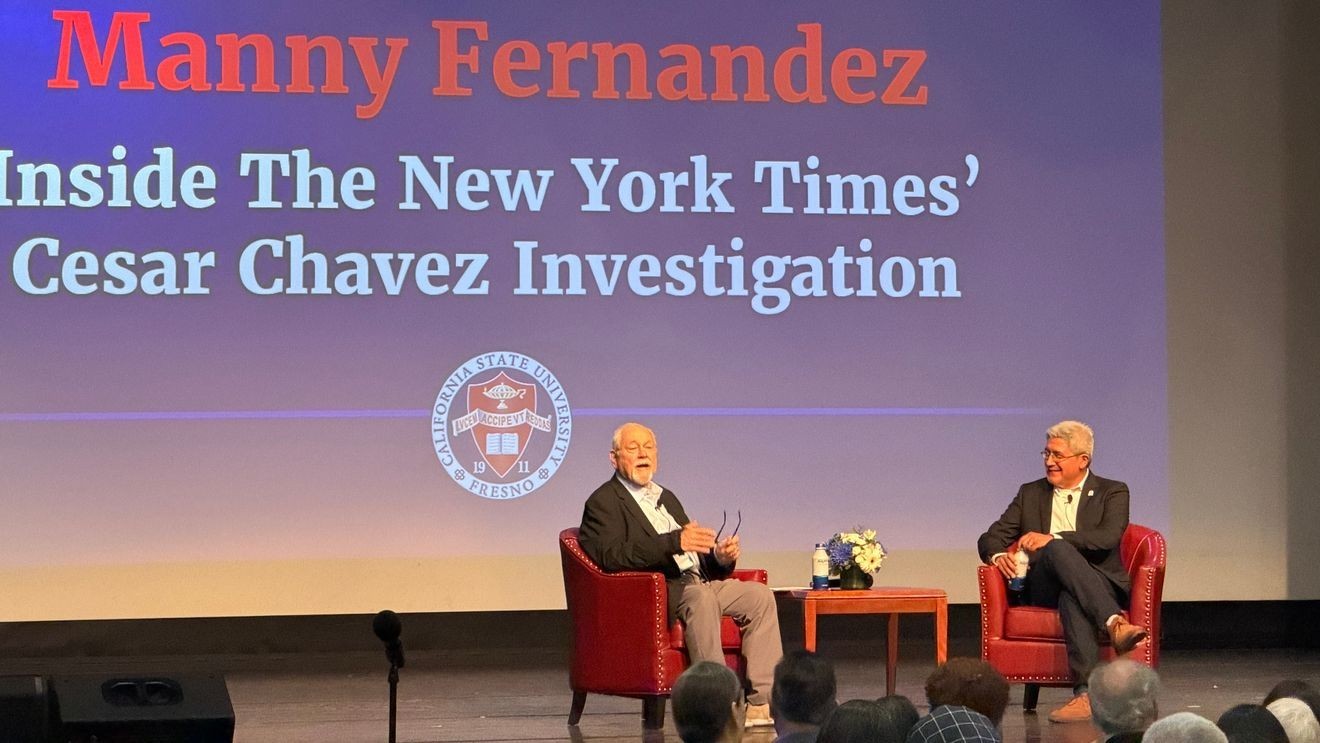
FRESNO, Calif. (FOX26) — A Fresno State alumnus is back on campus after reporting a New York Times investigation that prompted renewed scrutiny of César Chávez’s legacy across California.
New York Times journalist Manny Fernandez spent more than five years investigating allegations of sexual abuse against the civil rights leader. The investigation, published March 18, was reported by Fernandez and Sarah Hurtes.
Chávez remains a prominent figure throughout the Central Valley, with his name appearing on streets, schools and landmarks across the region.
But the Times investigation detailed allegations of sexual abuse involving multiple women, including an allegation from labor leader Dolores Huerta, who told the newspaper that Chávez sexually assaulted her decades ago. The investigation also included allegations involving girls as young as 12.
Fernandez said the investigation began with a single tip.
“I got the tip and we started looking at it. And basically, I never let it go,” Fernandez said.
Over the course of more than five years, Fernandez interviewed more than 60 people as he worked to investigate the allegations and Chávez’s broader legacy.
Fernandez said the stories of the women involved were an important part of the reporting, even though the alleged incidents happened decades ago.
“And that’s why that story needed to be told, to tell these women’s stories of, yes, it’s in the past. Yes, he’s no longer alive, but for them, it is a very real painful thing,” Fernandez said.
The publication of the investigation was followed by changes in how some communities across California honor Chávez, including the removal or reconsideration of Chávez-related street signs and monuments.
At Fresno State, a Chávez statue that once stood on campus was later covered and has since been removed.
Fernandez said the reaction to the story was something he could not predict.
“As a reporter you learn not to think too much about what happens after your story runs, because you can never predict,” he said.
Months after the investigation was published, Fernandez returned to Fresno State, where he graduated in 1997, to speak with students preparing for careers in journalism.
For Fernandez, the visit was a return to where his journalism career began.
“I got to be in a newsroom the first time. And I don’t have to tell you how infectious and fun it is to be in a newsroom with people who are working on journalism,” he said.
Fernandez said he once believed he would have to leave the Central Valley to find major stories. Instead, one of the biggest investigations of his career brought him back home.
“That story was written by somebody from Fresno,” Fernandez said.
He said his goal was not simply to revisit Chávez’s legacy, but to examine it in its entirety.
“I wanted it to talk about his legacy and the good that he did. And I also wanted to have the stories of the women saying the other things he did too,” Fernandez said.
Fernandez acknowledged that the reporting would be painful for people who grew up admiring Chávez. He said some people told him he should be ashamed for publishing the investigation.
But Fernandez maintains that documenting the allegations and giving the women an opportunity to tell their stories was an important part of his work as a journalist.
According to the Associated Press – the first legal action since the allegation was a complaint filed in kern county earlier this month against the César Chavez foundation and the united farm workers foundation.
Both are accused of failing to investigate complaints including emotional distress and sexual harassment.