
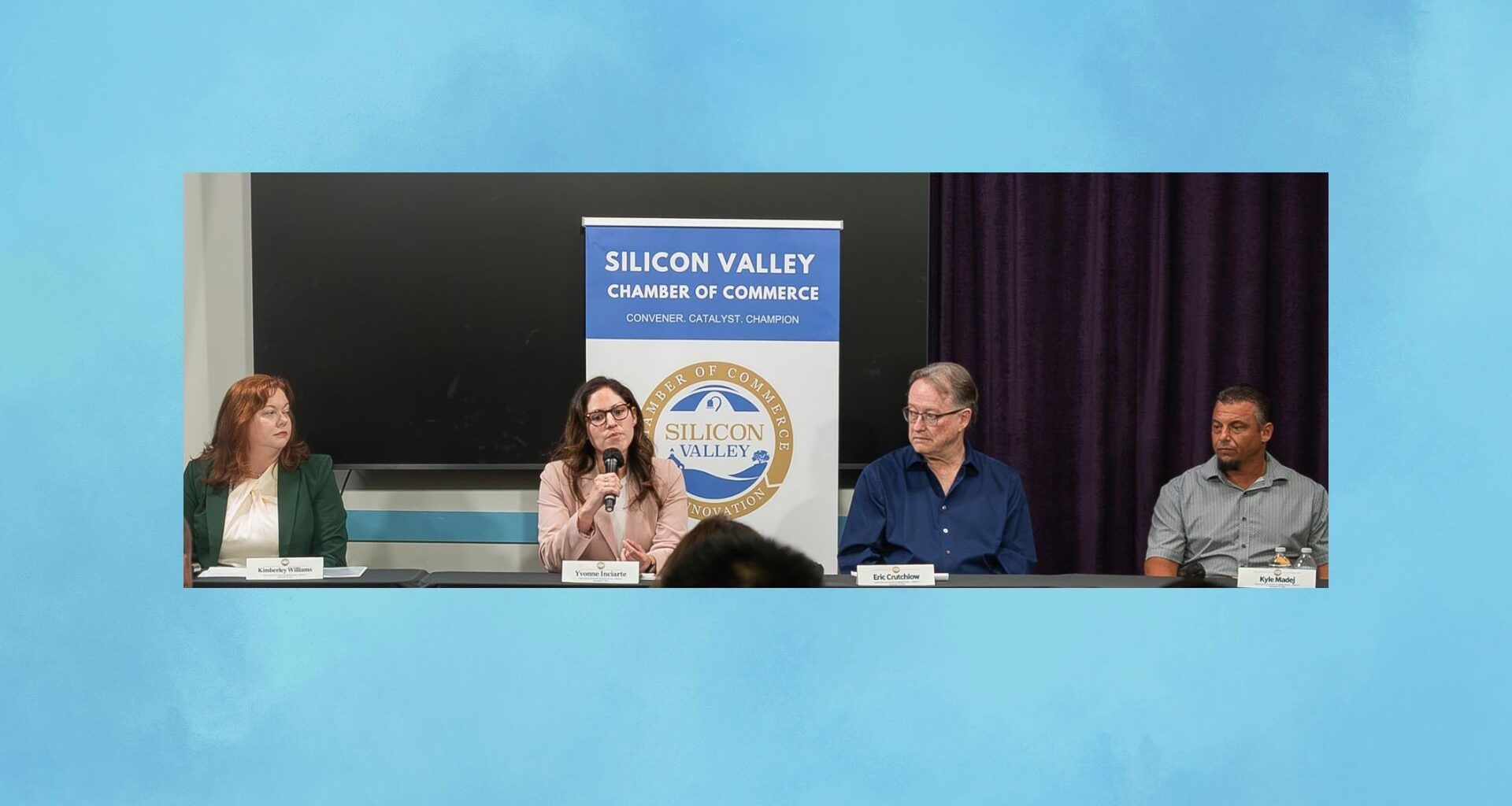
Sept. 27th’s candidate forum for Santa Clara’s District 2 and District 3 city council races heard from candidates about council dynamics, the city budget, housing, data centers and Santa Clara’s relationship with the 49ers. The forum was co-sponsored by the League of Women Voters of San Jose/Santa Clara, the Silicon Valley Chamber of Commerce and San Jose Spotlight.
Few policy differences emerged among the candidates, including on seemingly irreconcilable goals of spending more on infrastructure while restraining budget growth. Everyone agreed that the council should be on better terms with the 49ers and council meetings are too long.
What separated the candidates was whether they offered specific policies and actions versus general statements about problems and what the city “should” do. The 90-second answer limit, however, made substantial answers difficult.
District 3: Eric Crutchlow and Kyle Madej
Eric Crutchlow, a cyber-security engineer, has the most direct city experience of the candidates: three years on the Planning Commission, where he is currently the chair, and his service this past year on a charter review committee.
SPONSORED

On fiscal policy, he proposed a standing finance committee to inventory city assets and allocate money for their maintenance before emergencies happen.
Crutchlow favors a data center moratorium, but also proposes a simple beginning.
“I’ve already asked that at the next planning commission we do something simple: start a report that looks at an aggregate of all the data centers,” said Crutchlow. “That plus the other industry that we have in Santa Clara. If they all turn on their diesel generators, what would be the impact? Is it going to be a public health problem?”
SPONSORED

Kyle Madej is a founder and executive of several security and police equipment companies. His single specific proposal was a structural one: separating the Stadium Authority board from the City Council. He argued it creates “a huge conflict of interest” when the same people oversee both the city’s and stadium’s finances.
Crutchlow endorsed the proposal.
Madej also advocated for more parks and remedies for El Camino Real’s blighted state.
“We have two shopping centers on El Camino that are abandoned right now,” he said. “We have to find developers who want to come in, and … incentivize businesses to want to be in Santa Clara.”
District 2: Yvonne Inciarte and Kimberley Williams
Yvonne Inciarte is former Director of Intergovernmental Strategy for Congressman Ro Khanna. Inciarte serves on the Historical & Landmarks Commission and served on the Economic Development and Marketing Committee. Inciarte’s answers were characterized by the vocabulary of process: “explore,” “empower” and “create solutions.”
Addressing the conflict on the city council, Inciarte said she would “assess what’s the frustrations going on, on council … what are priorities? Why are we gridlocked? That’s something that I will do to empower collaboration.”
On data centers, Inciarte suggested education about data centers and sliding electric rates.
Although Kimberley Williams doesn’t have experience in city government, her answers showed knowledge about specific policy tools. Williams is a longtime volunteer in Santa Clara Unified schools, serves on the board of the Santa Clara Schools Foundation and California State PTA Board of Managers.
On the state’s affordable-housing mandate, Williams enumerated actions the city can take: contributing public land, deferring fees, streamlining approvals and partnering with the county housing authority and nonprofit developers. On the city budget, she identified a structural pattern: repeated failure to adequately fund infrastructure reserves.
Long Council Meetings, Data Centers, Levi’s Stadium, Downtown
Three of the candidates offered concrete ideas about corralling council meetings that last into the wee hours of the morning. Crutchlow and Madej both proposed a hard cutoff time for substantive votes and votes carrying deadlines. Williams put forward pre-recorded staff presentations and expanded language translation.
Inciarte recommended the city should “actually follow the Brown Act … so that we can be more efficient,” but did not elaborate.
Everyone bemoaned the absence of a downtown, and Madej had a concrete suggestion: demolish the city-owned building on the corner of Homestead and Lafayette and allow food trucks there.
“It’s something we can do really fast,” he said. “It would make a splash, and give us momentum to push through on the final project.”
Inciarte didn’t have anything to say about the downtown, instead saying the Super Bowl and World Cup events “showed that Santa Clara actually had soul” and “who we are as we’re growing together,” and something that she would “make sure that we empower.”
On the question of the stadium, Crutchlow pushed back on demands for more auditing.
“You should be auditing all the time,” he said. “We have to be proactive and look in the front and where we’re going, making sure the contracts have worked for us.”
Inciarte said, “We need to know how to speak to everybody,” and that she “would not like the stadium to be taking from our reserves and general fund.”
The video of the forum can be found at https://fb.watch/v/6CoJyVdZr/
Carolyn Schuk can be reached at carolyn@santaclaraweekly.com.