
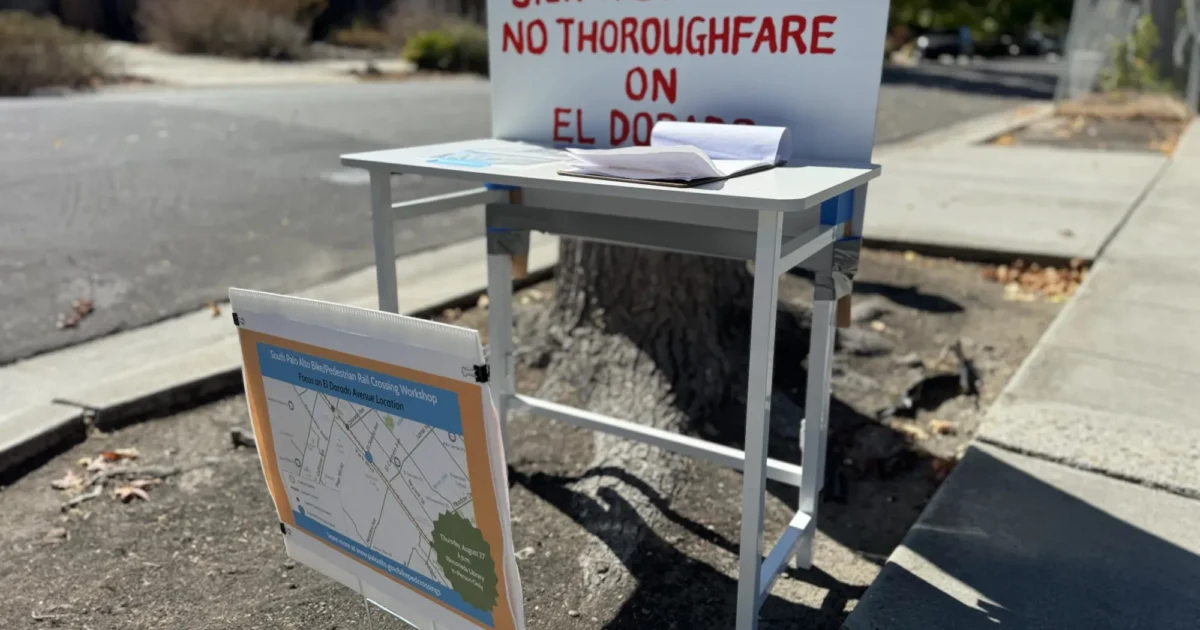
Midtown residents expressed dissatisfaction with both options, too, especially the traffic light version that some said would increase vehicle traffic in the area. David Hung, who created the El Dorado petition, described the signal light as a “vehicle magnet” because it would be the only signal between Churchill Avenue and Grocery Outlet, having the downstream effect of increased congestion and longer emergency response times.
Hung and other petitioners proposed a “hybrid” option that would put a signal at Loma Verde and Alma, a protected bike line on Alma between Loma Verde and El Dorado and a tunnel under the tracks at El Dorado and Alma.
Commissioners, however, were more concerned with eminent domain: With the new conceptual renderings, both options would require some parcel acquisition on the west side of the train tracks. The A2 alternative would also require the full acquisition of two properties on the east side of the railway, an affordable apartment building and a single-family home, according to city staff.
Eminent domain was the primary reason the council decided not to advance the options at Loma Verde, Commissioner Bart Hechtman said. Given the state of the available options at El Dorado, he said city staff should return with more information and quoted Kurt Vonnegut, who said “a step backward, after making a wrong turn, is a step in the right direction.”
“Is the project designed to achieve the greatest public good with the least private injury?” Hechtman said. “Maybe. It also may be true that it’s not. We’re not far enough along yet.”
Commissioner Allen Akin was slightly more amenable than his colleagues about the El Dorado option, stating that A2 was “not going to fly” but acknowledging that A1, with the Alma traffic light, could be viable if the city achieves bicycle network enhancements at the same time.
Another member of the public, former Pedestrian and Bicycle Advisory Committee member Paul Goldstein, was one of the few people to express support for the El Dorado option.
“This alternative on El Dorado is a clear winner,” he said. “Is it perfect? It is not perfect, but it is lower cost than any of the others and it’s most likely to be built sooner than any of the other plans.”
In terms of cost, however, the commission learned that a tunnel with a traffic light at Loma Verde could be relatively comparable to the same setup at El Dorado, although staff cautioned that comparing the two involves many assumptions about construction and design.
Commissioners also expressed concern that El Dorado would be too narrow to accommodate parked cars, vehicle traffic and cyclists — even with the A2 option that would turn El Dorado into a one-way street. Chair Bryna Chang described El Dorado as simply a “nonstarter” for cyclists given these concerns.
Commissioners also discussed the idea of an overpass instead of a tunnel, which may be cheaper and quicker to build. Staff explained that an overpass would have to extend three stories tall at its peak in order to sufficiently skirt the infrastructure in place for Caltrain’s electric fleet.
In order to comply with ADA ramp standards, the significant height of the overpass would then require long ramps on either side — but the commission was nonetheless intrigued by the option.
Instead of recommending that the council advance one or two tunnel options to 15% design, the commission voted unanimously to hold El Dorado A1 and A2 alternatives until conceptual designs were also completed for tunnels at Loma Verde both with and without a signal at Alma, as well as the exploration of an overpass and the hybrid option proposed by Midtown petitioners.
“This is the kind of project that will last for a very long time, and we need to make sure we do this right,” Vice Chair Kevin Ji said.