
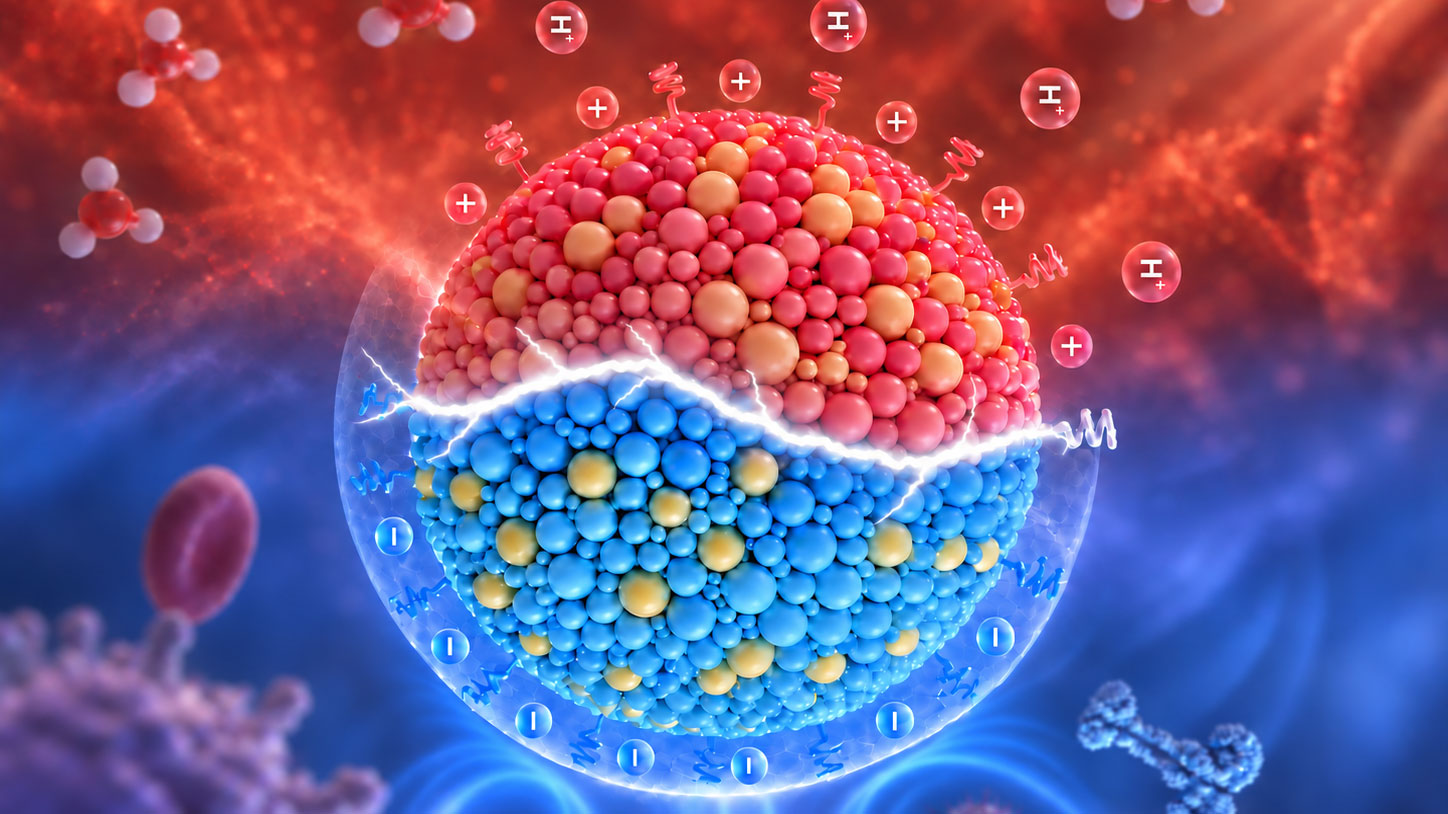
Researchers engineer charge-switching lipid nanoparticles that could lead to new mRNA-based therapeutics
October 1, 2026 by Marni Ellery
For many of us, getting a COVID-19 shot was our first encounter with lipid nanoparticles. These tiny fat droplets can safely carry messenger RNA (mRNA) and other therapeutics into our cells. But the same property that makes them great delivery vehicles — their positive charge — also triggers high levels of inflammation in people, limiting their applications beyond vaccines.
Now, researchers may have found a way to solve this longstanding problem, opening the door to new treatments for a variety of diseases.
In a study published in Nature Nanotechnology, a UC Berkeley-led team of researchers engineered a new lipid nanoparticle that can switch its charge from positive to negative and may avoid triggering inflammation. At the same time, it can still deliver mRNA and other nucleic acids very effectively.
“Until now, the idea of making lipid nanoparticles that are negatively charged, which delivered mRNA, seemed impossible,” said Niren Murthy, professor of bioengineering at UC Berkeley and a member of the Innovative Genomics Institute. “This work has opened up a new class of lipid nanoparticles that have the potential to solve a major problem in the field of drug delivery.”
In addition to Murthy, this multi-institutional study was co-led by professor Aijun Wang of UC Davis and by Hesong Han, a research scientist in the Department of Bioengineering at UC Berkeley.
Ease of delivery vs. toxicity
Ironically, those who would most benefit from lipid nanoparticle therapies cannot currently take full advantage of them. People with diabetes and cancer, for example, often have higher-than-normal levels of inflammation, and many studies have shown that traditional lipid nanoparticle therapies exacerbate inflammation, potentially causing severe, life-threatening reactions in these patients.
Developing non-inflammatory lipid nanoparticles, however, has been challenging. The lipid nanoparticle’s ionizable lipid has a positive charge, which is a major source of its toxicity, as it can activate inflammatory pathways in the human body. But that same positive charge is also essential for delivering nucleic acids through endosomal release — the process by which the particle escapes the endosome, a compartment inside the cell, so it can release its mRNA or DNA cargo.
Without a solution to this dilemma, designers of current lipid nanoparticles have had to make trade-offs between toxicity and mRNA delivery efficiency. This has been a challenge for the past 30 years, said Murthy, and has slowed down the clinical translation of this technology beyond vaccines, limiting the development of numerous mRNA-based therapeutics.
A charge-switching lipid
Seeking to finally resolve this issue, the researchers created something new: charge-switching ionizable lipids (S-lipids).
They modified the ionizable lipid by adding a carboxylic acid, which acts as a molecular switch. The result is an ionizable lipid that changes its charge depending on acidity, generating a switchable nanoparticle.
“We found that these switchable nanoparticles stay positively charged when needed in acidic environments, such as when encapsulating the mRNA and triggering endosomal release,” said Dengpan Liang, a postdoctoral researcher in the Murthy Laboratory and the study’s co-first author. “But when they circulate in our near-neutral blood, they flip to a negatively charged state that helps mitigate toxicity and avoids triggering inflammation. And they can still efficiently deliver the therapeutic goods, just like a traditional lipid nanoparticle.”
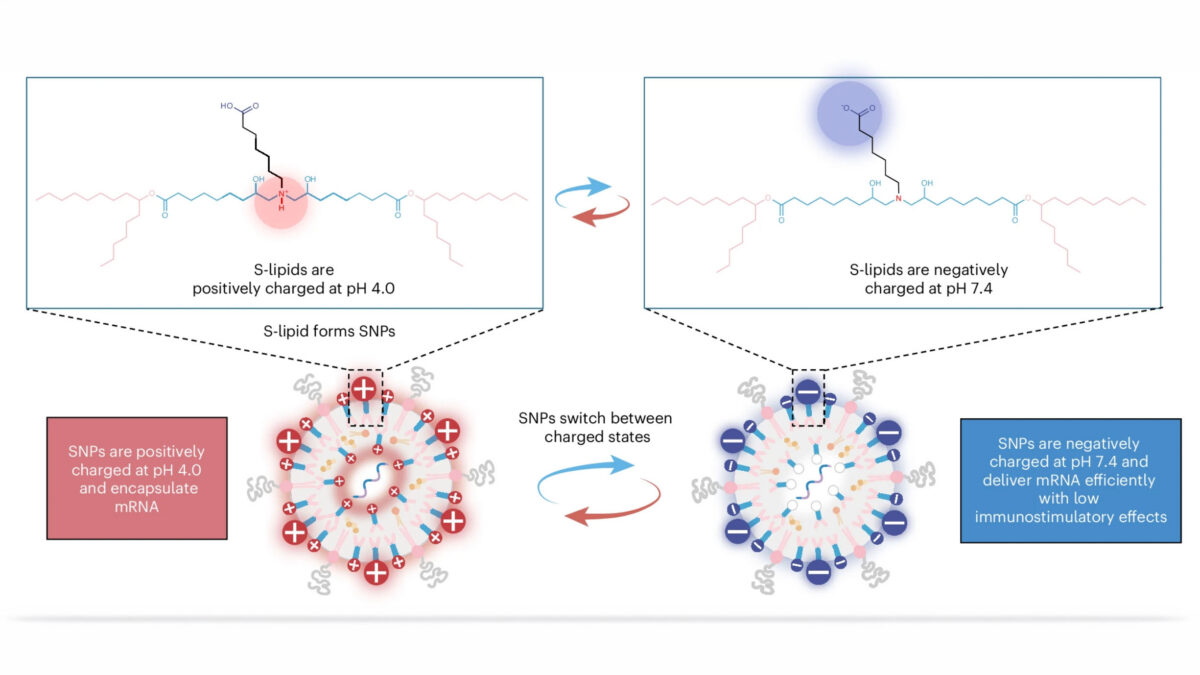
Switchable nanoparticles switch their charge states to deliver mRNA and DNA efficiently without causing inflammation. (Image courtesy the researchers)
The researchers reported promising results after testing their switchable nanoparticle in a mouse model of acute lung injury, a common disease characterized by intense inflammation and therefore difficult to treat with traditional lipid nanoparticles.
“The switchable nanoparticles were actually able to treat inflammatory diseases like acute lung injury really well,” said Liang. “And they could do it much better than traditional lipid nanoparticles because they don’t cause inflammation themselves.”
The researchers also tested their switchable nanoparticles on human blood cells. Compared to a panel of six commonly used lipid nanoparticles, the switchable nanoparticles were shown to be the only class of lipid nanoparticles that did not trigger inflammation in human blood cells.
Liang added, “Using human blood cells in our study, in addition to animal test subjects, allows us to more accurately gauge how patients will react to these lipid nanoparticle-induced inflammations.”
New therapeutic applications
According to the researchers, these new lipid nanoparticles have the potential to accelerate the clinical development of nucleic acid-based therapeutics and expand their therapeutic applications.
Out of the gate, Murthy and Liang envision their switchable nanoparticle being used for protein replacement therapy in the liver, specifically in patients missing a critical enzyme called ornithine transcarbamylase. This rare inherited deficiency leaves the body unable to clear ammonia from the blood and can be fatal without treatment.
“If we were able to use our switchable lipid nanoparticles to deliver the mRNA, we could actually cure this disease,” said Murthy. “In fact, there are many diseases like this that would be immediately curable if you had a lipid nanoparticle that could be chronically dosed with low toxicity.”
Looking ahead, the researchers plan to work on enhancing the degradability of their switchable nanoparticle, so that once it releases its therapeutic payload inside cells, it will quickly break down. They also want to develop switchable nanoparticles that can travel to more tissues; this first generation goes just to the liver and the spleen.
“So far, we’ve only made about 20 lipids that are really good,” said Murthy. “But now that we’ve figured out a lot of the design rules, it should be easy to make hundreds of new and even better ones.”
This study was a collaborative effort involving researchers from UC Berkeley, UC Davis, Stanford University, Shriners Children’s Northern California, Lawrence Berkeley National Laboratory, Chongqing University and Chan Zuckerberg Biohub. The paper has a complete list of co-authors and their affiliations.
This research was supported by the California Institute for Regenerative Medicine (CIRM), the Bakar Fellows Program, the Cystic Fibrosis Foundation, the Innovative Genomics Institute, the CRISPR Cures for Cancer Initiative, the Weill Neurohub, Shriners Children’s, the Chau Hoi Shuen Foundation, the National Science Foundation and the National Institutes of Health.