
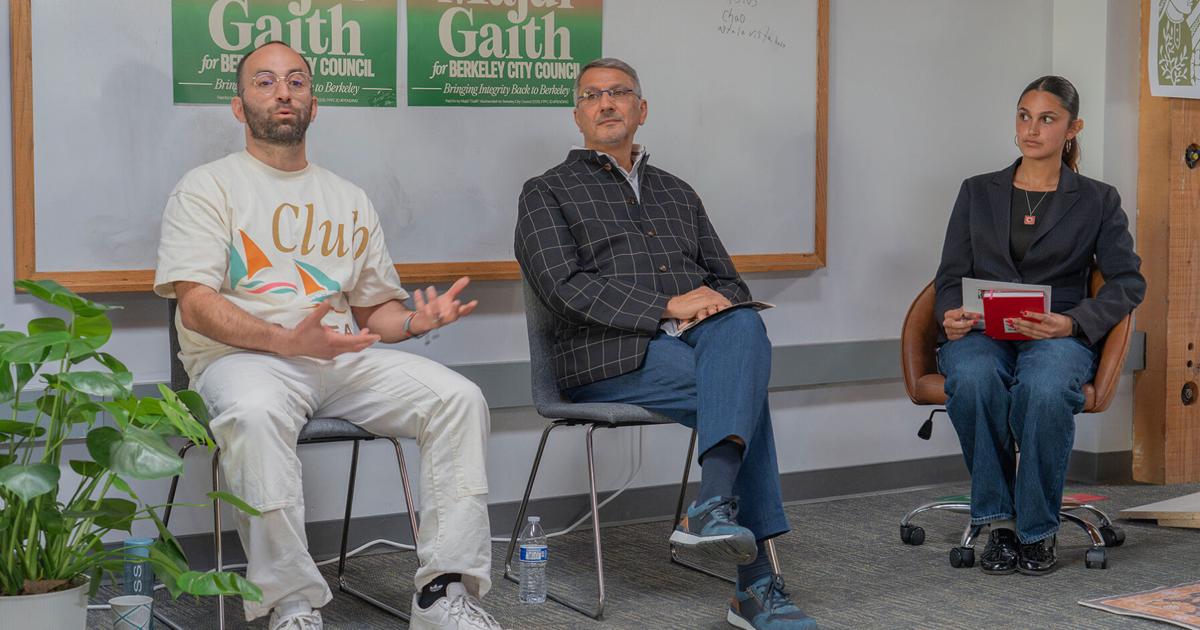
A few dozen spectators gathered Tuesday for a conversation between Berkeley City Council candidate and UC Berkeley alumnus Majdi Gaith and UC Berkeley lecturer Hatem Bazian. The conversation took place at Solidarity Collective, a local coworking space, and touched on Gaith and Bazian’s Palestinian roots, affordable housing, small businesses and progressive activism.
The event is part of Gaith’s campaign to take the City Council seat of District 4 Councilmember Igor Tregub, which is up for election this fall. Tregub first joined the City Council in a 2024 special election to fill the seat left vacant by former Councilmember Kate Harrison. District 4 includes Downtown Berkeley and nearby neighborhoods.
A significant portion of the talk revolved around the city’s response to Israel’s genocide in Gaza. Gaith was born in San Francisco but said he has visited Palestine almost 50 times and carries a West Bank ID. Bazian was involved in the first chapter of prominent pro-Palestinian group Students for Justice in Palestine as a UC Berkeley graduate student in the 1990s and later founded American Muslims for Palestine.
Moderator and Barnard College student Safiya O’Brien posed a question alleging Zionist and housing developer lobbies have been attempting to gain power over the City Council. O’Brien pointed to how the City Council repeatedly edited the Peace and Justice Commission’s proposed resolution on Gaza. Both Gaith and Bazian have served on the Peace and Justice Commission.
O’Brien talked about Tregub firing a commissioner and approving a new one for failing to make required adjustments to the resolution. O’Brien alleged the new commissioner holds Zionist beliefs.
“I saw a lot of the same problems that we all know (are) going on in the city,” Gaith said, speaking about his time on the commission. “It’s not just the Zionist takeover of council. It’s also a pro-developer, runaway upzoning of our communities. It’s not helping small businesses. It’s bringing in draconian technologies such as Flock … which are incredibly disastrous for our societies.”
When contacted by The Daily Californian, Tregub did not comment on the allegation of appointing a Zionist commissioner but said in an email that he was proud to appoint or retain “commissioners who bring with them deep expertise, valuable lived experience, and a spirit of collaboration.”
Addressing the allegation of Zionist and developer lobbies taking over the council, Tregub said he helped create the city’s Public Financing Program, which matches donations of up to $60 to candidates running for certain offices in Berkeley with six times as much in city funds. Tregub noted Gaith could also benefit from this program.
While Gaith spoke at length about his experiences in Palestine, including the moment that inspired him and his brothers to open Jaffa Coffee Roasters in Berkeley, he also discussed his perspective as a small business owner and as someone in the Bay Area tech scene.
Several minutes were devoted to issues facing small business owners, with Gaith sharing some of his experiences running Jaffa Coffee Roasters. He alleged private developers were in part responsible for discouraging small businesses and affordable housing in the city. According to Gaith, a 2024 ordinance implementing tax exemptions for research and development companies shows the City Council’s disregard for small businesses, which still have to pay taxes and fees.
The speakers also focused on what it looks like to mobilize for progressive causes in Berkeley. The event resounded with references to Berkeley progressives of previous decades, such as Mario Savio and Maudelle Shirek, and laments for the direction the city has since taken.
“I’m a student of the civil rights movement and civil rights work,” Bazian said. “You have to use all the tools that are at your disposal. For one, you have to use the legal track … or organize protests, to be out there, to stop traffic at the bridge, to take over buildings.”
Gaith said a full version of his platform, which covers 20 policies, will be shared with the public soon.
The conversation ended on an optimistic note, with Bazian and Gaith talking about how their Muslim backgrounds give them faith for eventual divine justice.