
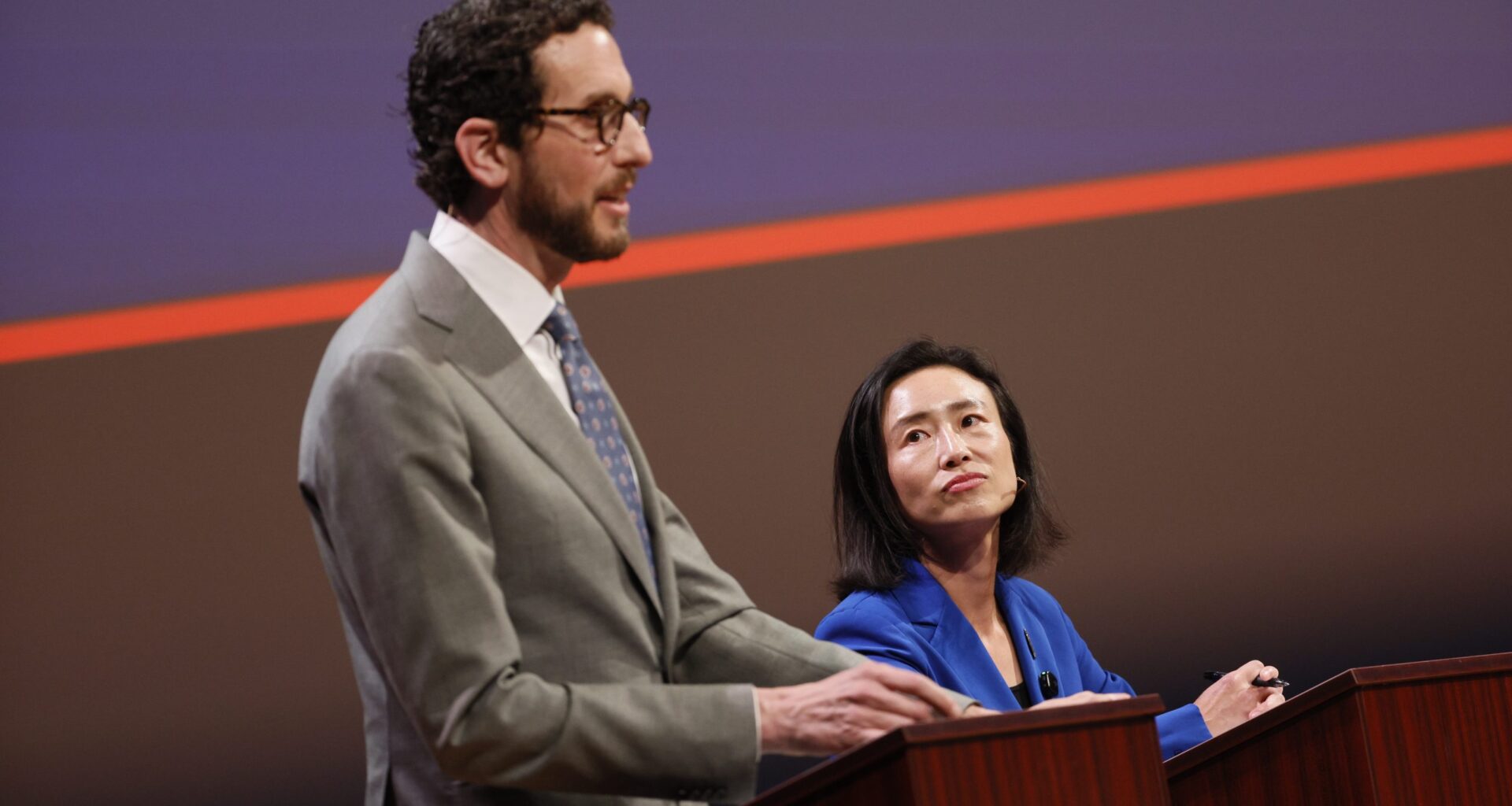
Overnight, AI has become a central issue in the San Francisco congressional race, and at Thursday’s forum, both candidates made the case for why they would be the better regulator.
State Sen. Scott Wiener pointed to the AI regulation he has already passed. SB 53, approved in 2025, protects whistleblowers at AI companies, requires companies to report safety incidents to the state, and requires AI developers to publish their safety plans.
“I was the first state legislator in the country to introduce legislation to regulate AI for safety,” Wiener said to the audience at KQED’s headquarters in the Mission District. “It’s a strong law and it’s just the beginning.”
Supervisor Connie Chan tried to undercut that experience by calling Wiener untrustworthy because an AI-backed PAC is supporting his campaign.
“Can we actually trust politicians who are bankrolled by the AI industries to also write legislation to regulate the industries? The answer is no, we cannot,” she said.
While the candidates largely agreed on what kind of AI regulation is needed — independent safety checks and human oversight — the topic remained front and center at the debate co-hosted by KQED and the San Francisco Chronicle, and moderated by their reporters Marisa Lagos, Scott Shafer and Joe Garofoli.
Answers to four of the 10 questions touched on AI, offering a strong indication that it will continue to take center stage, joining the campaign’s earlier playbooks that focused on searing criticism of Donald Trump, addressing the affordability crisis, the cruelty of the American healthcare system, and pleas for progressive taxation.
The pivot began on Sept. 8 when AI researcher Jacob Coxon resigned from Anthropic, accusing AI labs of “gambling with our lives.” His post on X went viral, setting off a news cycle in which, all the sudden, government regulation of AI became the biggest political story in America.
Chan and Wiener’s campaigns quickly adjusted. Wiener trained his canvassers to be fluent in the minutia of AI safety, while Chan took to social media, posting her “late-night thoughts on the future of AI.”
On Thursday night, Wiener defended the $500,000 that Public First Action gave to a PAC supporting him. The Anthropic-funded organization advocates for AI regulation and was founded in opposition to other AI-industry PACs, which spend against candidates who want regulation.
If anything, Wiener said, that support is evidence that he will effectively regulate AI. “The people who are most focused on AI safety, they’re supporting me because they know that I have done the work to regulate AI, and that I will do the work in Congress,” Wiener said.
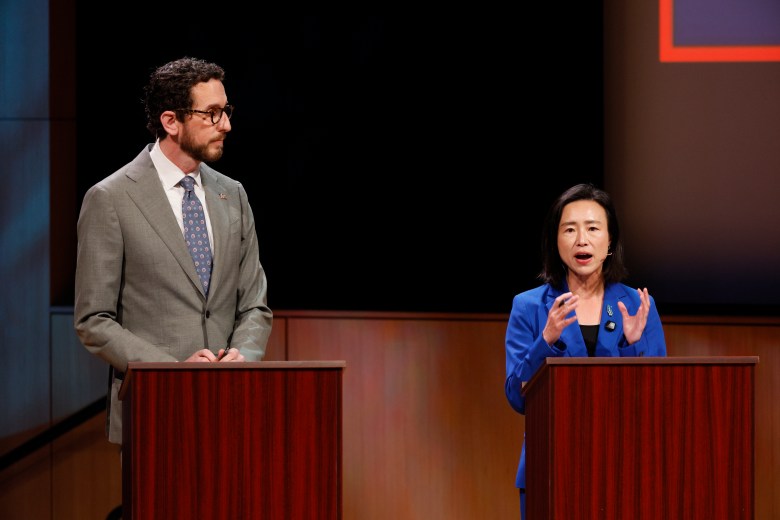 From left: State Sen. Scott Wiener and San Francisco Supervisor Connie Chan debate at KQED in San Francisco on Thursday, Oct. 1, 2026. The two Democrats are running for California’s 11th District, a seat Speaker Emerita Nancy Pelosi is leaving. The debate was co-hosted by KQED and the San Francisco Chronicle. Santiago Mejia/S.F. Chronicle/Pool.
Chan also accused Wiener of hiding who had shaped the amendments to his AI law, calling the final version “watered-down.”
Wiener tried to pass a more stringent AI-safety bill in 2024, but Gov. Gavin Newsom vetoed that bill.
“To refer to SB 53 as ‘watered down’ is a joke,” Wiener retorted. “Multiple states have literally cut and pasted this law and then built on it. … Other states don’t think it’s watered down. All the tech companies that tried to undermine and sabotage SB 53 don’t think it’s watered down.”
“It’s very easy when you’ve never lifted a finger for AI safety regulation to armchair-quarterback it,” Wiener added. “That’s fine. That’s politics. But I’m proud of the work that we’ve done.”
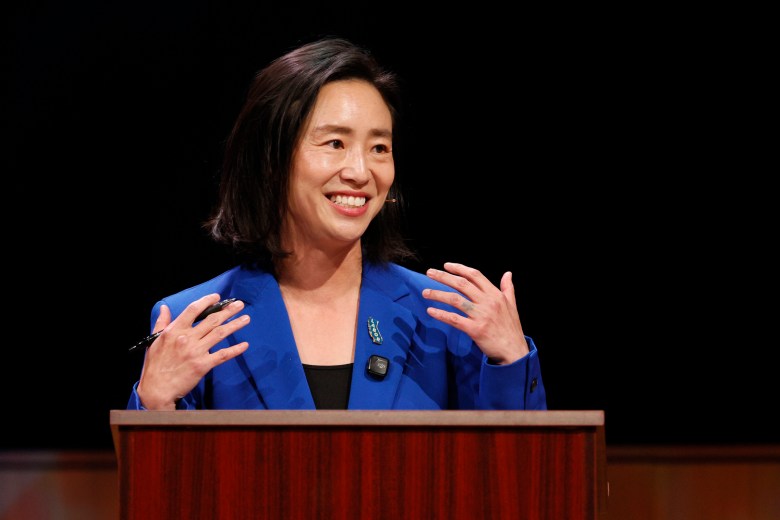 San Francisco Supervisor Connie Chan during her debate with State Sen. Scott Wiener at KQED in San Francisco on Thursday, Oct. 1, 2026. The two Democrats are running for California’s 11th District, a seat Speaker Emerita Nancy Pelosi is leaving. The debate was co-hosted by KQED and the San Francisco Chronicle. Santiago Mejia/S.F. Chronicle/Pool.
AI also came up because of the chatbot that Wiener’s campaign released in August. It was intended to be a parody of Chan that highlighted her history of opposing housing and transit projects.
But Chan accused it of sexism for “putting words in my mouth,” and racism because prompting it with “accent” made it say, “my San Francisco accent is so thick I can barely understand myself.”
Amid criticism, Wiener took the bot down, and at Thursday’s debate, he apologized to Chan.
“It was a terrible mistake, which is why we took it down, and why I apologize,” he said.
Chan and Wiener also responded to a question about ensuring that the United States stays competitive with China in the AI race.
Chan rejected the premise of the question.
“We should not allow the AI industries to pit our country, United States, with other countries in the name of competition,” she said. “It should not be in the framework of competition, but the framework of protecting our future, protecting our humanity, and protecting our workforce.”
Wiener called for cooperation between the United States and China.
“We do not need some mega arms race where we’re just like, ‘Who’s going to be the first to potentially melt down the world?’” he said.
He compared the situation to the U.S. and Soviet Union reaching agreements on nuclear arms, even though “that was a much more contentious relationship.”
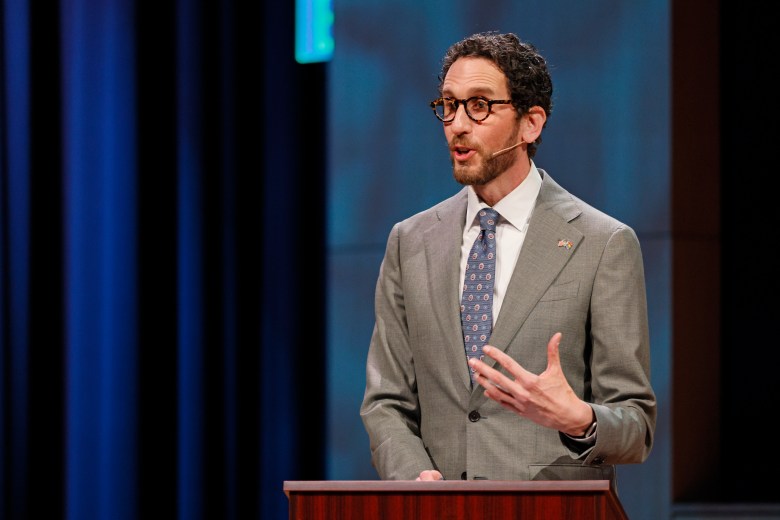 State Sen. Scott Wiener during a debate with San Francisco Supervisor Connie Chan at KQED in San Francisco on Thursday, Oct. 1, 2026. The two Democrats are running for California’s 11th District, a seat Speaker Emerita Nancy Pelosi is leaving. The debate was co-hosted by KQED and the San Francisco Chronicle. Santiago Mejia/S.F. Chronicle/Pool.
“China is a rival, economically and otherwise, and that’s okay, that is normal, but we have an obligation to work with China on AI safety, on climate, on so many different issues,” Wiener added.
Though much of the debate focused on AI, Lagos also made the candidates tighten their positions on military aid to Israel.
“In the past, you’ve said defensive military aid, such as funding for the Iron Domem should be packaged with humanitarian aid in Israel. Your campaign has said recently that you support a full arms embargo. Which is it?” Lagos asked Chan.
“Because it has changed,” Chan said, explaining that, to her, it’s become clear that even when aid is conditional on a ceasefire or humanitarian aid, the Israeli government is “time and again, violating the rights and committing a genocide and pushing forward the apartheid state.”
Wiener, for his part, was asked whether he would be open to restarting aid to Israel if a new government came into power, which he has previously said should be considered.
“There’s an election happening in about a month there. If Prime Minister Benjamin Netanyahu’s coalition loses, does your position change at all in terms of what aid you think America should be selling or giving to Israel?” Lagos asked.
This time, Wiener said no. “This government, and it’s not just Netanyahu, is an absolute abomination, in my view, in terms of what it has inflicted on Gaza, in terms of Israel empowering settler violence and land grabs in the West Bank.”