
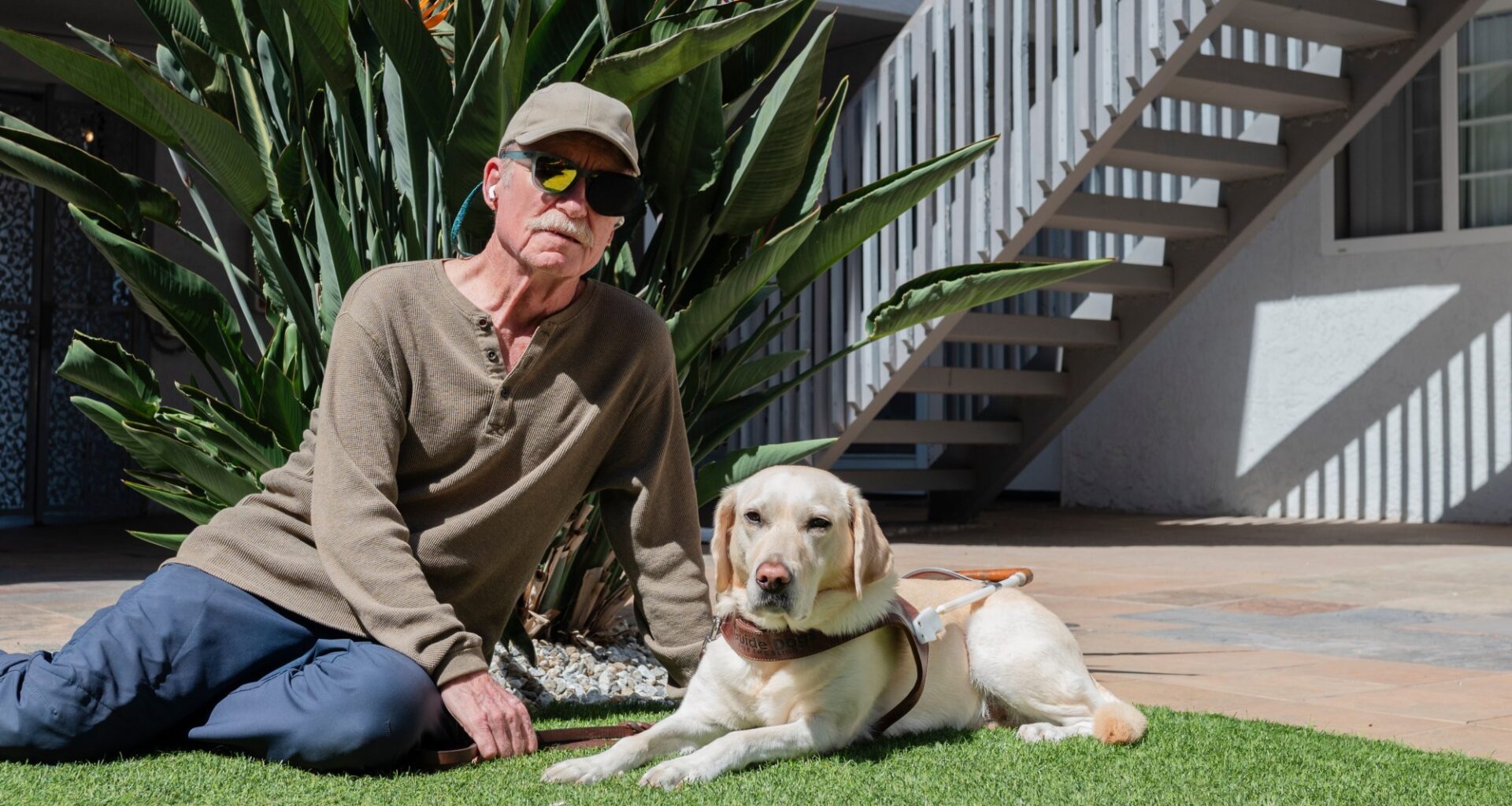
Ron Peterson learned so much from his dad, but three things continue to reverberate for him today: a love of science and how things work, a love of nature and finding happiness in life comes through being kind and helpful to other people.
He applied each of those things to earning his bachelor’s, master’s and a doctorate in mechanical engineering from Virginia Polytechnic Institute and State University (Virginia Tech) before going on to work for the U.S. Navy as a civilian in marine vehicle dynamics and human systems research and development, or “how to make marine vehicles go fast, and making them safe for everyone on board.” In 2019, after retiring five years earlier from a nearly 40-year career with the Navy, his glaucoma had progressed to the point of needing a number of surgeries, resulting in the loss of more than 90% of his vision in both eyes. He estimates that he’s about 97% blind now, with the ability to see some light and dark areas with his right eye.
“I lost my vision and something really amazing happened. I was in quite a hole, but it was almost a gift because I realized the way for me to crawl my way out of this hole was to combine my engineering background and skills, as problem-solving skills — that’s what engineering is,” he says. “Combining that with my newfound understanding of blindness, and it was a perfect fit. I could come out of retirement and still practice my engineering background, but now for a really great cause where I felt like I was really making a difference for people in need, as opposed to building ships and weapons and such for the Navy. If somebody said I could have my vision back, I’d have to stop and think because it has opened a new door for me and given me a new life’s purpose.”
Today, at 75, he’s fulfilling more of his father’s advice to be helpful to others through his work as an independent consultant on assistive technology for the blind; as an adjunct faculty member at the University of San Diego where he teaches a class on assistive technology for the blind with co-instructor Susan Lord; and as a docent at the Tijuana River National Estuarine Research Reserve and volunteer instructor at the Braille Institute San Diego Center and the San Diego Center for the Blind. His consulting work has included the Tijuana Estuary NaviLens Accessibility Project — alongside estuary staffers Haley Calhoun and Jessica Looney, and USD professor Odesma Dalrymple and her engineering students — to make the nature reserve more accessible to the blind through the use of NaviLens, an accessible signage system for blind and low vision users. He’s also consulted on the development and launch of the app, Step Navigation, developed by Paul Ruvolo, a professor of computer science at the Olin College of Engineering in Massachusetts.
Peterson, who lives in Imperial Beach with his wife, Darcel, and his guide dog, a 5-year-old petite yellow Labrador retriever named Gidget, took some time to talk about learning to live without his eyesight, and his desire to make San Diego more accessible for everyone with a disability.
Q: In 2019, you lost your vision due to glaucoma. What were some of your initial thoughts about what this meant for you, when you were first diagnosed?
A: It was a shock. I was just sort of in denial, like, ‘This can’t be.’ I was really depressed and confused and frightened. I just couldn’t imagine how I could possibly do all my volunteer work, like at the (Tijuana) estuary, for example.
I didn’t know the first thing about how to be blind, but I knew that blind people had a white stick, better referred to as a white cane. How do I get one? I had no idea, so I grabbed an old golf club, cut the head off of it, painted it white and wrapped red tape around the bottom. Now, I have a cane, but it was way too short. It came up to my waist and it ought to come up to about your nose. I used that for a while, and then one day I was at the senior center with this ridiculously short golf club stick, and a lady said, “Have you heard of the Braille Institute?” I’d probably been blind for three or four months at that point, so I went to the Braille Institute (San Diego Center), and I also heard about the San Diego Center for the Blind. That was my turning point. That’s when I realized that I could still do things without vision. I started learning how to use a computer and how to use a phone without vision. I could come out of retirement and put my engineering background and my blindness together. By then, I was starting to understand what the different needs of the blind are, so I understood blindness and I had this engineering background. At the Braille Institute and San Diego Center for the Blind, they taught me how to use the computer, and that just put it all together. That’s where I very quickly started to spend hundreds — probably a couple thousand — hours investigating assistive technology for the blind, and that’s when my new career kind of began. I’m putting the engineering with my blindness, along with my newfound ability to actually use the computer, so I can research again.
What I love about Imperial Beach…
It’s quieter, it’s a little bit less expensive. There are lots of fun things to do, like the estuary. We have this incredible little apartment and a balcony overlooking the Pacific Ocean, right across the street. There are all kinds of little pizza shops and taco places, friendly people, car shows. We love it here. My wife and I have been all over the country, and we just don’t know of a place we’d rather be retired in.
Q: What were some of the different needs of the blind that you began to understand?
A: Using the computer and the phone. I can do almost anything on my phone that you can, it just takes me longer. I can do almost anything on the computer that you can, but it takes me longer. So, using the computer and the phone were huge. Then, finding my way around, working in the estuary. How can I do my volunteer work? I was so used to working at the estuary and clearing trails, so that was a huge loss. I would go to the estuary with my blind cane, and I tried to help people as I used to on the trails, and I was a burden more than a help. It was so depressing; finding my way around, walking across streets and not knowing how to be safe crossing streets is scary. It’s really scary crossing the streets as a blind person when there’s traffic, and these are all skills that you can learn at the Braille Institute and the San Diego Center for the Blind. I learned how to use the white cane, I learned how to cross streets and be safe, I learned how to use the phone, I learned to ask questions and get help. I love to read and I just started listening to books, that was a pretty easy one. It’s not nearly as nice as reading a book with your eyes, but it’s a whole lot better than not reading at all. One thing I didn’t learn was braille.
I lost my vision at a kind of a turning point where assistive apps for the blind have really matured. I was always technically inclined, and apps, and now AI, have reduced the need to learn braille. It’s very hard to learn braille, especially when you’re older. And, the technology has evolved, so it’s not as necessary.
Q: How would you describe your relationship with your guide dog, Gidget, and what your days together generally look like?
A: We’re never apart. The only time was during an operation I had about a year ago, and they said she couldn’t go in the operating room. That might be one of the very few times that I’ve been away from this dog. She goes in restaurants and on airplanes, and she lies between my feet on the floor. I go into the bedroom, she goes to the bedroom. I go in the bathroom, she comes into the bathroom. She’s so loyal, so loving. She’s just a very loving, gentle, well-behaved dog. When I put that harness on her, she turns into a guiding machine. We’ll walk down the sidewalk and I can totally depend on her to walk around obstacles, or to stop if there’s an obstacle she can’t walk around, or to stop at curbs. The two things that blind people fear most are going up and down curbs, downstairs and upstairs, because you can fall down a curb into the traffic. Or, when you go up, you can trip and fall on your face. When you approach stairs, especially going down, you can really get hurt. In four years, this dog has never once failed to stop me at an obstacle, not once. She’s totally dependable. I love this dog.
Q: You lead the “Eye Opening Experience Without Sight” nature walk at the Tijuana Estuary. What was your process for developing this walk? What was important to you to include and convey to participants? What happens on these walks?
A: There were three or four years where I volunteered at the estuary clearing trails and planting native plants, and removing invasives, until 2019 when I couldn’t do that work anymore. But, I had learned my way around the estuary like the back of my hand, and I’d learned to identify maybe 25 or 30 plants because I’ve always been interested in nature. After about six or eight months in 2019, I sat down with a couple of the staff there, and we kind of jointly came up with the idea of teaching people to identify plants by smell and touch, and I’d become a docent. There are 130 hours of training to become a docent, so I did the training and spent a few months learning to identify about 38 different plants just by touch and smell. I began this nature walk called “Eye Opening Experience Without Sight,” (about three years ago) and it had become quite popular. It was a way that I could continue to volunteer at the estuary again, taking advantage of my love of nature and my blindness, and it led to a very unique and popular hike. I’ve probably given this walk to 1,000 people over the past few years. They come at 11 a.m. on the first Saturday of each month (to walk about a quarter mile). I’ve hosted this nature walk to blind groups, as well as many sighted people because, for the sighted people, it’s a chance to appreciate the plants with their other four senses. For the blind people that I take on the walk, it’s the only way that they can appreciate the plants, is with the other four senses. So, it’s expanding the horizons of sighted people, and it’s the only way the blind people can really enjoy the plants.
I find my way to a plant and talk about the bladderpod, tell them to smell it, to feel the plant, to shake the pods and they rattle. The Fremont cottonwoods, when the wind blows, the leaves shake and tap into each other, creating the sound of falling rain. If you stand below cottonwoods in a breeze, you hear what sounds like falling rain, even though it’s a hot, summer day. Then, there are bees that buzz in the lemonade berry; the sound of the bees, the sound of the bladderpods, the sound of the Fremont cottonwoods. There’s the smells. So many of the plants have wonderful smells. We’re not supposed to eat the plants, but if you were to find some, the berries on the lemonade berry taste like lemon drops. The bladderpod has kind of an unpleasant smell and little pods that rattle. Every one of these plants have a different feel, the shape of the leaves, the texture, the shape and feel of the bark. I’ve learned to identify at least 38 or 39 plants just by walking up to it and touching it.
Q: In leading the work on the yearlong effort to turn the Tijuana Estuary into an accessible nature reserve, with an emphasis on blind accessibility, what are some of the changes or additions that you prioritized in order to make the estuary accessible to the blind?
A: I’ve been studying all these different technologies to make different venues accessible, and there’s something called a NaviLens code. It’s like a very high-tech QR code, except it’s color, and you can see them from a long way off, and they will guide you. These codes can be read from up to 90 to 100 feet away, and the app will guide you right to the code. You can program the code to give you all kinds of information on your phone. You can play videos, you can hear text descriptions, and so forth. These codes are also used for product identification, so you can find them on products at Walmart or Target.
I’ve been consulting with NaviLens for a couple of years, trying to figure out how we can expand the application of NaviLens for a nature reserve. We’ll post the NaviLens codes at about 10 different native plants, so when a blind person or sighted person walks along, all you have to do is get within 15 or 20 feet of that plant, and the app will guide you to it. Once you get to the plant, you push a button and it’ll give you a description of the plant, play a video about the plant. I would call that digital interpretive signage in the form of a NaviLens code, so a blind or sighted person can learn all about that plant. We also have another 20 or so NaviLens codes that we mounted every couple hundred feet along the McCoy Trail. A blind person can now walk along, kind of leapfrogging from code to code, and follow the trail to a cool overlook. Each time you get within 100 feet of a code, you hear it announce and guide you through that code, and you can start listening for the next one. I would call that trail guidance, or navigation; those are the purposes of NaviLens.
We’ve made the estuary accessible for the blind, and we’re also working very hard to expand that accessibility to the deaf and hard of hearing. We haven’t done it yet, but we’re working on picture-in-picture American Sign Language being embedded in the videos. We’ve already added closed captions to the videos, but we also want to add ASL. We’ve also improved the trails to make them more wheelchair accessible, and we’re trying to accommodate mental health disabilities and neurodivergent persons by setting aside quiet places for someone to sit and listen to the birds without a lot of people around. We’re trying to cover the spectrum to make it accessible to the vast majority of the disabled community, not just the blind. What I’d like to see is expanding the application of this system to more places in the county, like Torrey Pines and other outdoor nature areas, parks, and such.
Q: You’ve mentioned that this past year, you’ve expanded your technical interest and studies to support the broader disabled community. Can you talk about the kind of impact that your own experience has had on your perspective on accessibility for the disabled community, compared to what that perspective may have been before experiencing vision loss?
A: It made all the difference in the world. My only exposure to a blind person, prior to me losing my own vision, was a blind English professor that I had in college my freshman year. When you lose your vision, suddenly you notice these people, and you notice the struggles they have. There are about 7 million people in the U.S. who (have vision impairment; including 1 million who are blind, according to the U.S. Centers for Disease Control and Prevention), and you don’t see them very much because the world is not very accommodating. There are so many barriers for the blind in this country that it’s just hard for blind people to move around in buildings, between buildings. That’s one reason they stay home and we don’t see them. My entire life’s purpose right now is to make more places accessible to the blind, and also those with other disabilities. Once I became disabled, I noticed them more, but I also understood their needs more because there’s no one that understands the needs of a blind person better than a blind person. All of the different systems that are built, all of the work that’s done – apps, devices, cars, anything that might be used by a blind person – a blind person should be involved in the design because it’s blind people who understand the needs of the blind better than sighted people. So, blind people should be involved in the design of systems that the blind might use.
Another project I’ve been working on for four years with a professor of computer engineering at the Olin College of Engineering in Boston, is developing an app called Step Navigation for helping blind people navigate indoors and outdoors. At USD, this app worked for the blind on campus because, I’m blind, we have blind students and blind visitors who come to campus, and we all struggle to find our way around. I want to use NaviLens and Step Navigation, and other apps, to make Balboa Park more accessible to the blind. I’ve been working with a couple of students to make the campus accessible using Step Navigation. You have to map the campus, and they usually have students helping me because you can’t map the campus with the app if you can’t see. Once you map it, then people can use the app and find their way, but first you have to map the campus. I can’t see, I was on the campus running around, and didn’t have a student helping me. I was trying to learn what buildings were where, so we could label it with the app. I walked up to a big door and stepped inside. Usually, I’ll hear students and I can ask where I am, what building I’m in. I didn’t hear anything, so I yelled out, “Hello! Anyone here?” I yelled it real loud, and nothing. Then, I hear these footsteps – click, click, click, click-coming toward me, and this lady gets closer and says, “Shhh!” I’d walked into the church on campus, yelling out during mass. The lesson here is that if the campus and that church had already been mapped, I wouldn’t have made that mistake. That’s one of a thousand problems that a blind person has if he can’t see.
Q: What is the best advice you’ve ever received?
A: When I was about 10 years old, I went through a very difficult time, a period of about six or eight months of depression. I remember crying every night, and my dad sat down with me one night and said, “Here’s the key to happiness. Just devote your life to helping others.” I wrote that down on a piece of paper, and I carried that with me for years until it was just shredded, and I’ve followed it ever since. I’d have to say that was the best advice I’ve ever had, is to put other people first as a means of creating a full life.
Q: What is one thing people would be surprised to find out about you?
A: That I can use a computer and phone almost as well as anyone.
Q: Please describe your ideal San Diego weekend.
A: Oh, that’s easy. I love Balboa Park. One of the things I want to do is make Balboa Park accessible; I want to do to Balboa Park what we did to the Tijuana Estuary. I love the little international cottages, I love the roving performances, I love walking up and down the Prado. I love the museums, and the science museum. I love that place, but it’s hard for me to navigate there.
To suggest a notable San Diegan for the One-on-One series, contact Lisa Deaderick at lisa.deaderick@sduniontribune.com.