
Department chairs at San Francisco State University left the University Budget Committee meeting last Thursday with more questions than answers after Associate Provost Carleen Mandolfo and Vice Provost Michael Scott updated members on changes to the Office of Academic Affairs’ new time base policy for future incoming chairs.
The basic formula, first introduced last spring to the University Chairs’ Council, calculates the share of department chair workload between chair duties and regular faculty duties and helps determine their salaries.
A department’s share of the total 26 Full-Time Equivalents is weighted on measures of a department’s number of tenure or tenure-track faculty (30%), students in major or credential programs (25%), full-time students (20%), lecturers (20%) and full-time staff (5%).
Employers use FTE to calculate workload and anticipate labor costs based on total hours worked. In this case, 1 FTE equals 40 hours of chair-related work, or full-time equivalency.
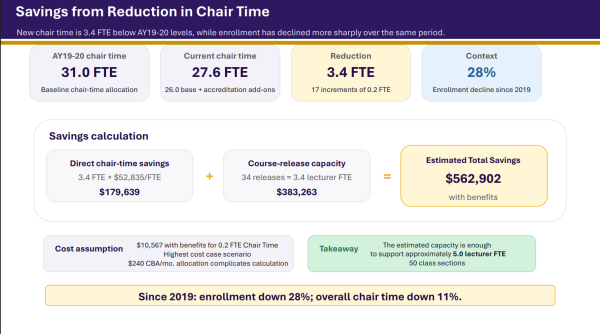 The University Budget Committee projected FTE workload for each department chair, presented at the UBC meeting on Thursday, Sept. 24, 2026. (SFSU University Budget Committee)
The provosts say the latest version of the algorithm introduced last Thursday uses the same method to produce the same results while being more “Excel-friendly.”
The Office of Academic Affairs allocates a total chair time base of 26 FTEs across 60 departments, an 11% decrease from the historically allotted 31 FTEs. According to Mandolfo, that figure had gone unchanged for decades despite a 30% enrollment decline since 2019.
“We had a very inequitable system,” Mandolfo said. “Many departments where enrollments had increased, the number of faculty had increased, some of them drastically, those chair time salaries had not been adjusted.”
Back in 2019, then-Provost Jennifer Summit urged the deans at SFSU to address this lack of even-handed allocation of department chair workloads. While the 2020 COVID-19 pandemic hindered initial progress, work on creating a simple, transparent calculation formula resumed in fall 2024 at the urging of department chairs and Provost Amy Sueyochi.
Mandolfo, along with a working group of deans and “budgetary input” from Scott, ultimately decided to implement an existing formula already in place at several campuses across the California State University system, while working with deans to determine weighted measurements unique to SFSU.
Scott, who oversees the academic affairs budget, projects nearly $563,000 in savings from this 11% chair time base reduction, which he says better reflects the campus’ ongoing budget crisis.
“If I don’t reduce here, then I have less money to fund lectures, which then means less classes for students,” Scott said. “It’s a zero-sum game. We have limited funds, so we’re looking for a little bit of cost savings so we can make sure we have the ability to teach students.”
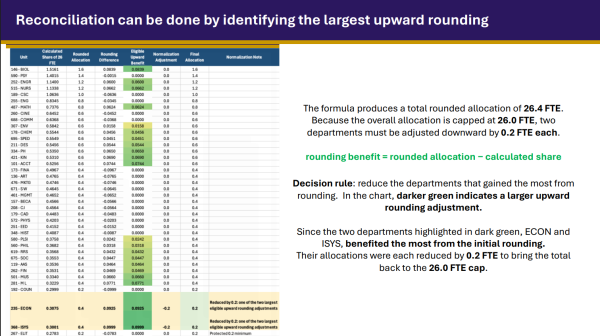 The University Budget Committee displaying the projected savings from the reduction in FTE workload for department chairs, presented at the UBC meeting on Thursday, Sept. 24, 2026. (SFSU University Budget Committee)
During the presentation, Scott demonstrated a scenario in which shares of the total 26 FTE pool are released in increments of 0.2 and 0.4. After rounding departments with odd-numbered shares upwards, he produced a total of 26.4 FTE.
Because the total chair time base is capped at 26 FTE, Scott adjusted two departments that “gained the most from rounding,” namely economy and information systems, downward to 0.2 FTE, frustrating their respective heads.
“This is a quandary about having such rigid 0.2 and 0.4 allocations,” Scott said. “It’s just a factor of this rounding, and we had to then correct it to be at the budget.”
Only four department chairs receive over 1.0 allocation, the department of biology having the largest slice of the pie with 1.6 FTEs, equivalent to 64 hours of administrative work a week.
Biology interim co-chairs, Dr. Blake Riggs and Dr. Robyn Crook, declined a request for comment due to ongoing chair elections.
Michael Bar, outgoing chair of the economics department, feels that an initial lack of clarity on the specific calculations of the new chair time base formula hindered his ability to elect his successor and ensure a smooth transition of power.
“They should not have revealed this information piece by piece or very late,” Bar said. “There is a transition. The outgoing chair has to explain some of the operating procedures to the new chair. We did not have that opportunity.”
Mandolfo recommended last spring that outgoing chairs delay elections because candidates would not yet “have the full picture” of what their salaries might look like under the new time base policy.
“There’s many reasons why departments don’t hold their chair elections right on time,” Mandolfo said. “It wasn’t really hurting anybody. Yes, it would have been ideal if as an institution, we would have been all done with everything and had it all wrapped up, but we weren’t there yet.”
Dr. Leigh Jin, chair of the information systems department, shares similar concerns with the new policy, saying that the weighted measures don’t comprehensively reflect her workload.
“What I do is definitely above and beyond the 0.4 time base, but it’s now reduced by half,” Jin said. “That is basically you’re telling the chair is, ‘don’t do a good job,’ and if chairs don’t do a good job, how do you expect the students will have a wonderful experience studying in this field?”
The academic affairs office says they are working with human resources to allow a one-year grace period before incoming and re-elected chairs see salary adjustments in line with the new formula.
Moving forward, Jin hopes for more direct input from chairs, suggesting that the weighted measures could be modified according to chairs itemizing their workload to better inform the formula of all that running an academic department encompasses.
“We need to support the faculty because ultimately, the student experience is delivered by them,” Jin said. “The more shared governance and faculty involvement in this important decision-making is very essential for the health of San Francisco State University and to make sure that our students have a wonderful experience on campus.”
Bar also believes that the hard FTE cap muddies the waters of simplicity, contradictory to the original intent of the academic affairs office in introducing the policy.
“Having such a complicated algorithm that you insist on rebalancing to exactly 26 [FTE], you put yourself in a corner,” Bar said. “That kind of precision, in theory, is supposed to be simplifying the practice, but in reality, it’s needlessly complicating things.”
While Mandolfo ultimately believes the formula is a step in the right direction towards much-needed transparency in how chair time bases are calculated, she sympathises with chairs’ concerns as a former department head herself and remains committed to tweaking the policy year-after-year to improve fairness.
“There are these factors that you can’t quite quantify, but there has to be some way of transparently measuring chair workload,” Mandolfo said. “This is our first year we’re rolling it out. Let’s look at the bumps. Let’s look at where we should tinker and make some adjustments, which we will do next year. We already have some ideas where we need to make some adjustments.”