

Electrician David Collins describes living in California and the Bay Area like he’s composing a love letter.
“It’s something about the magic in the air of this state, the land,” Collins said. “If you go into the Sequoia National Forest, you smell that little spicy scent that doesn’t exist anywhere else. From the phosphorescent algae in the middle of the night on the ocean, to the giant pumas all around here. It’s all so close to Silicon Valley, it’s just unbelievable.”
RELATED: Bay Area residents say their own lives are on track. The region is another story
But Collins’ ode to the place his family has called home for five generations comes with an unexpected ending: He is making plans to leave it.
 “I’d love to stay. I worked seven days a week trying to save money to buy a house, and it just kept being unattainable,” the 53-year-old said. “How am I going to retire?”
Like Collins, a Redwood City resident, people across the Bay Area are feeling the emotional turmoil between loving it here and leaving it.
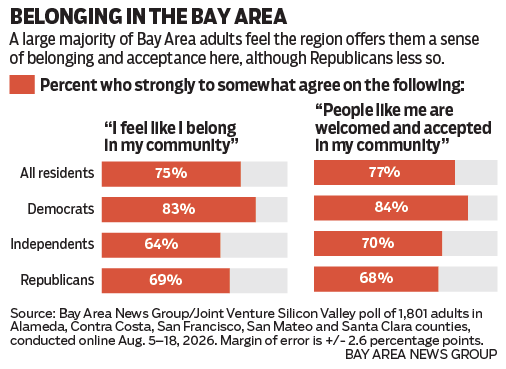
In the Silicon Valley Poll, conducted by Embold Research for Joint Venture Silicon Valley and the Bay Area News Group, 75% of the 1,801 adults surveyed said they feel they belong in their communities and 77% said people like them are welcomed and accepted. Yet nearly half said they are likely to move out of the Bay Area in the next few years. Even among those likely to leave, 66% said they still feel they belong.
The share saying they are likely to leave declined from 56% in 2021 to 43% last year before ticking up to 46% this year. This is the first year pollsters asked about residents’ sense of belonging.
The findings reveal two different pressures pulling residents away from a place many still consider home: Some no longer see a financially sustainable future here, while others feel increasingly alienated from the region’s politics and direction.
Fifty-one percent of renters said they were likely to leave, compared with 39% of homeowners, as did 52% of residents unable to consistently cover expenses and save, compared with 41% of those who could.
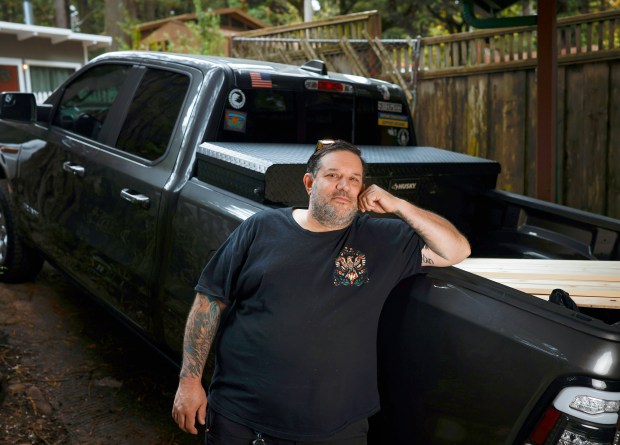 David Collins, 53, stands by his work truck at a house he is working on in Woodside, Calif., on Thursday, Sept. 17, 2026. David, an electrician, is a 5th-generation Californian who is considering moving because of affordability. (Shae Hammond/Bay Area News Group)
“What they’re concerned about is our inability to solve our basic problem, which is housing — housing and the high cost of living here,” said Russell Hancock, president and CEO of regional think tank Joint Venture Silicon Valley. “That’s what’s driving people out.”
At the same time, there’s a noticeable political split in this largely blue state — 83% of Democrats feel they belong, compared with 69% of Republicans. Republicans are also much more likely to say they may leave in the next few years: 64%, compared with 36% of Democrats.
“Democrats feel very comfortable here and Republicans, of which there are more more than a few, are feeling less comfortable here,” Hancock said. “It might be making them feel estranged, especially if it becomes too — I’m using air quotes — too woke.”
In interviews with this news organization, Bay Area residents who took part in the poll — from a 59-year-old widow to a 26-year-old tech worker — explained the opposing forces tugging at their heartstrings and purse strings.
Home economics not penciling out around the Bay Area
Gina Bidinger lives in a $2,600-per-month, two-bedroom, one-bath apartment in Alameda with her youngest daughter, Karina, who is 24, and her 76-year-old mother, Irene. Recently laid off from her business manager job at an auto dealership, she is getting serious about moving.
“It’s a little hard to make that decision to move out of California, because this is really all I’ve ever known,” said Bidinger, 59. “The only thing that really holds me back is my children that are here.”
Still, she can rattle off rents she reviewed across the country, where she can get twice as much for less than half the cost. In Virginia, where one of her six children just had a baby, she spotted a two-bedroom, two-bath apartment with a washer and dryer for $900 a month “in a decent neighborhood.”
In Las Vegas, where she and Karina have contemplated moving together, they looked up a house with a pool for $400,000. She even looked in Texas.
“You could get a mansion for $300,000, I mean, literally, like a six-bedroom, four-bath house for $300,000,” she said.
Even gas is half the price.
It’s all so tempting. But for this Bay Area native who hosts every family birthday party, every Christmas, Thanksgiving and New Year’s, leaving would mean moving away from her seven grandchildren and her mother, who doesn’t want to move and is on a waiting list for affordable senior housing.
As a multiracial woman, Bidinger worries she might encounter overt racism in some of the less diverse, more conservative places she has considered moving — something she said she has not personally experienced in the Bay Area.
“That’s been my biggest fear,” she said.
But when she visited her daughter this summer in Virginia, she was pleasantly surprised by its diversity. “It’s not as bad as I thought.”
Deep blue state not blue enough to keep them
Jervani “Xa’miel” Thompson has been on the move since childhood, from South Carolina to New Mexico, to college in Colorado and Texas, and on to jobs and grad school in Michigan, Florida and Washington, D.C.
“So there’s a little bit of melancholy in realizing and understanding that the place that you enjoy and almost feel like you’ve always sought out is, I don’t know, uninhabitable or unreachable in some way,” Thompson said.
Moving to Berkeley in 2023 to work in tech and teach math unearthed their nonbinary identity and “exposed me to what was even possible in myself.” Thompson joined the ballroom dancing and roller skating communities and the burgeoning hyperpop and underground disco scene and became a figure model for artists.
Thompson found comfort in California’s protections for trans youth and immigrants. But disillusionment crept in as the 26-year-old became politically active, protesting the use of Flock Safety automated license plate readers at Oakland City Council meetings and coming to terms with the failure of a ballot measure that would have banned forced prison labor and prohibited corrections officers from disciplining inmates for refusing such work assignments as cooking and cleaning.
“It might be like progressive aesthetic or an onset of veneer,” they said, “but a kind of rightward lurch is still manifesting in California. That was a little bit shocking to digest.”
Indeed, Thompson couldn’t afford to live here, and that was a practical reason for the move. But the main driver was a cascading disenchantment with politics, Thompson said, and “how tech has almost strip-mined the life out the Bay Area.” Earlier this year, Thompson moved to Washington, D.C., to work as a mathematician on satellite systems while pursuing a master’s degree in applied data science at NYU, with a concentration in complex systems.
Thompson returned for a recent visit to participate in a “Queen Out” queer dance party in San Francisco and a Brazilian martial arts capoeira festival in Oakland. The prospect of returning for good remains elusive.
“I have a lot of friends within each one of these niches,” they said, “so leaving that was very heartbreaking.”
 Jervani Thompson, center, takes part in the Festa Da Capoeira event on Sunday, Sept. 20, 2026, in Oakland, Calif. (Aric Crabb/Bay Area News Group)
‘Chasing grandchildren’
If California didn’t have so many scenic wonders, from the mountains of Yosemite to the beaches of Santa Cruz, Steve Franzese and his wife of 49 years would have moved by now.
Most of the lifelong friends they made raising their children in Saratoga have moved away — “chasing grandchildren” whose parents couldn’t afford the Bay Area. Franzese’s own children and grandchildren have scattered to Los Angeles and Brooklyn, with one in San Francisco.
“Those roots and the connectedness are kind of disappearing,” said Franzese, who is 76 and had a successful career in marketing and business development at Apple in its early years and other tech companies after that. It might be time, he said, to downsize from their four-bedroom home.
But there are other gnawing reasons. He finds himself constantly at odds with the direction the Bay Area and the state are going, especially progressive policies like sanctuary cities that protect immigrants without legal status and what he considers excessive taxes. And while he may not agree with those policies, he has tolerated them for years.
“That falls under the category of elections have consequences,” Franzese said. “You put up with it.”
Lately, however, politics has felt more personal.
“The unwelcome mat was rolled out,” Franzese said.
Successful people are “villainized” here, he said, and the Proposition 40 “billionaires tax” on the November ballot, which would levy a one-time 5% tax on people with assets valued above $1 billion “trickles down to everyone else.”
“If that passes, the house goes on the market pretty quickly,” he said.
He and his wife have already looked at real estate in Palm Springs, Lake Tahoe and Scottsdale. Still, the prospect is heartbreaking.
“You get a sense of what the world has to offer and it’s all right here,” Franzese said. “And then you look at the politicians destroying it.”
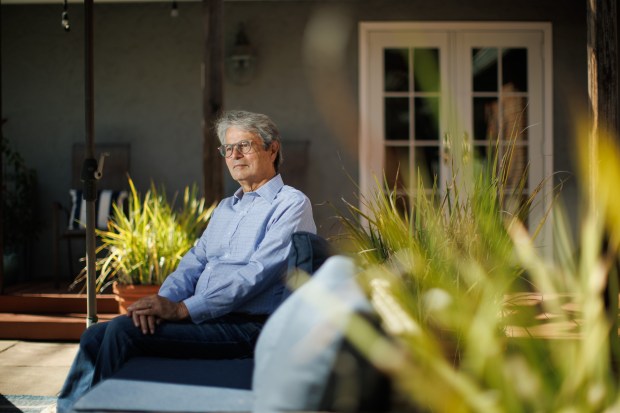 Steve Franzese of Saratoga at his four-bedroom ranch-style home, where he has lived since 1997, on Sept. 28, 2026. (Dai Sugano/Bay Area News Group)
Why staying has become harder
Hancock, who leads the nonprofit that commissioned the Silicon Valley Poll, said it’s up to politicians to solve California’s problems, especially the housing crisis, and believes it’s a good sign that the state is imposing housing requirements on local municipalities.
In many ways, however, the region’s problems seem intractable: The world’s “hottest economy” was built on a narrow peninsula, he said, and voters elect politicians “who make sure that no housing is built in our backyards.” At the same time, he said, “we’re minting new millionaires and billionaires every day, and so you can actually charge these prices (for real estate) and get away with it.”
The region’s affordability drove out his own daughter and son-in-law, who moved to Salt Lake City, where they earn good money and purchased a large home to raise their children.
“You can’t work in retail and own a house,” Hancock said. “You can’t be a nurse and aspire to live here. And so we’re actually not able to blend as healthy communities do. We’ve driven them to the periphery or beyond, and so that’s why it’s getting weird. And what’s left is the culture of the affluent.”
Collins, the electrician, spent his career working on the homes of the affluent and the tech campuses that minted them, and fighting for environmental causes along the way, including during “Redwood Summer” in 1990, when he joined the campaign to stop the logging of old-growth redwood trees.
But supporting six children between the ages of 13 and 31 — most of whom live on the East Coast now — he is living in a one-bedroom apartment with a renter sleeping in the living room. To retire, Collins is considering moving not just out of state, but out of the country, perhaps to the Netherlands, where he has relatives.
“Sometimes the bureaucracy gets out of hand, and they’re not leaving any way for the little guy to really stick around,” he said.
That leaves him with a painful choice.
“I don’t want to give up on California,” he said. “Believe me.”
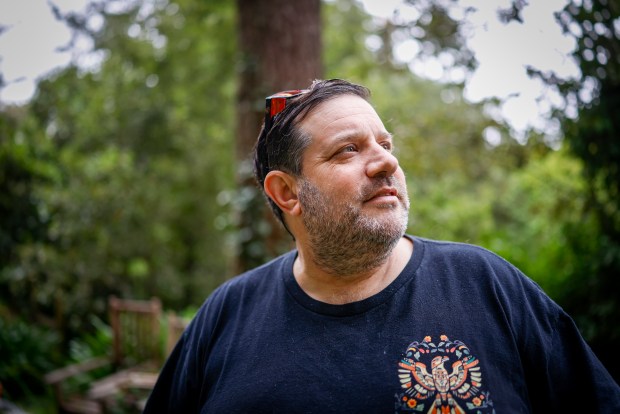 David Collins, 53, looks at the trees in Woodside, Calif., on Thursday, Sept. 17, 2026. Collins, an electrician, is a 5th-generation Californian who is considering moving because of affordability. (Shae Hammond/Bay Area News Group)