
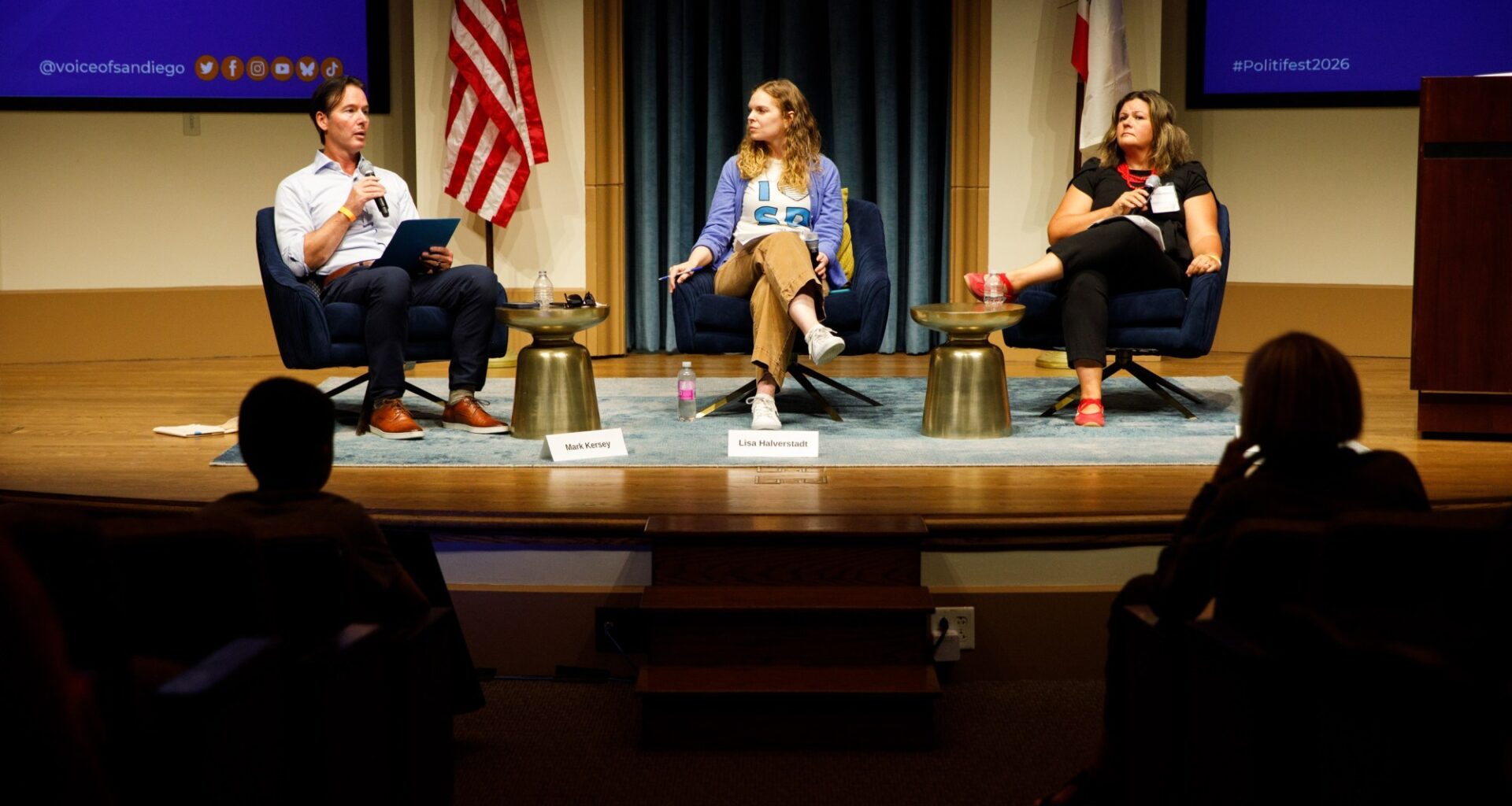
Will a half-cent sales tax hike in San Diego County resolve some of the community’s most pressing issues? Or is it a short-sighted “forever tax” with inconsistent priorities?
These opposing stances marked a spirited debate during Voice of San Diego’s Politifest on Saturday, with a lead advocate for the ballot measure and one of its critics spelling out what’s at stake in the race, just as ballots for November’s election go out over the weekend.
The ballot measure, sponsored by a coalition of labor unions and nonprofit leaders, would bring in up to $450 million a year for county government by raising the countywide sales tax rate from 7.75% to 8.25%.
If passed, the tax hike, known as Measure B, would fund a mix of programs and projects, namely social services, public safety and programs to alleviate the sewage crisis in the Tijuana River Valley.
The ballot measure needs only a simple majority to pass.
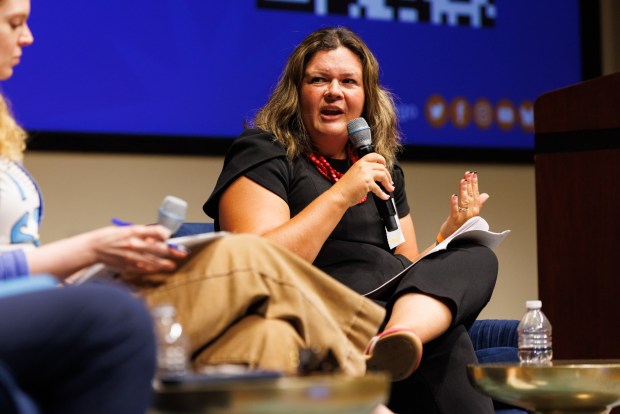 Courtney Baltiyskyy, Director of Children First SD, speaks during a forum on Measure B during Politifest, hosted by nonprofit news organization Voice of San Diego, at University of San Diego on Saturday, Oct. 3, 2026. (Kristian Carreon / The San Diego Union-Tribune)
Courtney Baltiyskyy, an executive at the YMCA of San Diego County who supports the ballot measure, said the county is in a “full-blown budget crisis” and needs more tax money to not only keep up with its responsibilities, but respond to the impact of the Trump administration on the region.
She also leaned heavily on what the measure can do for wildfire prevention and the sewage crisis.
“That’s why firefighters, ER doctors, nurses, environmental advocates and community leaders have come together to offer Measure B as a solution to this multi-faceted crisis,” Baltiyskyy said.
But Mark Kersey, president of the San Diego County Taxpayers Association, countered that neither wildfire prevention nor the sewage crisis account for a majority of what the money raised from the measure will go toward.
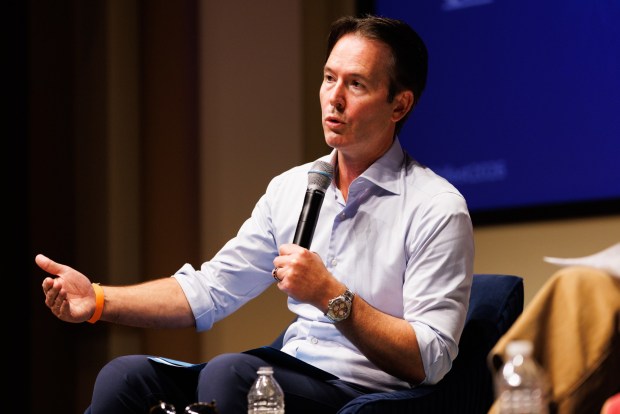 Mark Kersey, CEO of San Diego County Taxpayers Association, speaks at a forum on Measure B during Politifest, hosted by nonprofit news organization Voice of San Diego, at University of San Diego on Saturday, Oct. 3, 2026. (Kristian Carreon / The San Diego Union-Tribune)
In reality, 60% of the money is earmarked to go to county social services, while 22.5% will go toward the sewage crisis and the remaining 17.5% is allocated for public safety.
But Kersey’s leading criticism of the ballot measure is that it goes on in perpetuity.
Many sales tax surcharges passed by voters expire after a set number of years and have to be reauthorized by voters.
The countywide sales tax surcharge has no sunset clause.
What’s more, how the money gets spent has no flexibility, as the law requires the dollars be spent following the expenditure plan adopted by voters.
“That is just bad policy,” Kersey said.
The campaign for a countywide sales tax hike emerged in the aftermath of Republican-led changes last year to social programs like Medicaid, administered as Medi-Cal in California, and food stamps, administered here as CalFresh.
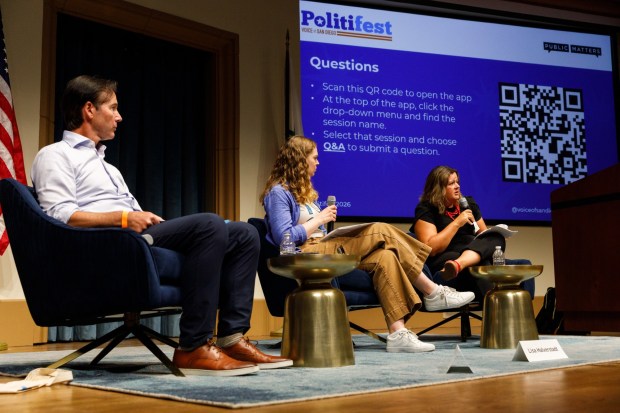 Mark Kersey, CEO of San Diego County Taxpayers Association, and Courtney Baltiyskyy, Director of Children First SD, right, speak at a forum on Measure B during Politifest. (Kristian Carreon / The San Diego Union-Tribune)
Healthcare and anti-poverty advocates worry that stricter rules and work requirements for those programs will result in people getting kicked off of the programs. Reforms to the programs also ban certain immigrant groups from accessing them.
But for Kersey, the motivations behind the ballot measure make little sense if a future Congress and White House controlled by Democrats undo those recent changes.
“Here we are passing a local measure that is imposing this burden of additional sales tax — on an already expensive place to live — on something that may not even be needed two years from now,” Kersey said.
Baltiyskyy responded that whatever a hypothetical Congress might do is years down the line, and even if reforms are made, it would take time to implement them.
“That’s not going to happen overnight,” she said. “We can’t control what Washington does, and we know that Washington may not move on these things in the future.”
Baltiyskyy and Kersey also clashed about how the measure would deal with the sewage crisis, which has throttled South County for decades.
If passed, county officials intend to use monies from the ballot measure to build a treatment plant to capture and treat raw sewage in the Tijuana River.
In September, supervisors green-lighted a preliminary engineering analysis for the project.
“We’re solving what Washington and Sacramento didn’t do for the sewage crisis,” Baltiyskyy said.
But with so much money already pledged by the federal government to fix the pollution, Kersey worries a new county-owned treatment plant would make federal officials less inclined to spend their resources solving the crisis.
“I still feel like (the federal government) should bear the brunt of spending money on it,” he said.
Beyond what the money will be spent on, the debaters also addressed how the ballot measure will raise costs in a region plagued by a high cost of living.
Sales taxes are inherently regressive and place a bigger burden on those with low incomes than they do the wealthy.
“Ironically, the same people that are purported to be helped out by this are actually going to have their taxes go up to help pay for the very thing that’s helping them,” Kersey said.
Organizers estimate that the ballot measure would raise costs by about $200 a year for a family of four, Baltiyskyy said.
“We want to make sure that we are informed and that we are knowledgeable about the impact that this will have on households,” Baltiyskyy said, though she added that the ballot measure would still “significantly benefit” low-income residents the most.
For some, $200 is a lot of money, Kersey responded.
“There are some people who just quite literally can’t afford that,” he said.
The sales tax measure coincides with another countywide ballot measure to rewrite county government’s charter.
That ballot measure, known as Measure A, would extend term limits for supervisors from two, four-year terms to three. If passed, the measure hands even more power to supervisors to shape the county’s bureaucracy, allowing them to confirm and remove a greater number of top county officials.
The measure also creates an ethics commission as well as budget analyst and program auditor offices controlled by supervisors.