
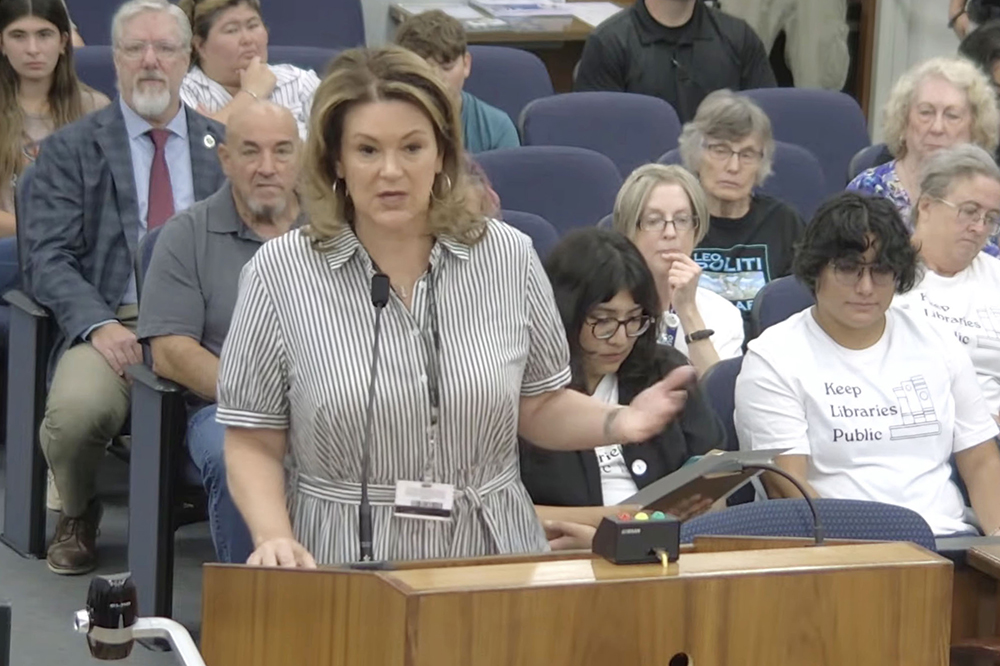
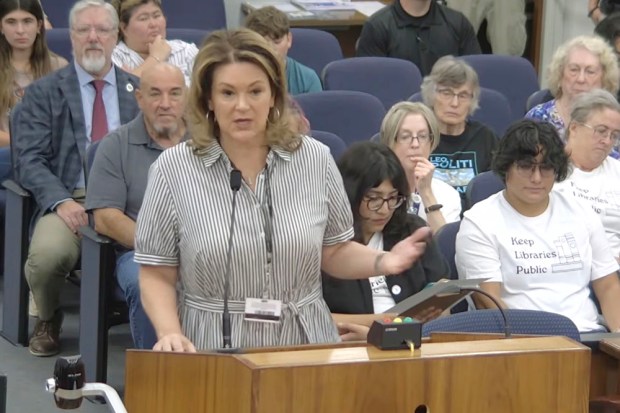
 La fiscal Lisa Smittcamp se dirige a la Junta de Supervisores. Captura de pantalla de la transmisión en vivo
Board Advances Arming of Even More County Employees
At its September 8 meeting, the Fresno County Board of Supervisors unanimously approved the first reading of an amendment to the county ordinance code that would let the district attorney authorize prosecutors and special investigators in her office to carry concealed guns on county property.
The ordinance was brought forward by Chair Garry Bredefeld (District 2), Sheriff John Zanoni, District Attorney Lisa Smittcamp and Supervisor Nathan Magsig (District 5), giving the impression that together they form a tough law-and-order flank. Smittcamp was present to speak about the ordinance, which was triggered by an August 20 incident in which a prosecutor was stabbed in Courthouse Park by a former defendant.
The decision follows a June expansion of a November 2020 “concealed-carry weapon” policy, which allows sitting members of the Board and their staff to carry guns on the job. This vote expanded that permission to the county administrative officer (CAO), county counsel—and, with the CAO’s permission, any other county employee. It was unclear why yet another guns-on-the-job amendment was needed.
Bredefeld described the stabbing incident, shrugging often as he spoke, as though to indicate that the new ordinance was necessary, long overdue, obvious and inevitable.
Smittcamp, noting that the injured prosecutor had recovered and returned to work, admitted that her office was “still developing a policy” regarding guns and workplace safety. If workers carry weapons, they must be trained, she said, raising questions about why such a training and safety policy had not been developed before determining that more employees should be authorized to carry guns.
Smittcamp spoke animatedly and at length about threats and harassment she herself has experienced and about California state policies to which she objected, such as the mental-health diversion law (Penal Code Section 1001.36), a pretrial program that allows eligible people who have qualifying mental-health disorders to receive treatment rather than go to trial or serve jail time.
Smittcamp complained that “people who commit attempted murder are eligible for mental-health diversion” based on a court order, calling it a “state issue” and implying that legal solutions were beyond the county’s jurisdiction. She cited a particular offender, an attorney whose wife is a doctor, who she said often threatens her. Other recent threats, she noted, came from someone she called a “beautiful criminology major” at Fresno State who has expressed opposition to prosecutors carrying guns. “We cannot rely on the criminal justice system that we are a part of to protect us,” Smittcamp said, appearing to make the case for arming her staff based on state laws she doesn’t like or to which she is ideologically opposed.
However, Smittcamp did not mention that the mental-health diversion law has recently been reformed: Assembly Bill 46, signed by Governor Gavin Newsom in June 2026 and taking effect in January 2027, changes the current law by requiring defendants to prove that their qualifying diagnosis was made within five years before the alleged offense, to prevent opportunists from getting a new diagnosis for the purpose of evading criminal charges.
Zanoni said that the demand for concealed-carry gun permission “keeps growing.” He described monthly “mass trainings” of 200 people at the sheriff’s range. He, too, said that “we need a policy,” adding for emphasis, “training, training, proficiency, proficiency.” Again, these disclosures gave the impression that the ordinance was being rushed through without detailed provisions for training and safety protocols. Though Zanoni repeated the false claim that the increased presence of guns “will deter incidents,” he also brought up the county’s potential liability in case of “accidents” but offered no details, raising yet another concern about the prematurity of the ordinance.
Magsig made bold to say that “we will not tolerate crime” and that “we’re very supportive” of those “exercising their Second Amendment rights.”
Supervisor Luis Chavez (District 3), appearing to question the need for the ordinance change but framing his question in a diffident manner, asked Smittcamp if there was “anything else we can do to make sure our folks are safe,” to which she replied that arming her staff with deadly weapons was “just one step.” She mentioned the need to “increase security staff” in the courthouse, which she noted would require more funding, and added that staff must apply to her, as head of the department, for the gun permit.
As these remarks wound down, Bredefeld was heard clearing his throat as though plotzing to speak. He began by lamenting the state government, as he often does: “We live in a society here in California” without a “real justice system.” In a “real” one, there would be no mental-health diversion program, and those such as the man who harassed Smittcamp “would be in prison.” He reasoned that “police can’t be everywhere,” implying that ordinary citizens have no choice but to take up the slack by packing pistols. “We believe in the Second Amendment,” he said, quipping with a snicker that “an armed society is a ‘polite’ society.”
There were no public comments on the item.
Bredefeld Ascends Soapbox
Bredefeld used the section of the meeting when supes discuss committee work or goings-on in their districts to grandstand about the upcoming anniversary of 9/11 as well as that of the murder of right-wing activist Charlie Kirk, who died by gun violence on September 10 last year. Bredefeld read from a written statement, complete with syntactical oddities and full of references to his many bugaboos.
He dispatched his September 11 speech with stock statements about heroic first responders, noting that America was in an “ongoing war against evil and terrorism,” adding “God bless America, the greatest country on earth,” before pivoting to his more emotionally charged speech about Kirk, which he framed in terms of an urgent moral battle. He called Kirk “brilliant” for “going into the lion’s den” of college campuses to conduct “debates” about culture-war issues. Kirk opposed “woke ideology,” “genital mutilation” (an allusion to gender-affirming care) and other things Bredefeld hates and often invokes, even when not the subject at hand. Kirk, posited Bredefeld, “was murdered for speaking the truth,” hyperbolically framing the right-wing provocateur as a martyr. Now Kirk was “in the arms of Jesus,” according to Bredefeld.
No remarks from Chavez, Buddy Mendes (District 4) or Brian Pacheco (District 1). Pacheco was conspicuously silent throughout the meeting. While he has often said that he speaks only when necessary, by remaining silent, he implicitly permits other voices and opinions to dominate, and observers may have the impression that he is disengaged.
Public Comment: Library Privatization?
Four library employees, union members wearing “Keep Libraries Public” T-shirts, were present to speak against the threat of privatization of the county library, in reaction to Bredefeld’s recent request to CAO Paul Nerland for a report on the feasibility of privatization. Union representative Riley Talford, also in a “Keep Libraries Public” T-shirt, said he was present in support of the library’s union employees.
Bredefeld suggested privatizing the library because he objected to the inclusion of gay-themed young-adult books in its collection. Critics and observers say that Bredefeld has not otherwise been successful at banning such books and sees privatization as a sure means of doing so. Nerland has not said when the requested report would be available, but local activists and library supporters have been organized and outspoken in opposing any attempt at privatization.
Facebook
Twitter/X
Email
Print