
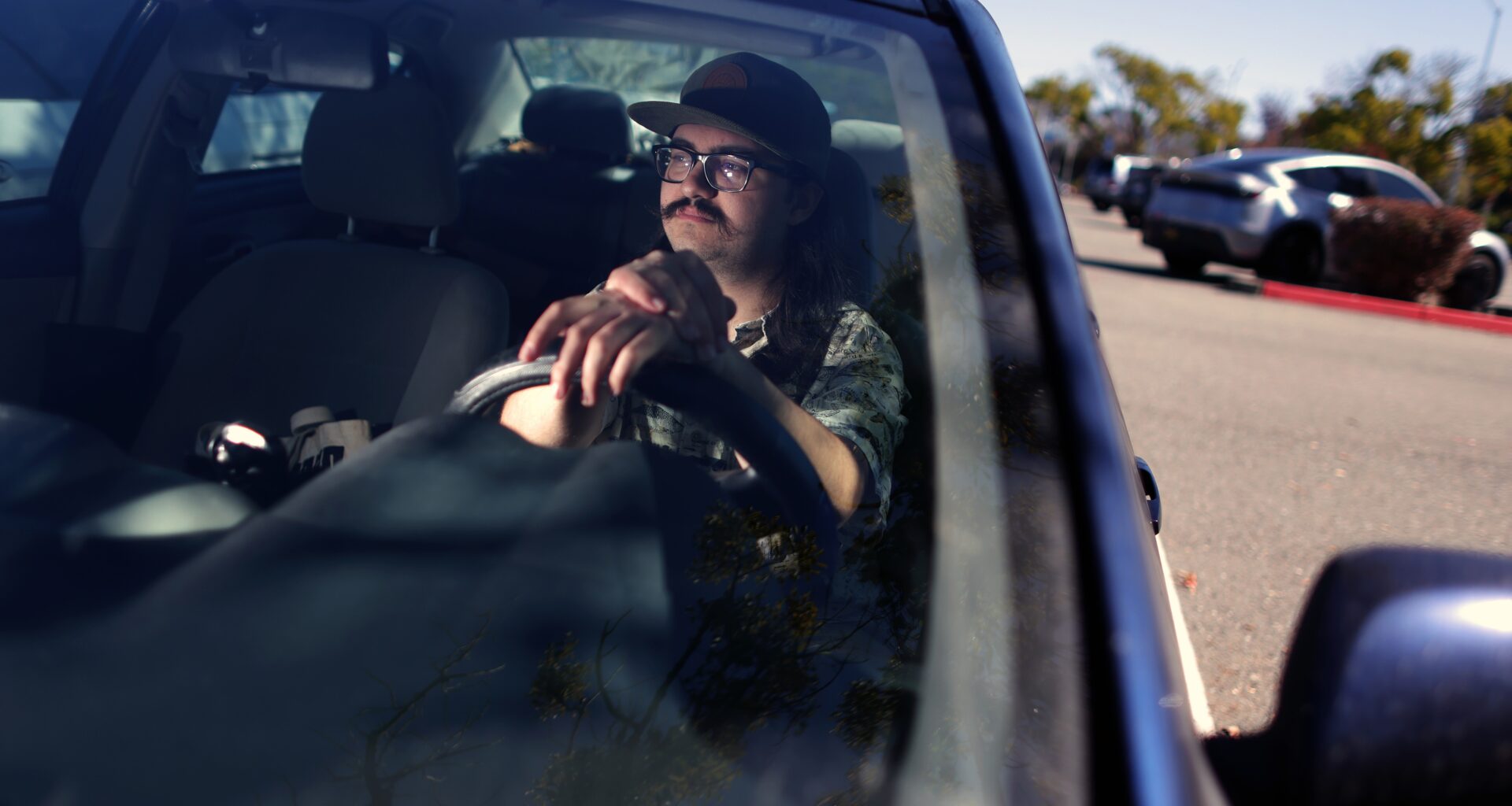
Misha Kesselman wishes they didn’t have to always rely on their car.
The Berkeley resident uses their car about 75% of the time to get around, largely because of the nature of their day job as a field coordinator for a political campaign. When they can, they take BART or AC Transit to get where they need to go.
RELATED: SV Poll: Bay Area residents feel they belong — but nearly half say they’re likely to leave
“I personally really do not like having to go through the stressful process of trying to find a parking space in these dense and urbanized areas,” they said.
Kesselman plans to vote “yes” on November’s Regional Transit Measure — a sales tax increase that would fund the Bay Area’s struggling transportation agencies, which have warned of drastic service cuts if the initiative fails.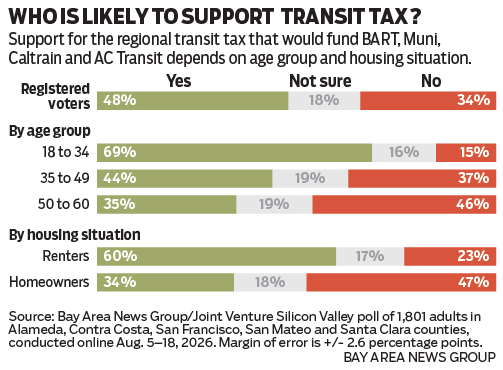
In the recent Silicon Valley poll, which was conducted by Embold Research for Joint Venture Silicon Valley and the Bay Area News Group, 48% of respondents said they supported the tax, while 34% were against it and 18% remained undecided. Those in favor of the tax were more likely to be younger and rent — 69% of adults under the age of 35 and 60% of renters were in support. The opposition was the highest among those between 50 to 64 years old — 46% of respondents — and those over the age of 65, 42%.
The poll surveyed 1,801 adults in Alameda, Contra Costa, San Francisco, San Mateo and Santa Clara counties and was conducted between Aug. 5 and 18. The margin of error was 2.6 percentage points.
Kesselman, 23, hopes that the measure will not only help preserve service, but also expand it for those looking to ride transit more regularly. And, as someone who predominantly drives, Kesselman worries about the impact service cuts could have on Bay Area traffic.
“I would have to get up an hour earlier to get to work regularly just because I would have to account for the amount of time it takes for me to actually go and park and get through traffic,” they said. “It would definitely drive up the cost of using my car.”
Homeowners, however, like 74-year-old Rick Spohn, are less likely to support the tax — the poll found that 47% of homeowners are against the tax, compared to just 23% of renters.
“I feel that those who ride it should pay for it,” he said. “I don’t need any more taxes. I’m on a fixed income, and I just don’t see them doing anything on their part to save money.”
The ballot initiative would raise the sales tax rate by 0.5 percentage points in San Mateo, Santa Clara, Contra Costa and Alameda counties and by 1 percentage point in San Francisco, and is expected to generate roughly $980 million annually for the next 14 years to sustain bus, train, metro and ferry lines.
Many of the region’s transit agencies have already proposed contingency plans if the measure fails. BART said it would likely have to end service at 9 p.m. instead of at midnight, reduce train frequencies to 30 minutes and move from five-line to three-line service outside of peak commute hours. Caltrain has proposed eliminating weekend services, closing more than a third of stations and ending operations around 9 p.m. instead of 1 a.m. AC Transit is looking at reducing service by 16%, while Muni said it could eliminate up to 20 routes, cut service by at least 30% and end regular evening service.
The fiscal cliff facing transit agencies was triggered by the decline in ridership due to the pandemic and hit agencies heavily dependent on fare revenues, like BART, the hardest.
Proponents of the measure argue the tax increase is essential to keeping public transit across the Bay Area afloat.
RELATED: Bay Area residents say their own lives are on track. The region is another story
SPUR, a nonprofit policy think tank sponsoring the measure, released a report last month that found that if the measure and San Francisco’s Proposition H fail, traffic delays on the Bay Bridge could increase by 33 minutes heading west in the morning and 43 minutes heading east in the evening. Caldecott Tunnel traffic could see delays of an additional 20 minutes in the morning and 27 minutes during the evening commute. Congestion could also worsen along Interstate 580, Interstate 680 and U.S. 101, the report found.
But opponents with the Committee for Affordable Bay Area Transit, a group sponsored by the Contra Costa Taxpayers Association, argue that many of the region’s transit agencies haven’t practiced fiscal prudence, should make cuts in other areas, including salaries, or could ask for help from the state.
Inefficiency, high cost of living among complaints from opponents
When Wayne Berner, 72, moved to the Bay Area in 1994, he was stunned to find that the region has 27 different transit agencies. He grew up in the South Side of Chicago and frequently used the three transit agencies to easily get around. But the Discovery Bay resident, who is retired, has found public transit much less convenient in the Bay Area.
Over the years, Berner has used transit to get to baseball games at the Oakland Coliseum, but beyond that, he hasn’t found it very practical. He once tried to take BART to the San Francisco International Airport, but the trains don’t start running until around 5 a.m., making an early flight next to impossible. When he lived in San Ramon, he tried to find a good route for his children to take to school in Concord, but the roughly 20-mile trip would take an hour, maybe longer if they needed to transfer.
Berner will be voting “no” on the Regional Transit Measure in November. He feels that BART especially hasn’t done enough to “control costs.”
“I look at it like, why do you throw more money at a dysfunctional transportation system?” he said. “If the 27 agencies actually sat down and said, ‘OK, we need to really do something,’ I think you get rid of them, you know, unify all those authorities under one or two umbrellas and call it a day. But there’s so much repetition in administrative and leadership costs.”
Spohn feels similarly to Berner. He’s lived in a home he owns in the unincorporated Santa Clara County community of San Martin for nearly 40 years. Located south of Morgan Hill and north of Gilroy, the area has limited access to transit. Caltrain doesn’t run service to its two southernmost stations on the weekend, and the Santa Clara Valley Transportation Authority only operates buses in South County.
Spohn, who is retired, said that because of the high cost of living in the Bay Area, he will never vote in favor of another tax or bond measure.
“You’d have to really convince me why I should have to pay a lot more money for something I don’t use,” he said.
Transit as a public good
Jason Muñoz’s earliest memories of taking transit were riding the bus from his home in Cupertino to the Valley Fair Mall or taking Caltrain up to San Francisco on the weekend. These days, the 28-year-old, who now lives in Santa Clara and works for Santa Clara University, doesn’t take transit very often. However, he still plans on voting yes on the measure.
“I think it’s important not to look at it like a business in that it should be profitable because I do consider it a sort of like public utility,” he said of public transit. “I have the luxury of access to reliable transportation. … But you know it’s a really important resource for getting to work, for visiting family, for keeping the Bay connected for a lot of other people.”
If the proposed sales tax increase fails, he doesn’t see himself being impacted very much on a day-to-day basis. But Caltrain and BART ending service at 9 p.m., he said, would likely reduce his options for getting to and from San Francisco on a night out.
Kesselman, the Berkeley resident, said that the sales tax is a minimal cost compared to how it would impact the region’s most vulnerable residents who rely on transit to get around.
“It just seems ridiculous on its face that we would ever allow these transit systems to fail,” they said. “It’s good for me that people have access to this transit and I would love to have more access to it myself.”