
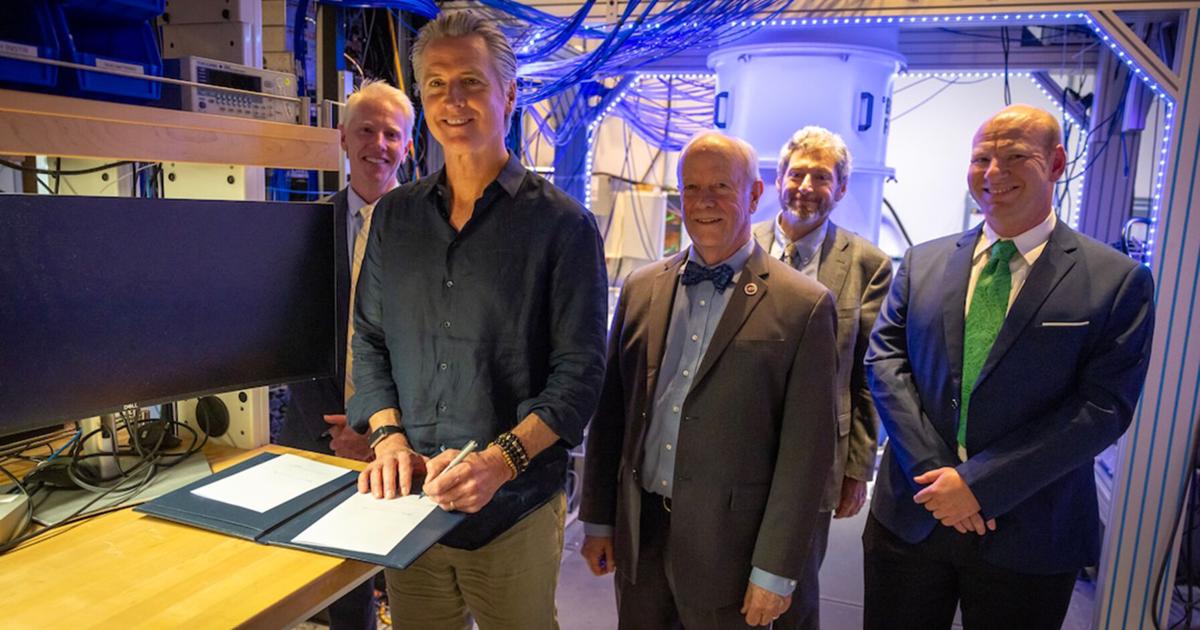
Gov. Gavin Newsom signed two bills at a quantum lab at UC Berkeley on Sept. 30 to accelerate the development of fusion energy in California.
The governor also signed a $30 million budget act to invest in cutting-edge quantum and deep space research, leverage public-private partnerships and promote a quantum startup ecosystem.
The first bill signed was Senate Bill 925, written by state Sen. Jerry McNerney, which requires the California Energy Commission to develop a strategic plan for the development of the state’s fusion energy.
The second bill, Assembly Bill 2647, written by Assemblymember Lisa Calderon, requires the CEC to “prepare a comprehensive assessment of the potential role for advanced nuclear technologies in supporting critical infrastructure in California,” according to an email from the CEC. The bill will also require new nuclear power plants in California to meet statewide energy demands in a cost effective way.
“UC is poised to lead in quantum and fusion energy research,” said UC Office of the President spokesperson Omar Rodriguez in an email. “This statewide investment will keep California at the forefront of this field by growing California’s future workforce, accelerating scientific discovery and advancing clean energy.”
According to an email from the CEC, UC Berkeley was chosen as the place of signing due to its status as the lead university for the National Science Foundation Quantum Leap Challenge Institute for Quantum Computation, a multi-institutional research center spanning universities across the state. The NSF just renewed its support for the NSF CIQC with $37.5 million in funding over the next five years to further quantum research.
NSF CIQC director, experimental atomic physicist and quantum scientist Shimon Kolkowitz said he wants to communicate that new cutting-edge quantum developments aren’t just “a lot of hype.”
“It’s just the early stage, but there’s a huge amount of promise here,” Kolkowitz said. “The people working on it, like me, we’re just very excited, and we’re glad that the state recognizes the potential and is investing in it.”
The institute is currently working on a quantum computer, technology that exists but is “not useful yet,” according to Kolkowitz. He said the center is now on the cusp of error-protected quantum computers that are big enough to do calculations such as modeling chemical reactions and the structures of molecules.
“There’s a whole range of new computational problems that we can hopefully very soon be able to solve, (problems) that were intractable before, that couldn’t be done on classical computers,” Kolkowitz said.
Raluca Scarlat, an associate professor in the UC Berkeley department of nuclear engineering, said the goal of SB 925 is to “help industry do what they’re doing a little faster,” and shared how it’s important for the university to give opportunities to students across disciplines to be a part of the growing field of fusion technology.
“It’s a really important signal that California is sending to say, ‘we care about investing in infrastructure that will help bring this technology to fruition,’” Scarlat said. “It says: California values clean energy, abundant energy, affordable energy (and) available energy, and we need all of the disciplines to help with this endeavor.”
The CEC said the state is still evaluating how the funding will be distributed to maximize impact.
According to Scarlat, the potential of nuclear power has already been acknowledged. Now, it’s a matter of “scaling it up, and making it an industrial facility that’s economical.”
“It’s not like we’re going to wait for the next 50 years,” Scarlat said. “Things are happening right now.”