
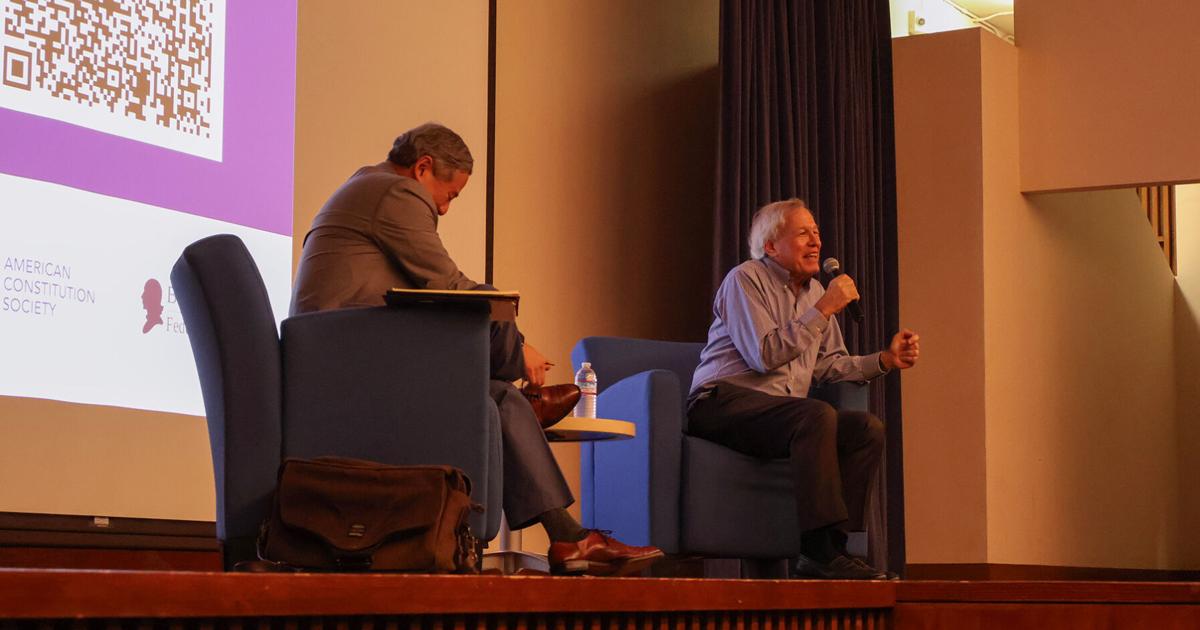
Ahead of the U.S. Supreme Court’s 2026-27 term, Dean of the UC Berkeley School of Law Erwin Chemerinsky and Berkeley Law professor John Yoo came together for an annual debate about the court’s judicial and political climate at the Supreme Court Roundup on Monday.
About 175 students gathered in Booth Auditorium to watch the roundup, hosted by the Berkeley Federalist Society and the Berkeley Law chapter of the American Constitution Society. Chemerinsky and Yoo debated controversial topics and judicial decisions from the past few years, such as the court’s conservative majority, voting rights and gerrymandering.
Chemerinsky opened the debate saying he believed a pivotal point in the current climate and conservative majority of the Supreme Court was the death of former Justice Ruth Bader Ginsburg and the appointment of Justice Amy Coney Barrett.
He noted court decisions from the past five years since Barrett’s appointment, such as the overturning of Roe v. Wade, gun rights expansion and overruling of affirmative action as evidence of the court becoming more conservative.
Yoo, a conservative professor known for his role in authoring the memos used to justify torture against terrorism suspects under former President George W. Bush’s administration, argued that the court is not politically conservative, but is more conservative in terms of judicial ideology.
“Courts, of course, have an ideology. Judges have a personal ideology,” Yoo said. “We shouldn’t want people who just are appointed to the courts with no idea about what they think about the law, and it happens to be that right now the court has a majority of people who are originalists, and it’s not a secret that was sprung on the American people.”
Yoo argued it is better to have justices who have an approach to interpreting the constitution, even if people disagree with the decisions they make because of it.
However, Chemerinsky argued that the Supreme Court’s conservative justices use this philosophy selectively.
“If you want to understand what they’re doing, it’s not based on (constitutional) originalism,” Chemerinsky said. “It’s based upon following current conservative political ideology … the conservatives on the Supreme Court follow originalism only when it gets the results they want to come to.”
The scholars weighed the court’s responsibility in overseeing redistricting, a prominent issue throughout this midterm election cycle following recent debates over the Supreme Court’s April 2026 ruling in Louisiana v. Callais, which struck down majority Black districts as gerrymandered and rolled back Section 2 of the Voting Rights Act.
Yoo asserted that judicial intervention in partisan gerrymandering is unnecessary.
“If Texas or Missouri wants to engage in excessive partisan gerrymandering … then other states, like our own state, like California or New York or Illinois, can do the exact same thing in the other direction,” Yoo said.
Chemerinsky argued that voting rights are precisely what need to be protected by the courts.
He said the Supreme Court’s decision in Louisiana v. Callais will be the “largest loss of Black representation in Congress and state legislatures since the end of Reconstruction.”
Michael May, copresident of the American Constitutional Society, said the group put on this event to raise “people’s consciousness,” because exposing people to both sides of the spectrum of constitutional ideologies is “really important.”
“I think the good humor between the dean and professor Yoo was good to show that you can have disagreements and still address the civil perspective,” May said.