
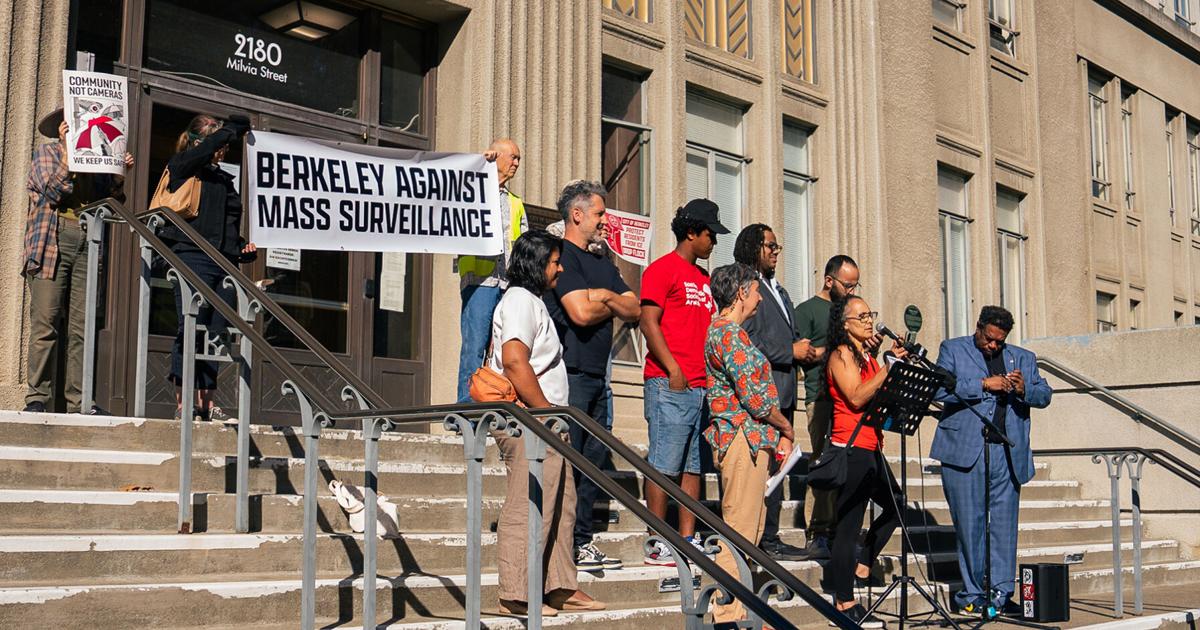
For years, Berkeley residents have expressed their frustration with the city’s use of Flock Safety cameras. Now, they’re turning their outrage into an organized coalition called Berkeley Against Mass Surveillance.
The organization has dedicated itself to eliminating mass surveillance in Berkeley, and sees an opportunity to do so by flipping City Council seats in the November election. On Tuesday, the organization drew together seven City Council candidates, all who represent an anti-Flock bloc opposing the technology, for a rally on the steps of City Hall.
At the rally, the candidates — including at least one from every district up for election this year — called for City Council to oppose all forms of mass surveillance technology.
They also urged council to delay what the candidates called a potential “lame-duck” vote deciding the vendors for a planned surveillance technology expansion.
The vote could happen as early as Nov. 17. If they take it up at that time, the council could decide what companies should supply the city with drones, automated license plate readers and investigative software for police two weeks after the Nov. 3 election and roughly two weeks before newly elected officials take office.
“If the lame-duck council takes up this crucial issue in its waning days, that will be widely perceived as an undemocratic move and flouting the expressed will of the electorate,” reads a letter signed by the seven candidates and sent to City Council members and Mayor Adena Ishii.
However, according to District 7 Councilmember Cecilia Lunaparra and city spokesperson Matthai Chakko, no vote on surveillance vendors is scheduled at this time. Lunaparra added that she is opposed to holding the vote before newly elected officials take office.
Standing on the steps of Martin Luther King Jr. Civic Center, many of the candidates made clear what they see as the stakes for the possible vote.
“I don’t want to be jarring in saying this, but you don’t want the West Bank to come to the West Coast,” said District 4 candidate Majdi Gaith, a Palestinian American and the co-founder of Jaffa Coffee Roasters.
The candidates attending the rally included Daria Wrubel and Moni Gangopadhyay for District 1, Gaith for District 4, Syrak Micael and Aidan Hill for District 7 as well as Mari Mendonca and Michael Wallman for District 8.
All seven candidates expressed concerns about surveillance technology such as the kind offered by Flock. Their concerns included the possible use of such technology by law enforcement to track immigrants, possible violations of state law and the constitution as well as the incredible difficulty of controlling the flow of the data collected by surveillance technology.
“This technology is not to be trusted,” Wrubel said. “If we gather the data, there is no way to keep it out of the hands of federal agents who are using it to kidnap our neighbors from our streets and lock them in concentration camps across the country.”
Mendonca and other candidates also expressed that they predict City Council serving “big tech” and corporate interests while supporting surveillance technology in the city. Many of the candidates at the rally positioned themselves as grassroots funded alternatives to the current council roster.
In May, a leaked memo from the city attorney’s office obtained by The Daily Californian warned that Berkeley risked millions of dollars in potential lawsuits from its Flock contract that could violate federal or state law related to data privacy. More recently, a federal judge in Oklahoma ruled last Friday that warrantless searches of camera data, such as those collected by Flock, without adequate probable cause may violate the Fourth Amendment.
While BAMS has not formally endorsed any of the candidates featured at Tuesday’s rally — some of whom are running against each other in their respective races — the coalition’s platform largely aligns with their concerns. All of the candidates have signed a “Berkeley Pledge to Oppose Mass Surveillance” prepared by BAMS.
According to organizer Sam Holtzman, BAMS was created to draw together people from disparate groups, such as Indivisible Berkeley and Berkeley Copwatch, into a more concrete opposition to surveillance technology. The organization began forming in June after the council voted on controversial police technology items earlier this year, including a May resolution to extend the city’s contract with Flock that drew more than a hundred people in opposition.
Beyond supporting candidates for the upcoming election, BAMS has run letter writing campaigns and teach-ins, canvassed at local events and demonstrated at an Aug. 21 Freedom From Flock Fest held in Berkeley as part of the National Week of Action Against ALPRs. The festival fell into line with a broader string of demonstrations championed by DeFlock, a national movement pushing for the elimination of ALPRs in policing.
Holtzman said in an interview Friday with fellow BAMS organizer Catherine Huchting that their organization seeks a complete elimination of all surveillance technology because, according to them, the spread of data from ALPRs is almost impossible to control.
“It’s in the city, and it’s kind of a Trojan horse,” Holtzman said. “I don’t know how you could ever expect the data to be secure.”