
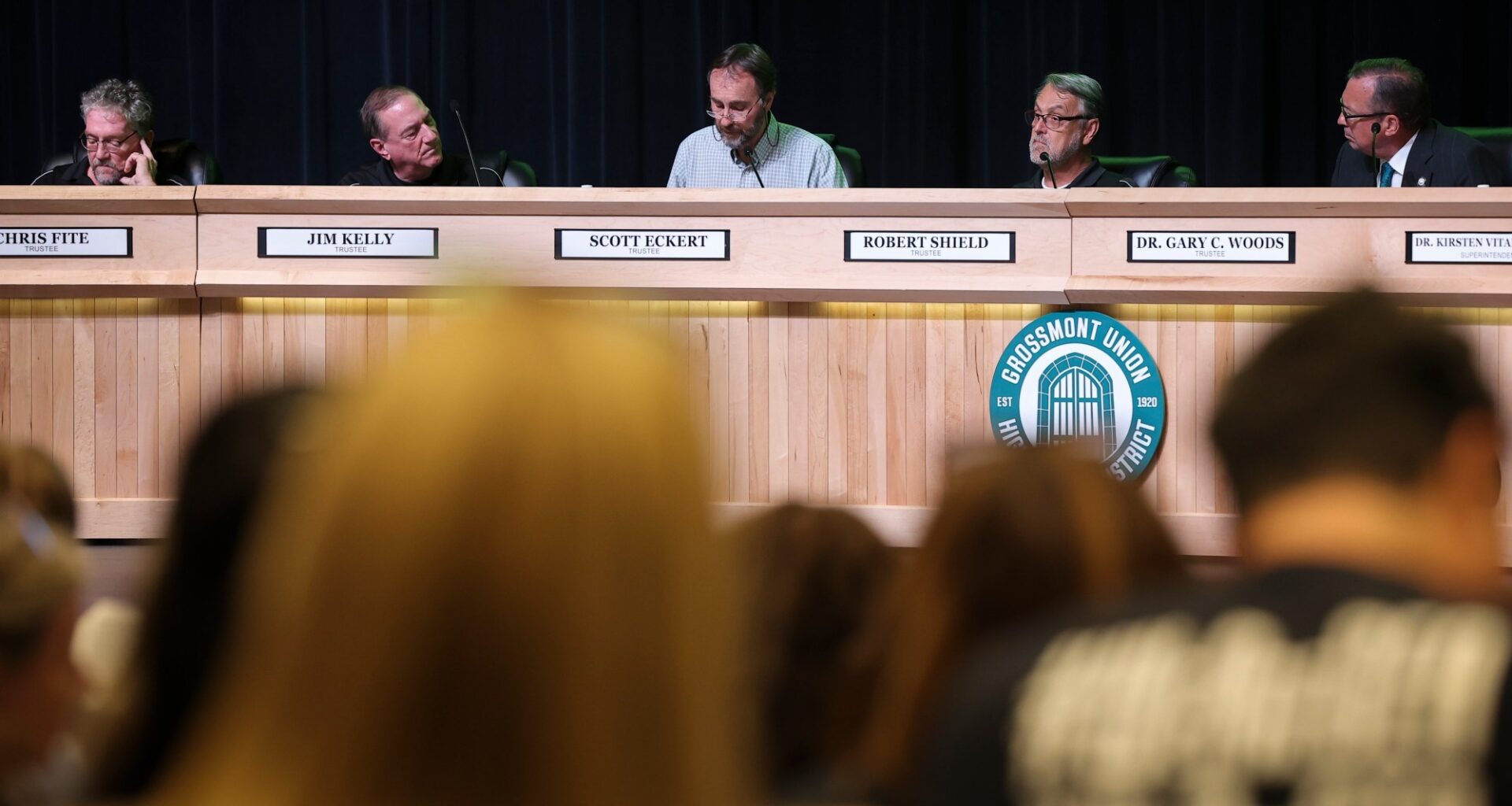
One of the longest-serving members of the troubled Grossmont Union High School District’s board has been flouting official guidance to share legally sensitive information with his friends, while also airing grievances privately and plotting to exert control over the superintendent and other trustees, emails obtained by The San Diego Union-Tribune show.
The behavior by trustee Jim Kelly has deepened a growing rift among one-time allies on the conservative-dominated school board. Now, revelations from the public records request have prompted an effort by one of those former allies, President Rob Shield, to formally censure him. The board will consider the effort Thursday.
The push marks a public escalation of conflict that has been brewing on the board for years, with disputes over librarian layoffs, building renaming efforts, immigration-enforcement policies and the controversial hire of a high-paid new administrator.
It also comes as the district has worked to right itself after years of superintendent turnover, high-profile legal payouts and trustee communications that raised concerns of violations of California open-meetings law.
In the summer of 2025, after the Union-Tribune reported on plotting by trustees and their political allies via private text messages, the board pledged to follow the Brown Act.
Meanwhile, the district got a new superintendent in Kirsten Vital Brulte, who had previously led school districts in Orange County and the Bay Area — a hire many hoped would quell months of tumult. What had been raucous board meetings began to calm down, and board trustees who had seldom explained their actions began to work out decisions in public view.
But resentments continued to simmer into this year, the records show, as Kelly complained in emails about other district leaders and sought to bring them in line.
The new records are only the latest obtained by the Union-Tribune to show board members working in messages among themselves and with their allies to influence the day-to-day operations of the district — a role legally delegated to the superintendent, not the board.
The communications that set off fresh condemnation from Shield came earlier this year.
In July, Kelly forwarded material to allies within and outside the school district that trustees had been explicitly asked not to share.
Months earlier, he had emailed with a former Republican lawmaker in an attempt to bend the district’s relatively new superintendent to his will. Their tactic: Asking her husband, a prominent former Republican lawmaker and party leader, to pressure her.
The emails suggest Kelly expected credit from the new superintendent, and fealty.
“I think she knows that (it) is because of me she has her current position but her actions do not suggest any sort of appreciation or help,” he wrote in an email to a former lawmaker.
“You asked me in a previous email whether she is quietly supporting the conservative majority,” Kelly wrote about Vital Brulte. “After thinking about that, I don’t think I’ve seen any evidence of that. I told her in my last conversation, they have not come to the conclusion that I can trust her.”
Kelly did not respond to requests for comment.
‘Unauthorized disclosure’
Shield’s proposed resolution to censure Kelly leads with and focuses most prominently on what it describes as a violation by Kelly of attorney-client privilege, uncovered when the district fulfilled a recent Union-Tribune records request.
“WHEREAS, the introduction of this formal action to censure is compelled solely by Trustee [Jim] Kelly’s actions, for which he alone is responsible — most notably his unauthorized disclosure of confidential, attorney-client privileged information, evidence of which was first revealed to the Board in September 2026,” wrote Shield in the proposed resolution.
He was referring to a July 9 email that district spokesperson Collin McGlashen sent the board members, with the phrase “Attorney Client Privileged Memo” in the subject line. Attached was a file called “Confidential Memo to GUHSD Board 7-9-2026-final.pdf.”
“As this is a confidential attorney-client privileged document, we respectfully request that neither the memo nor its contents be forwarded or otherwise shared,” McGlashen wrote in the otherwise heavily redacted email.
The next morning, Kelly forwarded the email to district employees Jessica Merschtina and Coleen Topper, both part of the conservative board majority’s inner circle. Merschtina responded by questioning district lawyers’ guidance and giving her own analysis of the politics of the situation.
While the beginning of the sentence was redacted by the district, Merschtina told Kelly: “[Redacted] right before a three seat Board election when we have everything on the line would only feed into the narrative that Kirsten is a hero and you and (trustee Gary Woods) are awful.”
“This is all about power and made clear at the last Board meeting.”
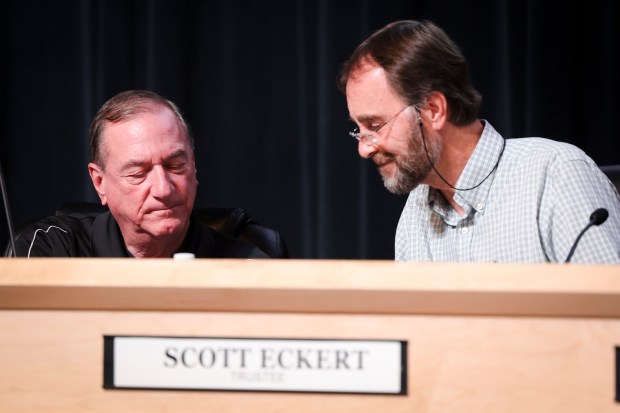 Trustees Jim Kelly and Scott Eckert chat before a Grossmont Union High School Board meeting at Grossmont High School on Thursday, July 17, 2025 in El Cajon. (Meg McLaughlin / The San Diego Union-Tribune)
Kelly was not the only board trustee to share the sensitive information McGlashen had asked trustees to keep confidential.
Trustee Scott Eckert fed information the district had identified as legally sensitive into Grok, an AI chatbot associated with the social media platform X — apparently seeking a second opinion on district attorneys’ legal advice. He then forwarded the results to Kelly.
“Hi Grok, I think you know about my board work with GUHSD, the history about [redacted],” Eckert wrote in his AI prompt. “Our [redacted] lawyers are [redacted]. Do you think this is a real legal concern?”
The chatbot’s output is almost entirely redacted from the email. The only portion that is not says: “This is not legal advice. Your district counsel [redacted].”
Kelly then forwarded the AI output on district legal guidance to his friend John Howard, an attorney who once performed work for the district — until the board last year ended the arrangement amid public controversy.
“Scott went to AI to get advice as to what their attorneys told us,” Kelly wrote to Howard. “Would you please comment on what AI analysis is suggesting?”
Eckert did not respond to a request for comment.
The district’s director of risk management said the records were redacted because they repeat legal advice provided to the district.
“Although it appears from the records themselves that the privileged legal guidance given was shared by at least one trustee to other individuals, there was never any authorization from the Board (a Board majority) to waive the attorney-client privilege or otherwise share the contents or substance of attorney-client privileged communications,” wrote Shawn Guffey.
“A single Board member does not have the authority to waive attorney-client privilege held by the District or Board as an entity, and to be clear, the District declines to waive attorney-client privilege,” Guffey continued.
McGlashen would not say whether the sensitive information contained student information, citing attorney-client privilege.
He said the superintendent expects district staff and trustees to comply with federal and state law, district policies, board bylaws and proper procedures and has held multiple governance team workshops and ethics trainings in recent months.
“With respect to concerns about whether a Brown Act violation has occurred and compliance with our Rules going forward, the Board will have the opportunity to discuss such issues at Thursday’s meeting,” he wrote.
Such issues came up with revelations last year, and again earlier this year when Vital Brulte reminded trustees repeatedly in emails of the need to ensure they did not violate the Brown Act’s ban on what are known as serial meetings — discussions in non-public forums of board matters by a majority of board members.
In a Feb. 27 email, Vital Brulte — with the other board members CC’d — told Kelly that she would not respond to his email under a separate cover in order not to violate the Brown Act. She instructed the other board members not respond.
Weeks later, in a March 22 email responding to Kelly, she told him she would reply in a separate email with Shield copied because she didn’t want to risk a Brown Act violation. Trustee Scott Eckert was also CC’d.
‘Family fights can never be won’
While the alleged violations of attorney client privilege seems to be the inciting incident for Shield’s censure, the records request and memo show multiple concerns about Kelly – most notably after the board passed an immigration policy that adhered to updated state guidance.
In the censure resolution on Thursday’s agenda, Shield cites a memo he sent in May to the rest of the board, focused on Kelly’s behavior in open and closed session, as well in an email thread with a former lawmaker.
His memo referred to and quoted from a January email exchange between Kelly and a former lawmaker.
That email exchange, reviewed by the Union-Tribune, shows Kelly and former Republican Assemblymember Steve Baldwin complaining about Vital Brulte, as well as about Shield and other trustees.
In the emails, the two men can be seen making a plan to urge the superintendent’s husband — former assembly member and California Republican Party chair Jim Brulte — to influence her decision making at the district.
“I think she knows that (it) is because of me she has her current position but her actions do not suggest any sort of appreciation or help,” Kelly wrote to Baldwin.
 Kirsten Vital Brulte, superintendent of Grossmont Union High School District, on Monday, Jan. 26, 2026, in El Cajon. (Nelvin C. Cepeda / The San Diego Union-Tribune)
The complaints by the two came after Baldwin had sent an email to Shield and Kelly — as well as to dozens of other people, including well-known East County conservative activists and elected officials — criticizing Shield’s support for a new district policy on immigration enforcement on school campuses.
That policy, intended to comply with new standards in state law, passed the Grossmont board by a vote of 3-2. Kelly voted against it.
Baldwin’s mass email led to a lengthy exchange of emails with Kelly, in which Kelly took credit for Vital Brulte’s hiring and encouraged the former assembly member to talk to her husband.
“It was me single-handedly who got her appointed to be our superintendent,” Kelly wrote to Baldwin. “There was a lot of people praying for me that I would eventually win the board over to vote for her because she and her husband are believers and Republicans… Something we never get a chance to vote for as a superintendent.”
But he also urged discretion.
“If you communicate with Jim Brulte and you share anything I have shared with you that is not public knowledge she will know that it came from me,” he wrote.
Baldwin then emailed Brulte to share his opinion that school districts should challenge the state guidance, and to ask Brulte to instruct his wife to speak with the school board about potential risks to state funding should they reject the state guidance, and discuss a legal challenge.
“Your wife, as superintendent, should weigh in on this or she will go down in history as being on the job during an era in which America destroyed the concept of citizenship and started down the road of becoming a Third World nation,” wrote Baldwin. “(Your) wife does not need this on her record.”
Baldwin forwarded his long exchange with Kelly with his email to Brulte. He closed by suggesting that failure to do as he and Kelly wanted could cost Vital Brulte her job.
“After all, this area is the most conservative portion of San Diego County and if this policy is allowed to stand, (I’m) afraid there will be a removal of school board members and potentially your wife will lose her job,” he wrote.
Baldwin told the Union-Tribune he had written to Brulte as an old friend from the legislature.
“What the email does not show is that Brulte and myself had phone conversations around this time period discussing issues having nothing to do with the Grossmont School District — such as a reunion for all those who served in the Assembly together,” he wrote in an email. “It was only natural I would bring up the controversy involving his wife who, by the way, I don’t know. She married him after I left office.”
Brulte did not immediately respond to requests for comment.
But in January, he did not appear to welcome Baldwin’s entreaty, or the emails with Kelly that preceded it.
Hours after receiving Baldwin’s email, he wrote to Kelly that he was disappointed to read the emails between the two men. He said he would share them with Vital Brulte and believed she would be hurt by them.
He also said he had discouraged his wife from taking the Grossmont job, based on what he called “the conservative fracture” at the board.
“Family fights can never be won; and it seems like the conservative majority is still fighting each other,” he continued. “As this continues, the only sure losers are the kids who attend the GUHSD schools.”
Chris Fite, the board’s one liberal-leaning member, told the Union-Tribune on Tuesday that the email exchanges about it suggested Kelly had tried to go behind their backs after losing the vote on the policy.
“Needless to say I was shocked and appalled,” he said.
Kelly had detailed his idea for how to handle the results of that vote in an email with Baldwin.
“Perhaps you could ask (Brulte) if he thinks it would be a good idea for us to challenge the state law which mandates the policy change?” wrote Kelly in the email exchange with Baldwin.
“I was thinking of putting that on the agenda, but because I’ve already voted against that policy change and was on the losing side, we have a policy that says I would have to wait six months before putting anything on the agenda to challenge that vote,” he continued. “But, this would not be asking for a revote on that issue, but to move to closed session to talk with our legal council about the possibility of pursuing a lawsuit?”
Shield said he had never before in his years as board president felt the need before to write a memo like the one he sent in May criticizing Kelly’s correspondence. He said it was the first step to ensure all board members follow the rules, and the censure is the next.
“The rules addressed in that memo aren’t mine,” he wrote. “They are the Board’s, and we are all bound by them together.”
He said their bylaws state that public censure is a potential remedy when a board member improperly shares confidential information.
“We cannot look the other way or pretend like we haven’t noticed,” he wrote. “The question before us isn’t about personalities. It’s simply this: What kind of Board are we?”