
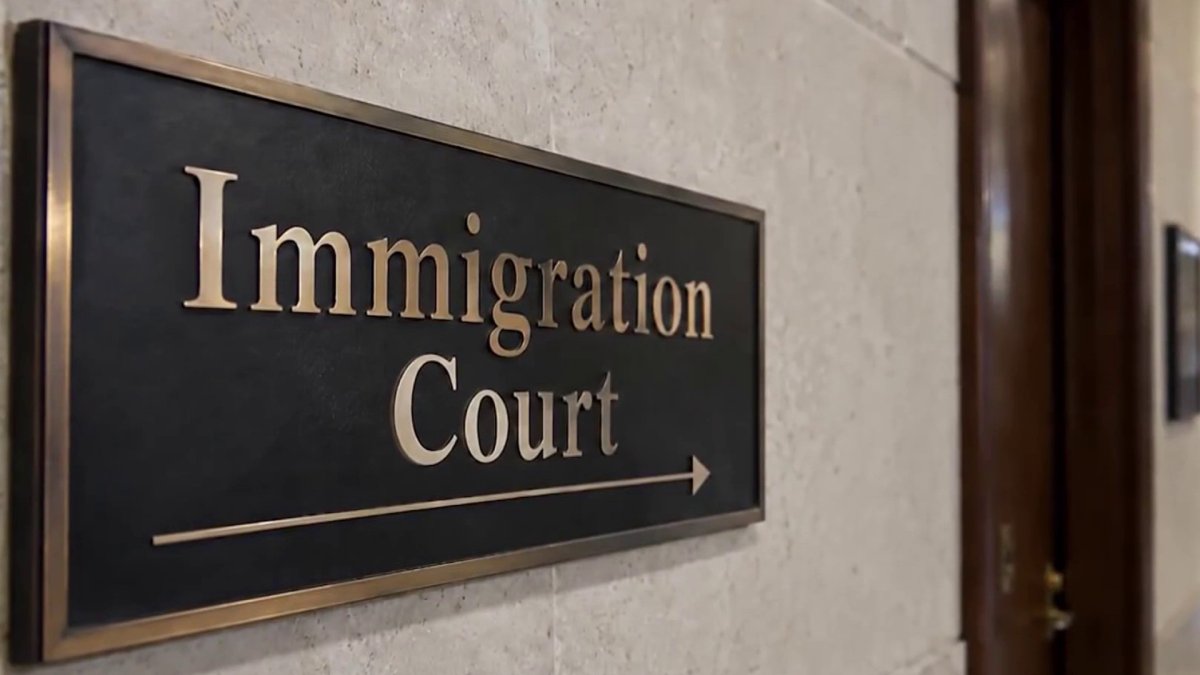
A once sleepy immigration court in Concord is now bustling with new activity following the official closure of San Francisco’s immigration court in September.
From thousands of additional cases to a contingent of brand new immigration judges appointed by President Trump’s Justice Department, court watchers on the ground are sounding the alarm about changes they say could impact due process for immigrants fighting their deportation at the Bay Area’s only remaining immigration court.
The rise of so-called “mega-master hearings” at the Concord court – where dozens of immigrants can be scheduled for the same hearing, sometimes with little notice – has also led to concerns among observers.
“The last time we talked [earlier this year], I think we were averaging about 43 hearings a month,” said Jere Ramsey, a volunteer court observer who’s been tracking changes at the court since last year. “And this month we have 104.”
Immigration attorney Heliodoro Moreno said immigrants with cases originally scheduled years into the future are suddenly being told to appear within weeks.
“They had hearings in 2028 or 2029 as their final hearing,” said Moreno, who serves as the senior removal defense attorney with Stand Together Contra Costa, a program under the county public defender’s office.. “Then [they were moved to] two weeks in the future. Not enough time to find an attorney. Not enough time to present their evidence.”
Devony Hodson, an immigrant from Nicaragua, told NBC Bay Area earlier this summer that her case had been abruptly moved from 2027 to July of this year.
“Suddenly, I got a notice on May 10 advancing my court date to July 6 of this year,” she said.
Hodson’s daughters arrived in the U.S. as unaccompanied minors and she joined them here when they were at risk of being placed into the foster system.
Since arriving in the Bay Area Hodson said she’s held jobs in fast food restaurants, caregiving, and construction.
Hodson said she and her daughters were granted extensions in her hearing in July, however, and then once again in September Her final hearing is now scheduled for December 2028.
A spokesperson for the Executive Office for Immigration Review (EOIR) said in an emailed statement that the agency “prioritizes the timely completion of all cases and makes scheduling adjustments as needed to ensure cases do not languish.”
The spokesperson added that additional scheduling changes could follow the appointment of new immigration judges.
Attorneys such as Moreno are urging immigrants to regularly check the status of their case online to avoid missing any court appearances.
The San Francisco court’s closure – and the shift of thousands of cases to Concord – has caught the attention of Bay Area Congressman Mark Desaulnier. Given the longstanding backlog in immigration courts across the country, he questioned the wisdom of shuttering the San Francisco court.
“What was the rationale for doing it?” he said. “What kind of analysis did you do? Is it going to help with the backlog? All those things and we haven’t had a response.”
Then there are the judges.
When President Trump returned to office last January, EOIR’s website listed eleven immigration judges serving the Concord court. But more than half of them have been fired and replaced by the Department of Justice since then.
Now the court has 20 judges, according to the EOIR website, including at least two assigned to a satellite location in San Francisco.
Observers like Ramsey say most of the new judges are appearing remotely.
“I’ve not seen anyone appear other than remotely, except for our four original judges,” Ramsey said.
Lopez said those remote appearances create another layer of confusion for immigrants and have led to significant consequences.
“[One woman] entered the courtroom and the judge didn’t see her because she sat in the back,” Lopez said. “The judge didn’t see her so she was ordered removed in absentia.
“She has to file a motion to reopen the case and spend a thousand-something dollars more just because they couldn’t see her.”
Some veteran immigration attorneys have expressed a lack of confidence in many of the newly appointed immigration judges, citing a lack of training and little-to-no experience in immigration law.
“What’s happening is we’re seeing judges come onto the bench who really don’t know the law,” Heliodoro Moreno said. “So they’re up there, they’re saying things, doing things, that are confusing respondents.”
According to EOIR, the Department of Justice removed the requirement that immigration judges have previous experience with immigration law.
A 2025 DOJ recruiting campaign said the administration was seeking to hire so-called “deportation judges,” a term that attorneys and immigrant rights advocates said has never previously been used to refer to immigration judges.
Many of the newly appointed judges have enforcement-oriented backgrounds, such as prosecutors or DHS attorneys. Others come from the military.
According to EOIR, all new immigration judges go through a rigorous training program that includes both classroom-based training and on-the-job training.
At least five new judges serving the Concord court have previous experience working as ICE attorneys, according to EOIR press releases describing their backgrounds.
Moreno said he’s seeing more asylum cases denied since the DOJ began overhauling immigration courts last year. The national asylum denial rate reached an all-time high of 94.1 percent in June 2026, according to data from TRAC.
After living in the U.S. for nine years, an immigrant who spoke to NBC Bay Area on the condition of anonymity said she may be forced to return to Mexico.
“The judge said he believed me, he believed I was sincere, but that was not enough to grant my petition,” she said following an April hearing at the Concord court. “In order for them to give you asylum you have to practically have a family member murdered first and then come.”
Attorneys and advocates on the ground say they’re still grappling with the new changes – and believe more pro-bono resources will need to shift from San Francisco to the East Bay to ensure due process.
Some, like Moreno, say the sweeping changes at immigration court are part of the administration’s broader agenda to ramp up deportations of undocumented immigrants.
“It’s very frustrating to all of us,” Moreno said. “We really feel that the purpose of these changes is to order people removed as quickly as possible and as many people as possible.”