
We sat at a circular table with a pink tablecloth against two huge single-pane windows that met in the wedge of a street corner. Inside a Cantonese restaurant with a view of the foggy San Francisco night, a place picked by my oh-so sophisticated local cousin Noreen, plates piled with orange chicken and honey walnut shrimp paraded past me on the lazy Susan in the center. I was 8 or 9 years old, had never seen such a contraption, and had never felt fancier.
Memories like these compound with time and taste. Late-night al pastor tacos from a stall in the Rampart district of Los Angeles. Untold orders of combo plates or carne asada fries from any of the dozens of taquerías in metropolitan San Diego with names that end in -berto. A simple, abundant cheese plate on the patio of a winery in Temecula, or Napa Valley or Santa Ynez Valley. My first slice of Zachary’s deep-dish spinach pizza in Rockridge, Oakland.
A lamb skewer. A banh mi. A roadhouse cheeseburger. Pho. A Guatemalan tamal. A chilled glass of Sauvignon Blanc. A West Coast IPA. A slice of Julian apple pie.
California is the most supreme territory in which one can eat at the widest degrees of sensory satisfaction in this country. Actually — by volume, scale and range — I’d say this is true by far. It’s been said many times before and it’s worth repeating in this space, as this edition of L.A. Omnivore arrives as more of a treatise. If California is the best state to eat in the country, and if, like me, your brain is hopelessly food-wired, this makes California arguably the best place to live among these United States.
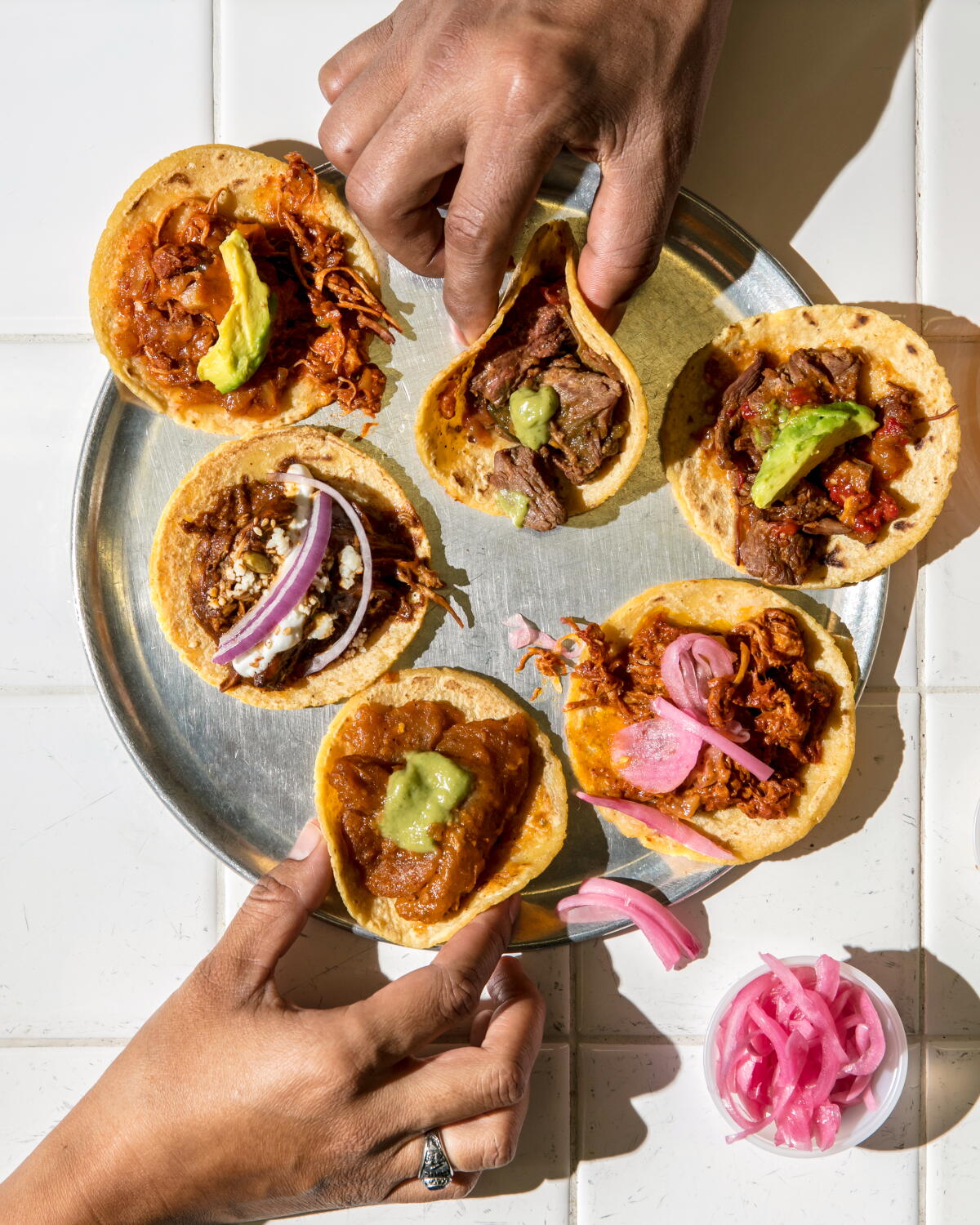
The strength of California’s food cultures is owed to its awesome diversity of diaspora. Above, a taco sampler from the original Guisados in Boyle Heights.
(Silvia Razgova / For The Times)
Beyond its food culture, when considering its coastline, awesome geographic features, diversity of population, records in industry and innovation, and general strength in the global culture, California is the most important state in the union. By far.
As the midterm election approaches and Republican candidates across the country use our state’s name as an all-purpose boogeyman of what not to be, it’s time we reconnect with reality. It’s all B.S. We must begin to own the actual truth. Proclaim it. Stand by it. After a whole lifetime of being told how unlivable and ridiculous our state is whenever I travel elsewhere (or whenever I have the misfortune of dealing with an embittered transplant), I’ve swung my pendulum in the opposite direction.
I’m not holding back anymore. I’ve become a California exceptionalist.
You’re reading L.A. Omnivore
Daniel Hernandez digs into the stickiest questions around food and culture in Los Angeles and the California borderlands.
By continuing, you agree to our Terms of Service, which include arbitration and a class action waiver. You agree that we and our third-party vendors may collect and use your information, including through cookies, pixels and similar technologies, for the purposes set forth in our Privacy Policy such as personalizing your experience and ads.
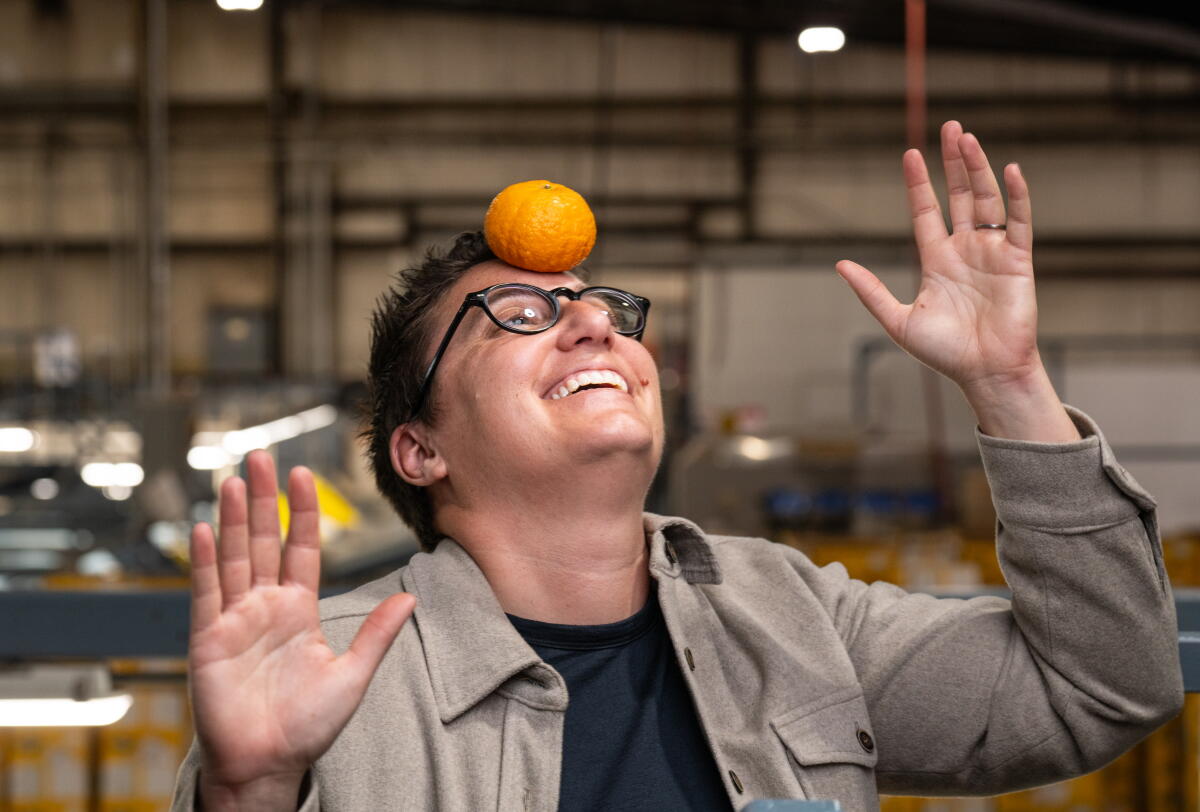
Don’t mess with our California oranges! Above, farm owner Bianca Kaprielian in Reedley.
(Tomas Ovalle / For The Times)
Enough is enough
We must reembrace and herald California’s exceptional status, a notion I didn’t invent by any means. Historian and journalist Carey McWilliams did with his 1949 book “California: The Great Exception,” a volume that’s credited with setting the baseline of California’s modern mythologies.
Forty-nine other states and a few territories would probably like a word, right? You can disagree. A recent private-sector survey named California the 31st-most desirable state to live in, not the 1st. That would be Idaho, according to WalletHub. On affordability alone, the website ranks California 50th.
Our state definitely has major problems, which are exploited gleefully around each election cycle. So many algorithms are chock-full of messaging deriding our state for its problems with affordability, housing costs, homelessness, the wealth gap, or regulation and bureaucracy. Adding inflation, people and small businesses are hurting in our state, and in L.A. especially. Many have given up and are deciding to leave.
However, the promise of affordability advantages in lesser locales are not always fruitful. The cost-of-living has risen more sharply in once-mythical Austin, Seattle, Denver, Portland and Atlanta, among others, than it has in Los Angeles, according to a recent analysis by L.A. Times reporter Terry Castleman. He found that people who left L.A. for these places since 2020 “are paying more now than when they arrived.”
There’s an exodus reversal happening, as seen by a growing body of relevant anecdotes. Many such tales involve Texas, a state that I’ve always felt believes its own delusions far more strenuously than most.
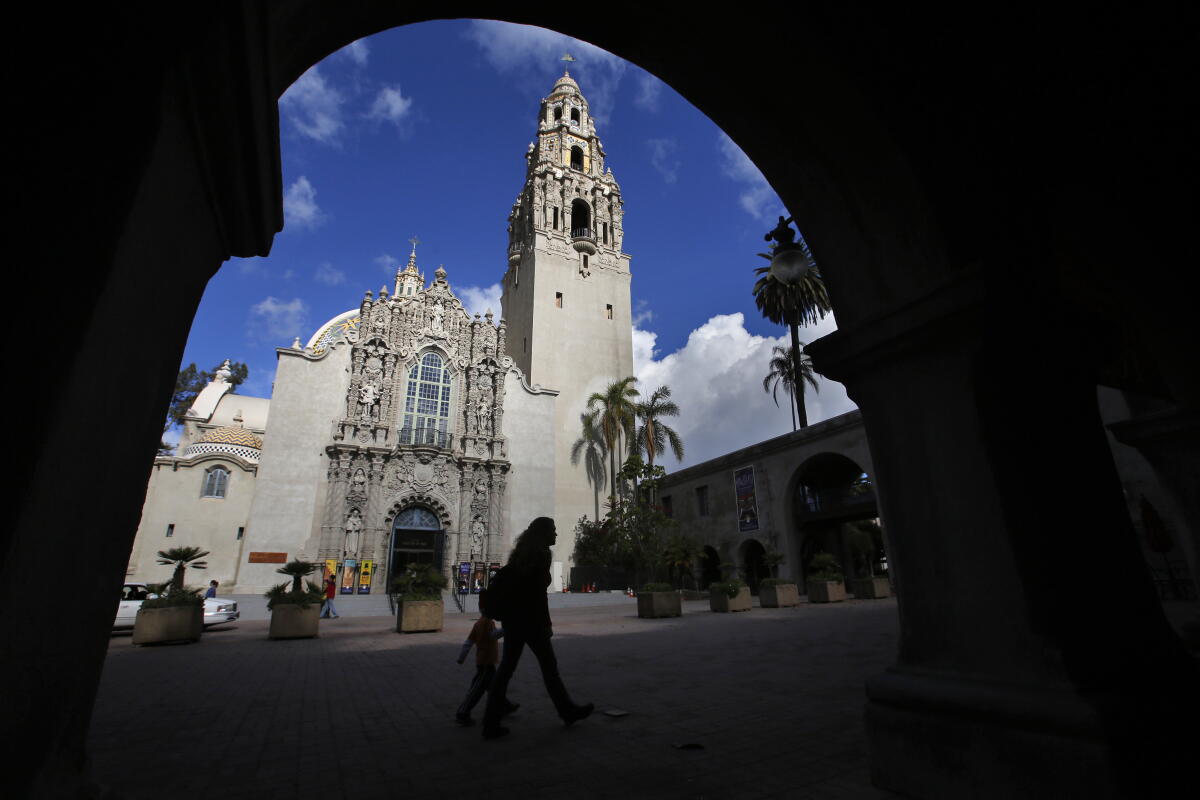
Balboa Park in San Diego is one of several features that one California-to-Texas transplant missed the most, according to Business Insider. So she moved back.
(Los Angeles Times)
Priscilla Barros, for example, moved her family from Murrieta to Houston in 2021 to “save money, have a bigger house,” then found reality hit against the move’s fabled advantages. “The state’s politics, weather, and lack of mountains or beaches made me realize the grass isn’t always greener on the other side,” Barros told Business Insider this year.
The weather was oppressive and Texas’ cheap brand-new homes, she surmised, were being built too quickly and under par. She realized she missed the land itself, California’s greatest capital, its restaurants, parks, mountains, beaches and landmarks. So in 2025, Barros moved back. “I’ll never move out of state again,” she concluded.
There are many more such stories out there, not limited to the Texas return. It’s time we start trusting the people who’ve been coming back.
Remember these data points
Whenever you’re confronted with a California naysayer, record the following points and keep them handy for future use. California is:
The largest state by population, with more than 39 million people.The fourth-largest economy in the world. If California were its own country, its economy would be bigger than Japan’s, India’s, the United Kingdom’s, France’s, Russia’s or Canada’s. The largest agricultural state, growing 75% of the nation’s fruits and nuts and at least a third of its vegetables, according to the California Department of Food and Agriculture.Home to 80% of wine production in the United States and 95% of U.S. wine exports globally.The center, for better or worse, of the artificial intelligence and tech industries, worth unimaginable trillions in the form of capital investments at Nvidia, OpenAI, Anthropic, Alphabet, Apple and others. While some companies made dramatically bitchy exits from the state in recent years, there are signs that several are itching to get back to the golden coast. The historic center of the film and television industry, and despite the doom narratives, still its leader. California’s film and sound industries generated $57 billion in 2025; that’s exactly half of the national film industry’s economic output, $114 billion last year, according to federal data. A place where you live a long life. Life expectancy in California is ranked sixth by the Centers for Disease Control and Prevention as of 2025.Home to two of the most admired universities in the world, Stanford and UC Berkeley. Berkeley is also the best public university globally (according to Times Higher Education), plus the nine other campuses that sprung from it, including prestigious UCLA and UC San Diego.Also home to Caltech, USC and the Claremont Colleges, the 22-campus California State University system, plus the largest network of community colleges in the country. Education is worth belaboring because clusters of high-performing colleges and universities are correlated to powering economic growth.The incubator for innumerable cultural innovations and political breakthroughs, from the lowrider to fitness culture, skating to the California burrito, gay rights, immigrant rights, disability rights. 
California’s skate culture is one of several global exports that endure for generations.
(James Michael Juarez / For The Times)
So by now you’re thinking, OK, inflation is still socking me in the face. It feels like everyone is teetering on one bad month or two away from homelessness. Also, Daniel, the AI industry might be threatening the human species and the film industry is consolidating and hemorrhaging before our eyes. Be serious…
And you’re right. The bad things are bad. As we cope and find solutions, we’re still in a place where at any time we can leave the house and find ourselves at:
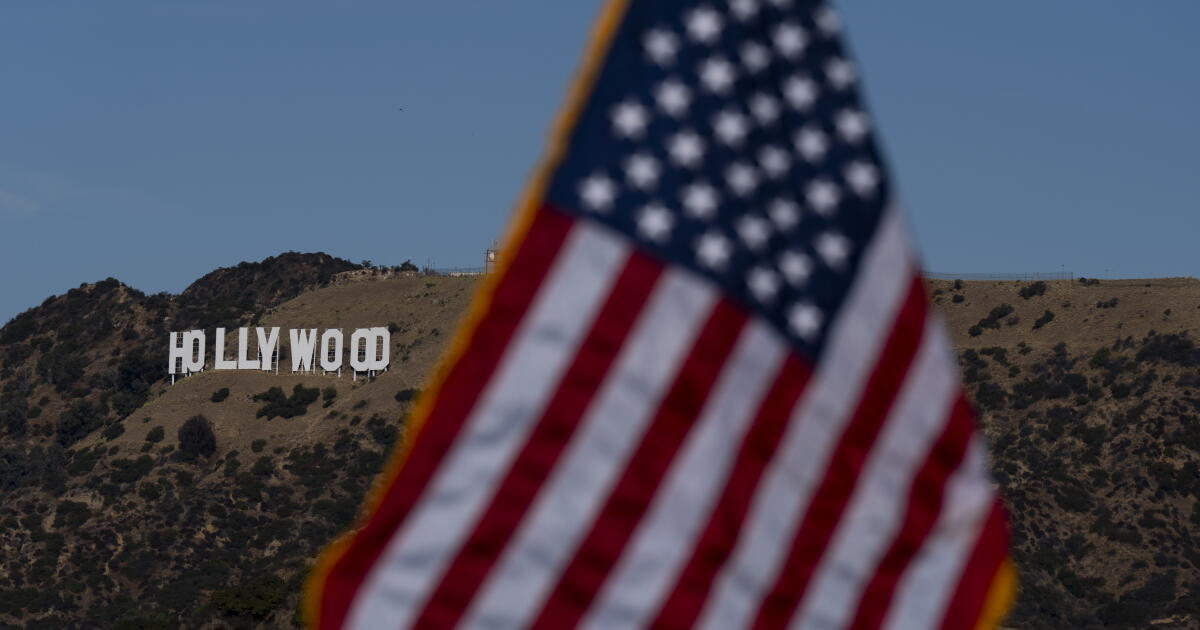
The highest peak in the contiguous U.S.: Mt. Whitney, at 14,500 feet.Just 140 miles away, the lowest point in North America, at Death Valley, 282 feet below sea level.Yosemite National Park.Mt. Shasta.840 miles of sparkling Pacific coastline.Lake Tahoe.Mono Lake.Big Sur.The Golden Gate Bridge, since 1937.The Hollywood sign, since 1923.Balboa Park, since 1868.Golden Gate Park, since 1870.Sequoia and Kings Canyon National Parks.Joshua Tree National Park.Redwood National Park.Disneyland.LAX (just kidding).Any one of our state’s 22,000 Mexican restaurants.The border with Mexico itself, because, honestly — thank goodness.[Name any of the dozens of other geographic, cultural, historical or weird landmarks that can be found only here. It would require another whole newsletter.]
Join me in no longer entertaining any of the doomer hype. Instead, if you’re so moved, you may even be spurred to demand some gratitude from an out-of-state doomer. Because what would you be without us, Mississippi or West Virginia? For one — since California is one of the biggest “donor states” to the federal tax base — a lot poorer.
The dark vision of what California is in the Musk-ian or Miller-ist worldview is unreal and inaccurate. Steve Hilton is wrong about us too. Taking all this in, there’s only so much doomer propaganda a mind can take before it clamors for revolt.
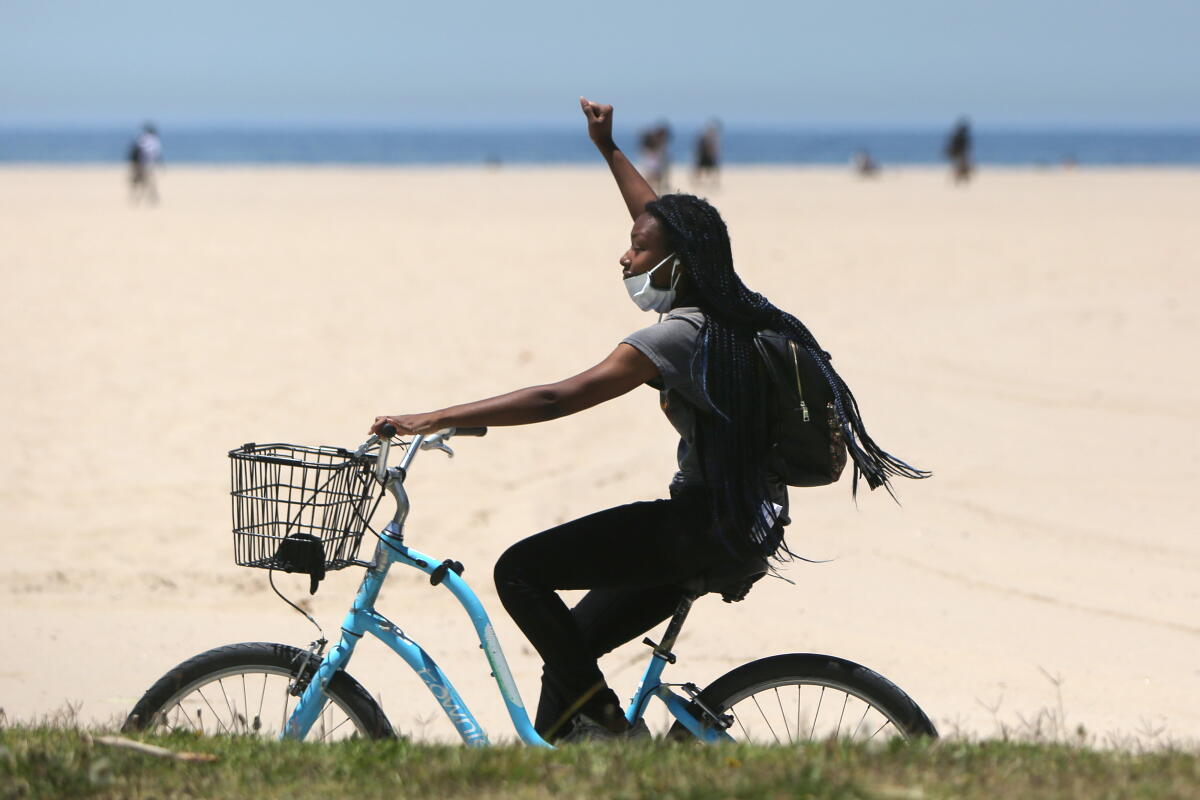
Stand up, California! Or, as the case may be, ride a bike with an upward fist on the Ocean Front Walk in Venice Beach!
(Dania Maxwell / Los Angeles Times)
Something to learn from Texas
Now there is one score where Texas is way ahead of us: state pride. Having visited and enjoyed Austin, Fort Worth and the Rio Grande Valley several times, everywhere I’ve turned, some bumper sticker or billboard is triumphantly declaring “Don’t Mess With Texas” or branded with the flag of the Texas Republic. Texas pride is like wading through soup.
In contrast, the vibe in California still seems far less braggadocious than it could legitimately muster to be. We’re just too groovy to be boastful, I guess. But this is about putting our foot down. We can defend the state without disavowing its problems. Love for California is what spurs so many of its people to call out its flaws and agitate for change. This space will always err on the side of pushing for better.
For a lot of us it always goes back to the food. The range, the variety, the freshness, the ecstatic culture of experimentation. That Cantonese feast in San Francisco burned this worldview into my childhood brain. Every day offers moments in the senses that can make California’s too-frequent drudgeries feel “worth it.”
Now are you a California exceptionalist?
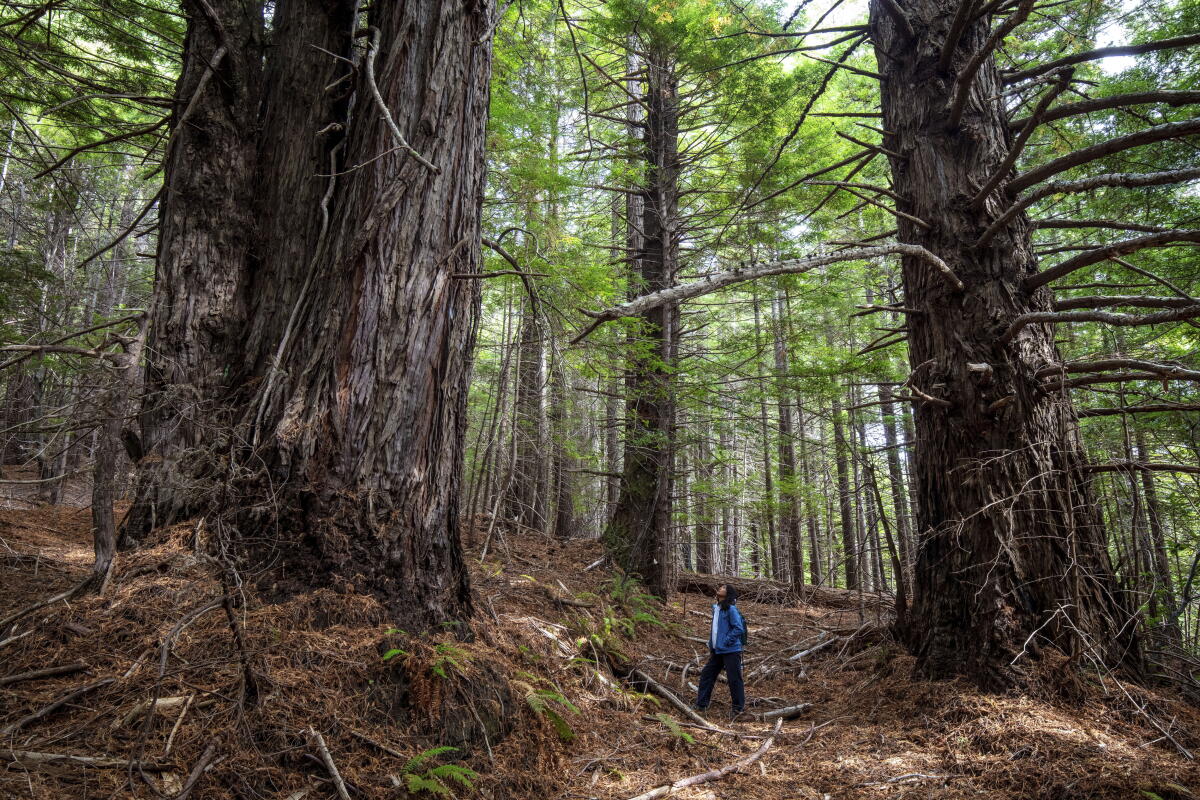
Redwood forestland in Mendocino County.
(Max Forster / Associated Press)
Reading the state, and between the linesI’m currently reading “California: A History” by the late Kevin Starr. It’s a decent, optimistic sweep so far, part of a major stream in my reading diet that centers state history, especially from alternative perspectives. More on that later.Recently, The Times’ Shelby Grad wrote about the last time Los Angeles had a somewhat rosy moment, as symbolized by the pastoral musical film “La La Land.”Conservative or libertarian-centric media voices use us as a punching bag a lot. The most lavish example is probably “The California Dream Is Dying” by Conor Friedersdorf in the Atlantic. Many naysayer arguments boil down to “economic opportunity” and, forgive me, I like a layer or two of protections for competition, the environment, and society at large from the fangs of totally unfettered capitalism, how about you?The Times’ business columnist Michael Hiltzik did a convincing breakdown and rebuttal to Friedersdorf. Hiltzik is a weekly must-read for me. He’s author of a new history of his own, “Golden State: The Making of California.”
In future L.A. Omnivore dispatches, I’ll discuss what it means now to be “Californian,” a term which I believe is in desperate need of a redefinition. I’ll also posit a new pan-Californian identity that can replace our, ahem, out-of-date provincialisms.
Sign up at the module box above or at this link to stay up to date.