

In a historic decision last week, U.S. District Judge William Orrick released the Oakland Police Department from 23 years of federal court oversight. Orrick, city leaders, and the civil rights attorneys who were party to the lawsuit that led to OPD’s oversight all agreed that the police department has come a long way since the early 2000s, when the “Riders” scandal exposed a group of officers who’d been accused of beating up people, planting drugs, and lying on police reports.
But they also agreed that OPD’s near fulfillment of its reform agreement — 50 of 51 tasks that overhauled the department’s policies and procedures — isn’t an end point.
“Joy should be tempered with humility,” Robert Warshaw, Oakland’s longtime federal monitor, told city leaders last week. “The things you’ve accomplished, you should have been doing all along.”
Mayor Barbara Lee called the end of oversight a “floor, not the ceiling,” and said Oakland will continue to seek ways of implementing constitutional policing.
That puts much greater pressure on OPD’s internal accountability systems, the mayor’s office, and the city’s civilian oversight bodies, including the Police Commission, which oversees the Community Police Review Agency and Office of the Inspector General.
Whether Oakland is ready for this responsibility is still up for debate.
Some residents and officials say the city has built the systems it needs to oversee its police department. Others worry those systems lack the resources necessary to hold OPD accountable without the federal court as a backstop. Still, others criticize federal oversight and say the city will thrive now that it doesn’t have to answer to the court-appointed monitor and judge.
Oakland’s civilian police watchdogs say they need more resources
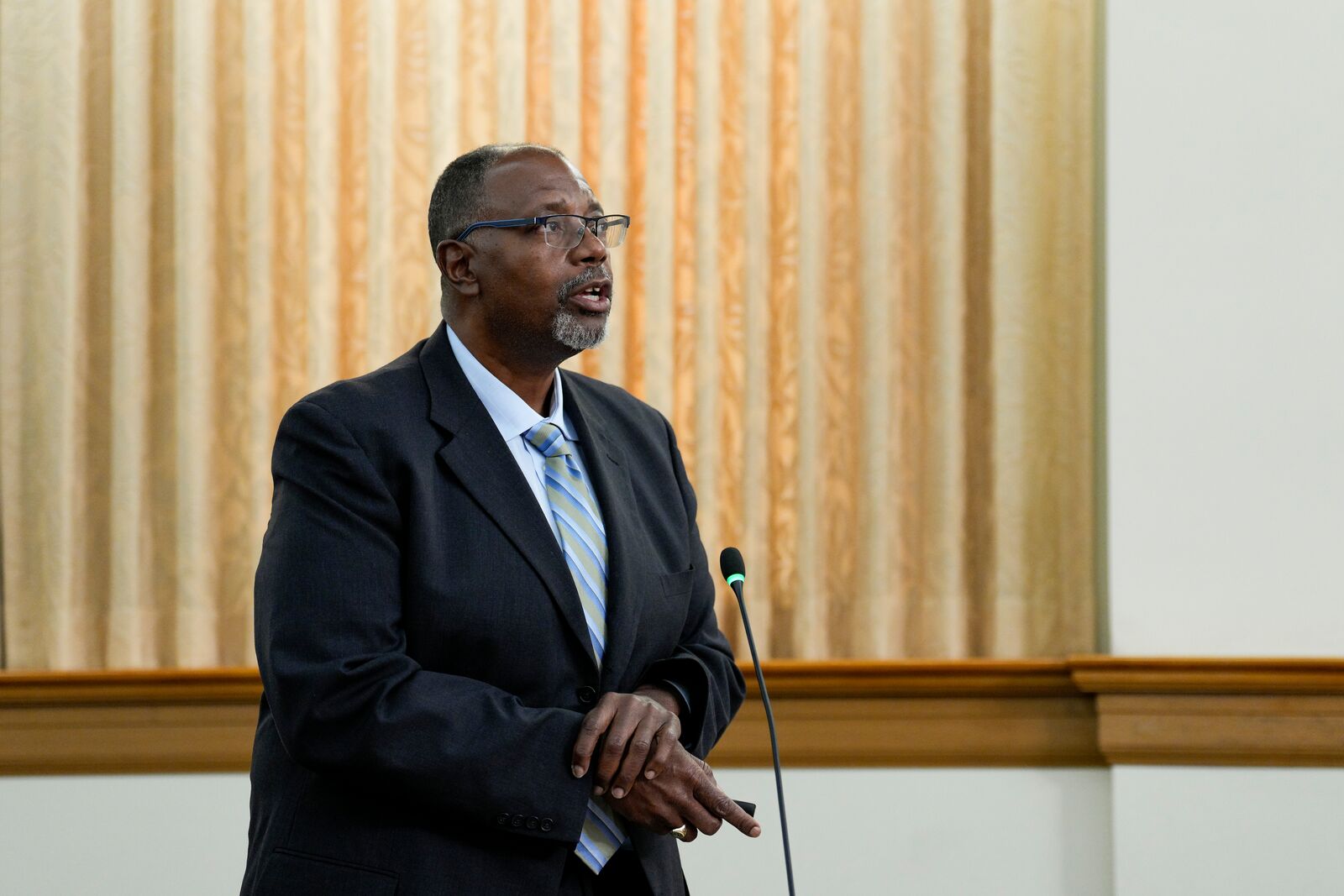 Community Police Review Agency Executive Director Antonio Lawson, seen here on June 18, 2026, says he wants the mayor and City Council to provide more funding to hire more CPRA investigators. Credit: Godofredo Vasquez for The Oaklandside
The most significant civilian oversight body Oakland has created is its Police Commission. Voters established the powerful board in 2016. Under the commission’s authority is the Community Police Review Agency, or CPRA. CPRA investigates complaints of police misconduct and recommends discipline when officers violate rules.
The agency hasn’t always had the staff it needs to deliver on this goal. Last year, CPRA had just three investigators, according to its 2025 annual report. From 2017 through 2025, the vacancy rate among CPRA investigators has ranged from 22% to 56%, including frozen positions.
But Antonio Lawson, CPRA’s executive director, said the agency now has 12 employees and recently hired a deputy director of investigations and a project manager. The mayor and City Council also increased CPRA’s budget this year to $5.3 million, according to Lawson. This is up from $3.3 million two years ago.
Still, Lawson said he wants to hire at least two more frontline investigators and two investigators with legal experience to handle more complex cases. The agency is also seeking outside counsel to help investigate some of OPD’s most serious misconduct allegations.
CPRA is required to investigate certain allegations, including uses of force, in-custody deaths, dishonesty, and crowd-control incidents. The agency has discretion over whether to investigate other complaints, meaning its staffing levels can affect how many cases it takes on, according to Lawson.
“If we have more investigators on staff, then we could take on more cases,” he said. “I think we’re prepared for the future, but we’re going to need more resources.”
Lawson said he’s encouraged by the mayor’s support for civilian oversight and believes CPRA is in a better financial position than it was before Lee took office. But he’s less certain whether the City Council, which ultimately approves the city budget, will provide the funding the agency needs.
“I’m hopeful,” he said. “Only time will tell.”
Less certain right now is the future of the Office of the Inspector General. Oakland voters created the office in 2020 to independently audit OPD’s policies and practices, including the reforms required under the negotiated settlement agreement, and to make recommendations for improvement.
But Inspector General Zurvohn Maloof said his office has just three permanent employees: himself, a deputy inspector general, and an administrative assistant. The mayor and City Council chose this year to allocate roughly $1.5 million to the office, down from $2.5 million two years ago.
Maloof said he wants to add five employees, including three auditors and a policy analyst, to fulfill the office’s responsibilities under the city charter. His office is also seeking an outside auditing firm to review some of the reforms previously monitored by the federal court.
The staffing shortage has already taken a toll. Maloof said employees have taken on multiple roles outside their job descriptions, and he regularly works 10- to 12-hour days.
“We’re all stretched very thin in this office,” Maloof said.
Altogether, the Police Commission, CPRA, and inspector general’s budgets total $7.3 million this year, less than 2% of the Oakland Police Department’s $410 million budget.
What kind of police department transparency can Oakland provide?
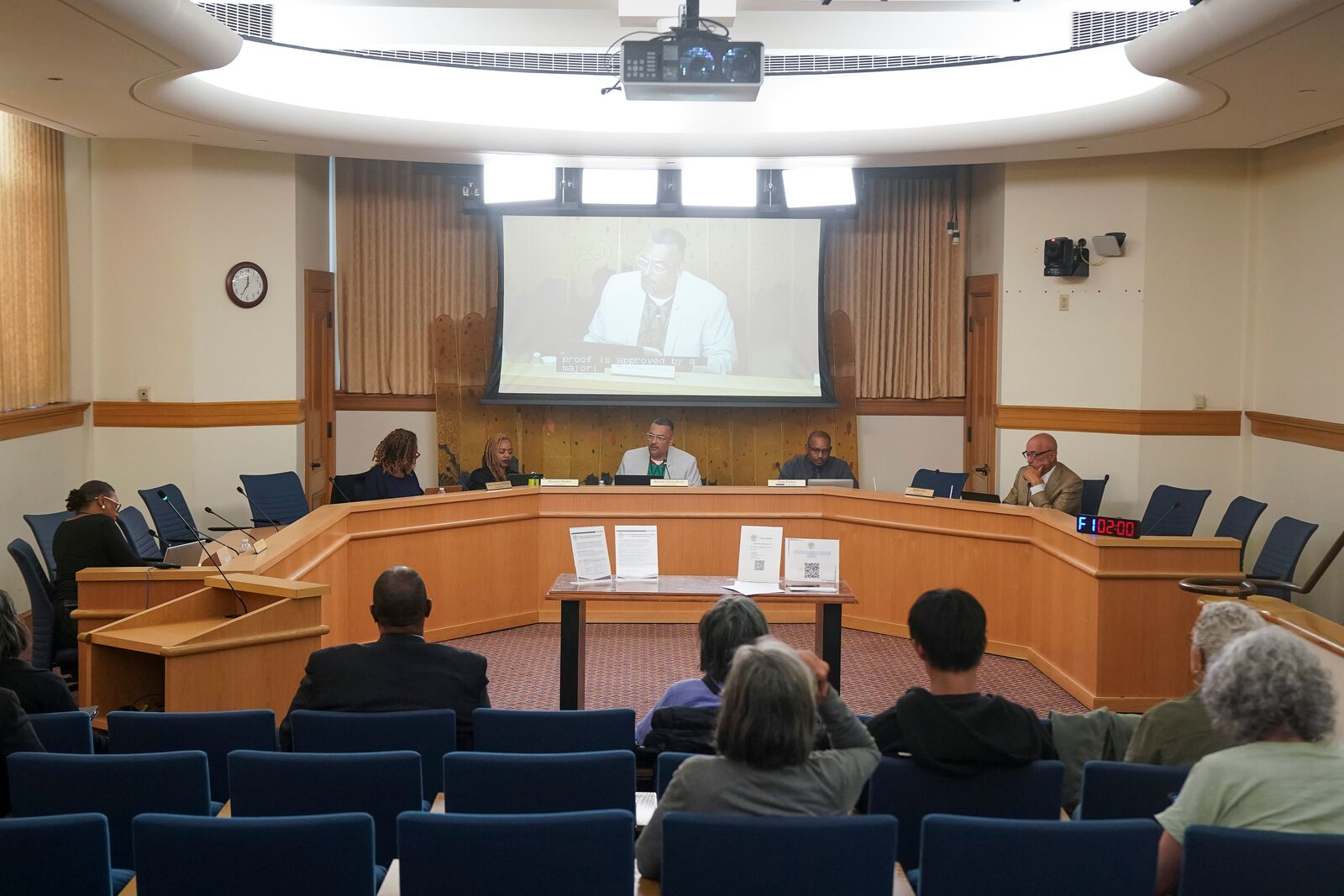 Garcia-Acosta, center, says the Police Commission is considering ways to help the public monitor OPD’s compliance with the reforms after federal supervision. Credit: Godofredo Vasquez for The Oaklandside
Ricardo Garcia-Acosta, chair of the Police Commission, believes the end of federal oversight gives Oakland’s homegrown accountability mechanisms an opportunity to take on a more prominent role.
“We’re committed to rolling our sleeves up and getting to work,” he said at a press conference after last week’s court hearing.
In a recent interview, Garcia-Acosta said the federal monitoring process sometimes focused too narrowly on whether OPD had technically complied with individual tasks and subtasks. The department could check those boxes, he said, while other problems persisted.
He pointed to OPD’s previous period of compliance right before a new scandal derailed its progress toward exiting oversight. OPD had come close to being released from federal supervision in early 2022. But later that year, Orrick prolonged federal monitoring after documents revealed that then-Chief LeRonne Armstrong and other OPD leaders had failed to adequately hold an officer accountable for an alleged hit-and-run with a parked car and, in a separate incident, allegedly firing his gun in an elevator inside OPD headquarters.
“What the last scandal showed me was that [OPD] could be in full compliance, and yet there may be scandals brewing under the scenes that we don’t know about,” said Garcia-Acosta.
Still, he said he’s hopeful the department will continue moving in the right direction under Chief James Beere’s leadership.
One question facing the commission now is how much of the reporting developed under federal oversight should continue. The federal monitor used to file quarterly reports detailing whether OPD was complying with the tasks in the reform agreement.
Garcia-Acosta said OPD could continue producing some of the risk-management reports it previously provided to the monitor and instead present them to the Police Commission and the public. That could give residents a more direct way to track whether OPD continues complying with the reforms, even after the federal court is no longer watching.
Last month, OPD commanders held a risk-management meeting, open to the public, at their headquarters. The sparsely attended meeting included presentations by multiple deputy chiefs describing the various metrics they track to monitor whether certain officers or squads are at risk of violating policies, whether new training or tactics are needed, and other information the department uses to guide its work. OPD hasn’t said whether these public meetings will continue.
The Police Commission is also considering how to regularly highlight OPD’s performance on the court-ordered reforms at its public meetings, Garcia-Acosta said, potentially giving residents more opportunities to follow the department’s progress.
But Garcia-Acosta acknowledged that CPRA and the inspector general are likely to see their workloads increase, making additional staffing even more important. Once the city stops paying the independent monitoring team, he said, commissioners intend to push the mayor and City Council to redirect some of those resources toward Oakland’s own oversight infrastructure.
“The mayor said she’s fully committed to allocating resources to our civilian oversight structures, and we’re looking forward to working with the city to make sure they cash in on those commitments,” said Garcia-Acosta.
Different views on the end of federal oversight
 The Phillip Burton Federal Building and U.S. Courthouse, seen here on Sept. 29, 2026, before the last hearing in OPD’s federal oversight case. Credit: Estefany Gonzalez for The Oaklandside
Anne Janks, a member of the Coalition for Police Accountability, isn’t sure Oakland is actually ready to take full responsibility for ensuring its police department doesn’t violate people’s constitutional rights. She worries Oakland is placing more work on institutions it has historically failed to adequately fund. She said the Police Commission, CPRA, and inspector general’s office remain severely understaffed and under-resourced.
“I don’t know how you can say Oakland is ready when the city administration and council have actively and intentionally decimated the charter-mandated funding for independent oversight,” Janks said.
The city charter states that Oakland “shall allocate a sufficient budget for the OIG to perform its functions and duties.” The charter also requires CPRA to have at least seven investigators.
The next test, Janks said, will be whether the mayor and the City Council will follow through.
“We need to ensure that funding starts immediately, so that these independent oversight bodies can begin to rebuild to do this essential work,” she said.
The coalition’s demands represent one side in the broader debate over the role and effectiveness of Oakland’s civilian police oversight system.
Some residents and community groups argue that civilian oversight has hindered officers’ ability to fight crime, driven away police chiefs, and demoralized the department. Earlier this year, District 7 Councilmember Ken Houston sought to address some of those concerns by proposing changes to the city charter that would significantly reduce the Police Commission’s powers.
The Coalition for Police Accountability — whose members spent years advocating for independent civilian oversight, leading to the commission’s creation in 2016 — argues that those criticisms are misguided and that weakening the commission would go against the will of the voters. Measure LL, which established the Police Commission and CPRA, was approved by 83% of Oakland voters in 2016; Measure S1, which created the Office of the Inspector General, passed four years later with 81% of the vote.
Others have questioned CPRA and the inspector general’s performance, pointing to a city auditor’s report that found both agencies had failed to carry out some of their charter obligations.
Janks rejects the argument that those findings demonstrate independent oversight is ineffective. The city cannot withhold resources from its oversight agencies, she said, and then cite their inability to fulfill all their responsibilities as evidence that the system does not work.
“If you want to criticize them, what you do first is you give them the resources they need, and then you can complain about what is or isn’t getting done,” Janks said.
Loren Taylor, a former City Council member and current leader with Safe Oakland — a coalition founded in August — was no fan of federal court oversight. He described it as “a shackle around the neck of our city for over 20 years.”
“We were subjected to the whims of these outsiders who don’t even live or spend more than one night in Oakland a year,” said Taylor in a recent interview.
Taylor said federal oversight complicated OPD’s chain of command because the police chief had to answer to the federal judge and monitor, as well as the mayor and Police Commission. He also said officers have told him the additional scrutiny led them to “err on the side of less interaction with the community” to avoid complaints, paperwork, and other administrative burdens.
Ending federal monitoring does not mean Oakland needs to create a local replacement for the monitor, Taylor said.
He believes Oakland’s civilian oversight structures have already been doing much of the work needed to hold the police department accountable. The federal monitor and judge provided an added backstop, he said, rather than performing the day-to-day work of the Police Commission, CPRA, inspector general, and internal affairs.
Taylor also pointed to the mayor’s creation of a constitutional policing administrator in her office, who is tasked with improving communication among OPD, the city administration, and civilian oversight bodies, as a positive sign.
“The monitor was not actually doing the job for us,” Taylor said. “The monitor was just an additional layer of oversight, review, and approval.”
Taylor said he and other Safe Oakland members — including the NAACP Oakland branch, former OPD Chief Armstrong, and leaders of local chambers of commerce — plan to continue attending Police Commission meetings, communicating with OPD and civilian oversight leaders, and reviewing reports to help residents understand whether the department is maintaining its reforms.
Even with resource constraints, civilian oversight leaders remain cautiously optimistic. With the city no longer expected to spend more than $1 million annually on the independent monitoring team, Maloof hopes some of that money can instead support the Police Commission, CPRA and his office.
Garcia-Acosta said discussions about that transition are already underway. City leaders have been talking about restoring frozen positions, he said, including investigators for CPRA and auditors for the inspector general.
In the coming months, Orrick is expected to issue a written order formally dismissing the case. Civilian oversight leaders told The Oaklandside they hope the judge will provide recommendations for the city’s transition, including how Oakland should support its independent oversight system.
“It will be important for us to understand where the city is going to invest resources and what type of reports they’re going to share with the public,” Garcia-Acosta said.
Maloof said the end of federal oversight is both an opportunity and a test of the commitments city leaders made in court.
“I’m optimistic that we’re going to get those resources that we’ve been trying so hard to achieve for the past four years,” he said.
“*” indicates required fields