
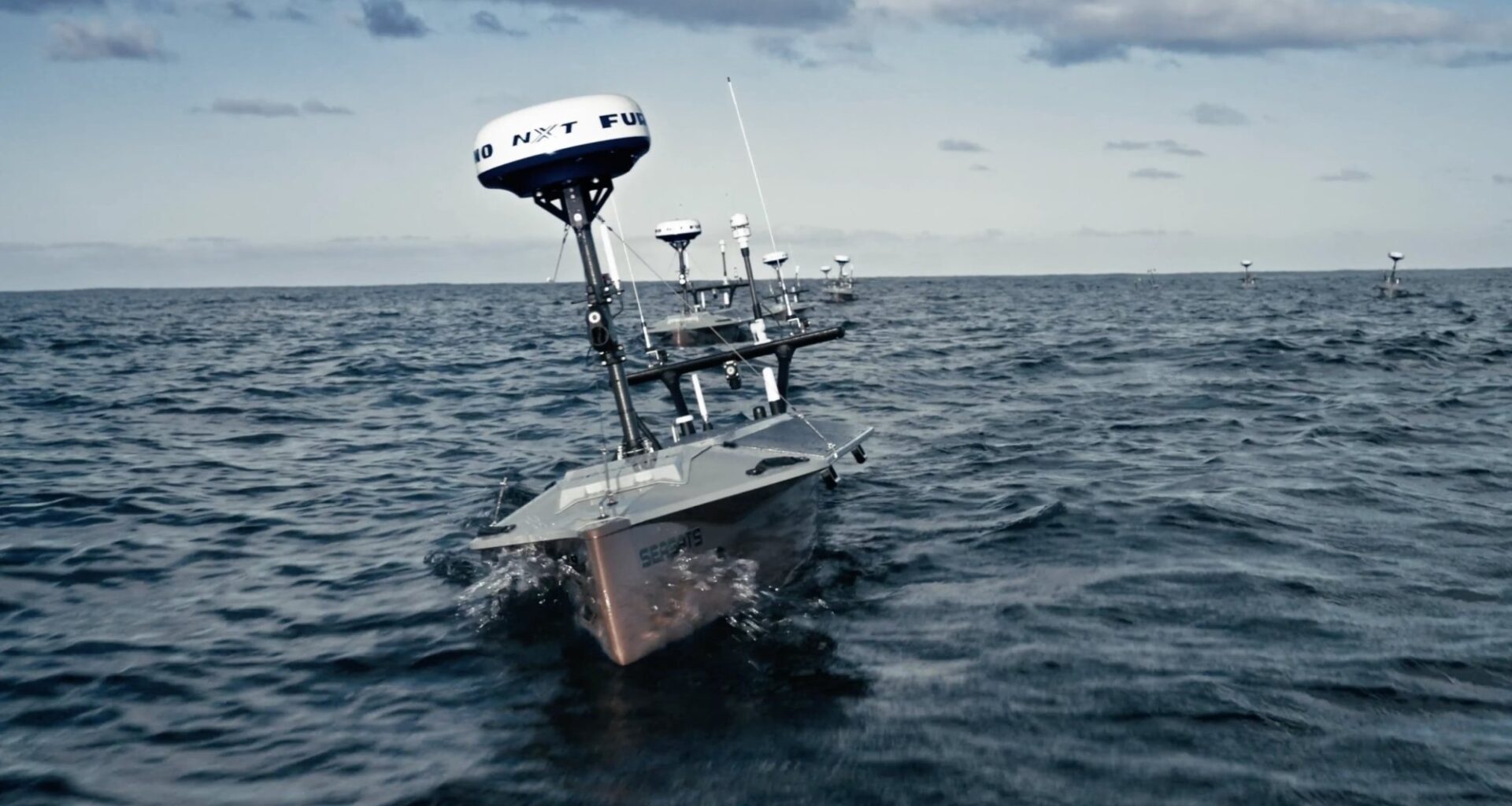
San Diego sea-drone company Seasats opened a new headquarters Tuesday to ramp up production of autonomous boats now being ordered by the Pentagon.
Seasats is part of a major Pentagon initiative along the southern U.S. border. Under “Operation River Wall,” dozens of low-cost marine drones have been deployed on the Rio Grande, across the Gulf of Mexico and into the Pacific Ocean near San Diego to deter narcotics trafficking and illegal activity.
Since launching the operation in January, the Pentagon reports that the fleet has averaged 452 detections, 350 apprehensions and 100 turnbacks per month, showcasing how venture-backed defense startups are reshaping modern surveillance.
Seasats, founded in 2020, gained international clout when it executed the first autonomous unmanned mission through the Taiwan Strait, where it proved how a relatively low-cost reconnaissance drone could capture high-resolution intelligence.
During the five-day mission, Seasats’ flagship vessel, the Lightfish, was able to capture close-up video of Chinese destroyers and warships — critical data that traditional shore-based radar cannot collect.
To date, Seasats has received $2.5 million — with the potential to be awarded up to $15.5 million — from the Department of Defense for Operation River Wall.
For Operation River Wall, the Pentagon also announced plans to expand the Lightfish fleet from 10 test vessels to 50.
The 300-pound vessel packs optical, infrared and sonar sensors. Its drones stream live tracking data into military software, including Palantir’s Maven Smart System and Anduril’s Fortress platform, giving Customs and Border Protection and Coast Guard teams an immediate view of activity at sea.
Production of these high-tech boats happens entirely in-house.
Each Lightfish has 1,500 discrete components, each requiring specialized oversight.
“Everything has to be marinized, connectorized, robustified,” said Mac Woodson, an engineer at Seasats. “We either take apart other devices to get the specialized component or just make it ourselves.”
Dozens of software engineers develop the systems that govern the drones’ decision-making at sea, while mechanical engineers work through detailed checklists to ensure the small skiffs can withstand the towering waves they’ll face during six months on the water.
If an enemy captures one, the Lightfish has a “sink button” that can destroy the system and safeguard sensitive data.
“We haven’t had to sink any ships yet,” Woodson said.
The Lightfish sells for about $240,000. “Our goal is attrition,” Woodson said. “If we can produce a drone that is not very expensive, if it gets lost, captured, blown up, stolen, it’s not a big deal, right?”
Seasats is one of several companies pursuing autonomous maritime drones. Saronic, Saildrone and Splash are developing vessels aimed at similar military and commercial applications.
During the company’s ribbon-cutting, potential contractors pressed engineers about specialized missions, while investors inquired about what’s next.
“That brings us to the Quickfish,” said Woodson. He walked down the production line, stopping at a row of huge gray torpedos.
He put his hands on the 17-foot, high-speed autonomous surface vessel. One had a shark’s menacing smile painted on the tip of the bow.
The Quickfish is faster than the Lightfish and designed to carry larger payloads.
And the best part? “They can be prepackaged, like an IKEA-style kit,” said Woodson. The aluminum drone is designed to be shipped in a box and assembled on-site without complex tooling.
He specifically noted Taiwan’s stated desire to buy over a thousand unmanned autonomous surface vessels in the near future.
It’s still in a pilot program, with no orders yet. “We are betting on ourselves,” Woodson said.