
On Nov. 3, San Francisco voters will be asked to pass judgment on no fewer than 25 ballot measures, 10 of them local. This is direct democracy run amok: Citizens doing what we pay elected representatives to do for us.
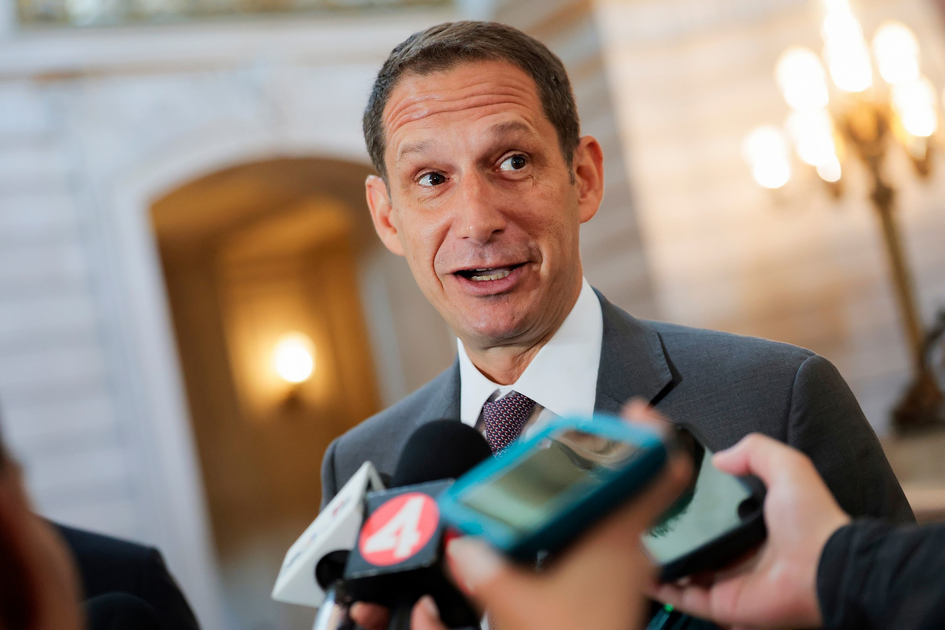
But in an act of sanity amidst this nonsense, Mayor Daniel Lurie is using one of those initiatives to ensure we’ll face fewer inane ballot decisions in the future.
That measure, Proposition D, is one of three Lurie is supporting as part of an effort to amend the city’s charter. It would raise the number of signatures required to ask voters to pass a city ordinance, making it more difficult — and more expensive — to fling special-interest junk onto the ballot.
Currently, it takes a laughably low 2% of registered voters — just 10,000 signatures — to qualify a measure for the ballot. Lurie wants to raise that threshold to 8%. Most of the state requires around 10%. “I told an assemblymember who is from L.A. that our threshold was 2%,” Lurie said to me in a wide-ranging interview last week about the upcoming election. “He was like, ‘What? You’re joking. That’s insane.’”
It is insane, as are the charter provisions that allow just four of 11 members of the Board of Supervisors, or the mayor, all by him or herself, to place a measure in front of voters. Prop. D would zap those provisions by removing ballot-placement power from the mayor and requiring a six-member majority of the board to advance a measure. This way, legislators would be forced to legislate: Either pass a law themselves or achieve consensus on what to ask voters to approve.
So far so good.
But as opponents will happily tell you, one drawback of Prop. D is that it benefits those with money. Which is why they’re billing it as a Lurie power grab, even if the mayor would lose some of his own ballot-tweaking power if it is passed. In our messed-up process, signature gatherers make on the order of $10 per signature to qualify measures. This means that placing something on the ballot costs a minimum of $200,000 and would jump to $800,000 at the new threshold. And those costs can rise if the market for signatures goes up, as it did this year when the billionaires fighting the Prop. 40 wealth tax started paying even bigger bounties per signature.
Lurie’s backers have raised $12.5million to promote Prop. D and two other charter-reform measures. Labor groups and their allies have raised a mere $200,000 to fight it. Guess who is likely to win?
For this, Lurie is unrepentant. “It’s free to get six supervisors to put something on the ballot,” he said.
That’s glib, but he’s right. If I could wave my magic wand, I’d bump the threshold so high (say, requiring one third of voters or an eight-vote supermajority of supervisors) that ballot initiatives would become rare occurrences. Lurie said his charter-reform team had been leaning toward a 10% threshold but ended up at 8% — a “good compromise” with “our partners in labor,” (opens in new tab)some of whom (opens in new tab) backed the measure.
Labor is quite capable of raising the big bucks needed to wage ballot campaigns, which may explain why it is not fighting back against Prop. D. Mike Casey, president of the San Francisco Labor Council, said his group is particularly unhappy with nixing the minority-of-the-board path to the ballot — unions often can rely on four supervisors to do their bidding, but six could be a stretch — but fighting Lurie on this issue is not its top priority. “Electing Connie Chan is our first, second, and third priority,” he said of the labor-friendly supervisor locked in an increasingly bitter fight with state Sen. Scott Wiener to succeed Nancy Pelosi in Congress.
Bumping up the ballot threshold will stop some of the tomfoolery that passes for democracy in San Francisco. (Fun fact: Recalled Sunset supervisor Joel Engardio might have been prevented from self-immolation had he not been able to place his 2024 measure to close the Great Highway on the ballot with a minority of the board. That measure passed with five votes.) Lurie pointed to Prop. I on the November ballot, a measure concocted by former Supervisor Dean Preston that mandates how a city real estate tax is spent on affordable housing. “It wouldn’t require one unit of affordable housing to be built,” said Lurie. “It is exactly what we’re trying to fight against.”
San Francisco’s ballots for years have been littered with similar special-interest trickery and irresponsible slop. A 2018 measure to combat homelessness, the (opens in new tab)“Our City, Our Home” tax (opens in new tab), allows no more than 10% of the funds to be used on homeless shelters, a handcuffing out of step with current priorities. A 2022 initiative sponsored by the affordable-housing manager TODCO, intended to tax Amazon, had to be yanked from the ballot because — wait for it — it did not tax Amazon. (TODCO, as it happens, is the largest current backer of the opposition to Prop. D.)
The mayor is taking other swings at reforming the city charter — so far, with little opposition. Prop. E grants more power over contracting to the unelected city administrator by, among other things, making it more difficult for the Board of Supervisors to meddle in contracting. That’s a positive step. Prop. F makes it easier for the mayor to hire and fire most department heads and allows him to name deputy mayors to help run the city.
The Prop. F moves are worthwhile if duplicative. Mayors already have wide latitude on high-level personnel. In 2019, for instance, London Breed (opens in new tab)chased out the head of the SFMTA (opens in new tab), even though its board, not the mayor, is technically supposed to make that call. Lurie already has swapped out department heads in less than two years in office.
What’s more, Lurie effectively has been ignoring the prohibition on deputy mayors by giving a group of “policy chiefs” the power, if not the legal authority, to oversee city departments. These are quibbles, though. A strong mayor should have his own team in key jobs, and it makes sense to codify that into law.
Still, granting more power to this popular mayor raises the concern, as good-governance think tank SPUR has voiced, of “misuse or abuse by an ineffective or unprincipled mayor” — the Trump Dilemma at a local level. Lurie argues, however, that expanded mayoral control will make him and his successors more accountable, not less, especially when compared to the current finger-pointing among supervisors, department heads, and various commissioners. “Guess what?” he said of strong but accountable mayors. “The voters get to vote us in or out every four years.”
There are ironies in this process that must be acknowledged. In his quest to thwart special interests from writing their own legislation, Lurie wrote his own legislation. True, he convened a powerless working group to discuss charter reform — and then had his team draft what they wanted anyway. Additionally, the most prominent backer — and biggest funder — of charter reform has been Michael Moritz, chairman of The Standard. For him, a victory for Props D, E, and F would be a win in what has been a (opens in new tab)years-long, up-and-down journey (opens in new tab).
In deciding to back these measures, you need to believe they will make government work better, not serve any particular politician or billionaire. I, for one, do.
In December, I fretted that Lurie would be unambitious with charter reform. In fact, he punted on two of the most grievous stains on San Francisco government: the charter’s arcane protections for city workers and the proscribed levels of funding known as set-asides that tie the hands of the mayor’s budgeteers.
Lurie, as he so often does, opted instead for a more modest plan he thought would win, rather than going for broke and courting defeat. In our interview, he didn’t challenge that assessment. When I asked if he would try again to do the harder stuff in a future election, he said, “If we’re able to pass these three, then let’s keep seeing where we can make government more effective, more efficient, more accountable to the people of San Francisco.”
I might not love everything about Props. D, E, and F, but I can’t deny their simple appeal: We need a little more democracy to curtail the city’s extreme version of democracy.