
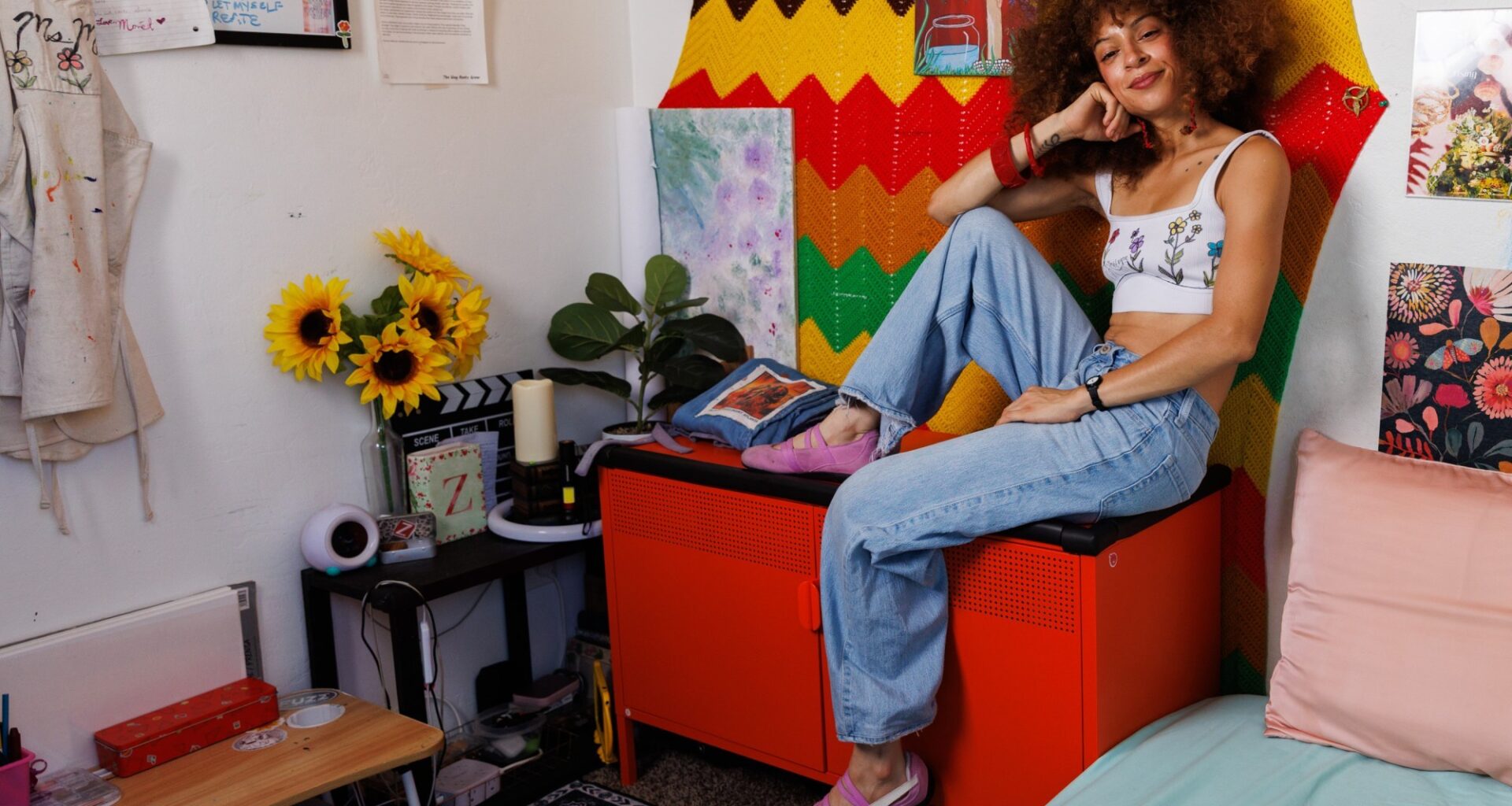
Her work is already rooted in using art as a way to reflect and connect, understanding the creative process as a path to better understand who we are, where we come from and how we see ourselves. An opportunity at the Bonita Museum & Cultural Center was the right fit for artist Monét Nyree Panza to share with her community.
“I wanted to bring a workshop involving collaging, in general, and because the Bonita Museum has such a rich way of valuing history. I’ve seen archivists there, so I wanted to do something that honors people’s families,” she says. “They said that would be perfect for Día de los Muertos, and in correlation with the exhibition taking place.”
“La Ruta de Nuestros Ancestros/The Path of Our Ancestors” is the museum’s Día de los Muertos exhibition, featuring a community artist collective with mixed media art inspired by the traditions and teachings each artist carries with the holiday. The exhibition opens Saturday and will be on display through Nov. 3, with a reception scheduled for 4 to 8 p.m. on Oct. 17. Also on Saturday, Panza is leading a collaging workshop as part of the exhibition and holiday celebration. “Collaging & Commemorating/Día de los Muertos” is from 3 to 7 p.m. at the museum, and participants can bring photos of loved ones to make a collage that celebrates each person’s life, memories and their story (RSVP online to secure a spot).
Panza, 28, (who goes by Monét Nyree in her artist work) lives in Paradise Hills with her daughter, Zula. She grew up in southeastern San Diego, stepping into the arts at Valencia Park Elementary School, later earning a bachelor’s degree in Africana studies and humanities from San Francisco State University, and previously working with San Diego Repertory Theatre and Project New Village. A multidisciplinary artist and creative director, she’s also a teaching artist and events assistant with A Reason To Survive, and took some time to talk about her work and the value of honoring and remembering ancestors.
Q: Your bio says that you work in multiple disciplines, including photography, collage, visual art and community-centered creative experiences. What kind of community-centered creative experiences are you referring to?
A: My community-centered creative experiences, lately, have been for the youth and families. I just led a youth art lesson with an organization called Park Takeover, and I had them create portraits where everybody got to take a photo and design the frames with different aspects that they love about themselves, about their lives, about their families; getting them in the mindset of thinking about their identities. I also wrapped up a fall camp with A Reason to Survive and the LEAD Program with the Chula Vista Elementary School District, teaching pre-K and kinder students in Chula Vista, and having them draw portraits of themselves in different possibilities — thinking about what they want to be when they grow up, what that looks like, what they look like on an adventure, what they look like helping someone. Getting them in the space of imagining themselves in different roles as they grow up.
What I love about Paradise Hills…
I grew up in Southeast and Paradise Hills, so I love that this neighborhood carries the same energy in the sense where it’s very calm, but when it’s time to celebrate, there are a lot of lowrider shows, or sometimes there’s a community market. When it’s time for the community to show up, they do. And, when it’s time for everybody to work and do what they need to do, we do, so I like that.
Q: In this workshop you’re leading to commemorate Día de los Muertos and the opening of the “La Ruta de Nuestros Ancestros/The Path of our Ancestors” exhibition, participants will create collages to celebrate the lives of people who have passed away. Walk us through what your plans are for the workshop.
A: When I have workshops, I love to incorporate the body and the mind, so we’ll probably start with a grounding movement, whether it be light stretches or some breath work to get present. From there, I’ll introduce Día de los Muertos and the overall themes, and what we’re creating; the root of our creations, which is honoring our ancestors, honoring how they show up in our lives today, although they may not be physically present; or even honoring just what reminds us of them and how they live on through us. Then, I will introduce materials, so customizing metallic paper frames with a base for their photos, and we will get into collaging and conversations about family members and the correlation with their artwork. Just having a moment to take that time to grieve or feel that joy and nostalgia of our loved ones who are in transition.
Q: Part of the description of this exhibition says “we also acknowledge our Indigenous roots in Día de los Muertos and the ongoing ancestral wisdom that we aim to pass down within the Mexican community today.” May I ask your ethnicity, and whether Día de los Muertos is something that is observed in your family?
A: I come from a Black American household, but my mother speaks Spanish and she was very interconnected with the Mexican community, and I speak a little bit of Spanish. I study the diaspora of my own history, of Black culture and African culture. I’m Jamaican, so there are connections of honoring ancestry. I have a space in my house where I have a photo of my grandmother and my auntie, and I like to leave fruit and flowers there, a really pretty vase of water. I’ve always had those ties and understood what Día de los Muertos meant and the value that it holds in the Mexican community. I also am part Mexican, but I would say that I’m more so raised in a Black household than a Mexican household. My father is Italian and Mexican; his father is Mexican, and then his mother’s father is from Sonora, Mexico, but is Yaqui native. I’m multiracial, so it’s really beautiful to get the story of my lineages and heritages.
When it comes to being involved in Mexican culture, I would say that my nana, I believe, is second-generation. Really, just being in San Diego, it’s very hard to not immerse yourself in Mexican culture and I always embrace it.
Q: Can you talk for a second just about your own practice of celebrating the lives of people who’ve passed away, maybe through ancestral veneration?
A: I do practice ancestral veneration, whether it be through my altar in my home that honors my grandmother, my auntie, my grandpa, or just by the way I live my life and how I move and operate in the world with integrity and grace and the characteristics that they have poured into me. I also like taking time to have moments of silence and breathing, and even just sending them light in their realm, so those are ways where I honor my ancestors. And, similar practices with Día de los Muertos, like offering flowers, maybe sometimes leaving their favorite candy on the space where I have the altar, where I’m honoring them. Those are ways that I would say that I honor my ancestors and those who came before me.
Q: An element of this exhibition includes a maze that represents life’s journey, and the roots left by ancestors for people to carry on through future generations. Is there anyone’s life you would celebrate during this time, whose roots from their life you want to carry on now and pass along to those coming after you?
A: Absolutely, my grandmother, Cynthia Arnette Williams; my auntie, Kristine Marshall. Those are very impactful women in my life who have poured their love, their poise, their tenacity, their endurance, their resourcefulness, and so many things that they have taught me. I definitely try to embody those things. Anytime I’m doing things that are honoring families or youth, I also feel like I am doing that in honor of them, and that they’re very proud of me.
Q: What do you hope your path includes when you become an ancestor? What would you hope the living would remember about you, and continue doing because of the foundation you’ve built?
A: Wow, I love that question. I want to be remembered as an ancestor who always brought joy and radical imagination into spaces, and people’s minds and hearts. I want to be an ancestor remembered for always encouraging hope, but at the same time, actions that will bring about that hope and tangible change. I hope that people remember the light that I spread, and also my realness and grittiness, and how I kind of dance between that spectrum as we navigate on the planet.
Q: What is the best advice you’ve ever received?
A: As cliche as this sounds, I feel like “follow your intuition and follow your gut” has probably been the best advice I’ve ever received — creatively, but also as a human in the world. I think we all have an internal compass of knowing, and it’s been really cool to exercise it as a mama, an artist, a person here on the planet.
Q: What is one thing people would be surprised to find out about you?
A: One thing is really silly, but when I was little, I got a popcorn kernel stuck in my ear and I had to go to the doctor to get it out, and I got ice cream after.
Q: Please describe your ideal San Diego weekend.
A: I would start the day at 6 Grados Coffee, then I would head to Balboa Park and probably take a stroll to a museum. Make my way to Little Italy for lunch, and then head to the beach and just spend the day drawing, meditating, collaging. Then, I’d probably find some nightlife happening, maybe a Future Is Color event, grab some food in the Gaslamp, and then head home. Something quaint.
To suggest someone for the One-on-One series, contact Lisa Deaderick at lisa.deaderick@sduniontribune.com.