
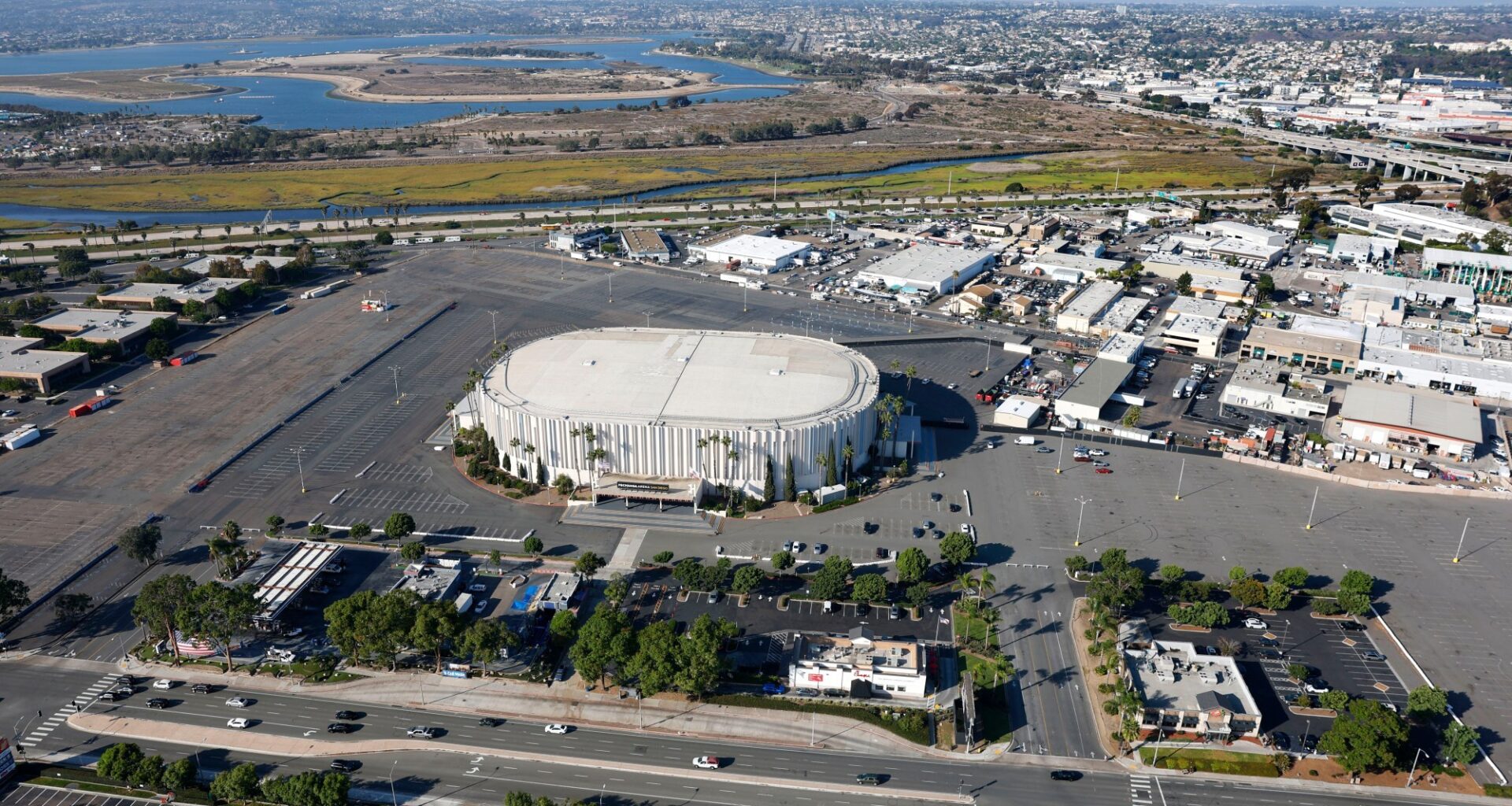
San Diego plans to trade its sprawling sports arena property in the Midway District for maximum value in the form of desired public benefits — and not max cash — as proposed in just-released transaction documents.
The documents, made public Friday, reveal the fine print of the negotiated deal with master developer Midway Rising, LLC, which has been in the works for more than four years. San Diego’s Land Use & Housing Committee will consider the transaction terms in open session for the first time on Oct. 16.
San Diego expects to collect $896.3 million in total rent over the lifetime of the proposed long-term arrangement, which could extend 100 years or more. The net present value of the rental payments, or the current value of future dollars, is $23.2 million.
Midway Rising is planning to redevelop the city’s real estate at 3220, 3240, 3250 and 3500 Sports Arena Blvd. with 4,254 residential units, a 16,000-seat replacement arena, 130,000 square feet of commercial space, 8.1 acres of parks, and an additional 6.4 acres of plazas and public space.
The city will collect rent as a small percentage of revenue generated by the project’s market-rate housing units and retail space, and on a per-ticket-fee basis for the future arena. The deal does not call for rent associated with the 2,000 residential units that Midway Rising is required to set aside for households earning 80% or less of the area median income, or what’s considered affordable housing.
The deal is purposefully not structured as a market-rate transaction, with the city benefiting substantially from the creation of the affordable housing units, new parks and open space, and the new arena, Christina Bibler, who heads San Diego’s Economic Development Department, told the Union-Tribune.
“This is a participation rent structure because their success is our success,” Bibler, who led negotiations on behalf of the city, said. “We have a participation structure that is trading these public benefits in exchange for rent. … It was a trade of what could be done in a $4.2 billion project, and poring over the pro forma (to find) areas that ultimately had opportunities for the city to be successful.”
The fair market value of the land was set at $75.6 million in March 2025, according to an appraisal report by Schneider Valuation Consultants, Inc.
The Midway Rising transaction delivers on what was promised when the team competed in and won the real estate competition to redevelop the land, said Brad Termini, a project leader.
The development team is composed of market-housing builder Zephyr, affordable housing developer Chelsea Investment Corp., and sports-and-entertainment venue operator Legends. The Kroenke Group, a subsidiary of billionaire Stan Kroenke’s real estate firm, is the entity’s lead investor and limited partner.
In September 2022, the City Council selected the team, at Mayor Todd Gloria’s recommendation, largely because of the project’s 2,000 affordable housing units, the most proposed among competitors. The land was being offered for lease under California’s Surplus Land, which requires municipalities to prioritize affordable housing when offloading excess land. At the time, Midway Rising was also said to be seeking the least amount of financial assistance from the city.
San Diego is not only receiving 936 more low-income housing units than required by the state housing law at a value of $548 million, but is also getting an all-new, privately financed, $520 million entertainment venue, and will enjoy $400 million worth of neighborhood-wide improvements and new park space, Termini said.
“For residents of San Diego to understand the value this project brings to the city, all they need to do is go walk down there today,” Termini, who is CEO of Zephyr, told the Union-Tribune. “(The arena) is at the end of its useful life. That asset is going to quickly become a liability. There’s homeless living all around those streets and those parking lots. The area is in despair. So, for the city to take a declining asset that’s in despair, and to be able to turn that in to a revenue-producing asset that’s going to pay $800 million to over a billion dollars in rent over the term of the lease, and get the benefits of a new arena, the benefits of affordable housing, all the infrastructure and parks improvements, that’s a major economic win for the city.”
The proposed redevelopment deal is complex and governed by a disposition and development agreement.
The umbrella contract is structured to allow the city and the developer to enter into a series of subsequent agreements, starting with a 15-year “horizontal” ground lease for 48.5 acres of land once a financing mechanism for the infrastructure work, like a tax increment financing district, is in place.
The city will charge $100,000 in rent per year during the horizontal lease term, with the developer using the period to ready, in three phases, between 16 and 20 individual pads for vertical construction.
Once a horizontal phase is complete, the city will then enter into 85-year, “vertical” ground leases for each development pad. During the vertical lease term for a pad with market-rate housing and retail, the city will charge rent as a percentage of gross revenue, or 0.5% of revenue through year 55 and 2.5% thereafter.
The umbrella contract also incorporates Midway Rising’s recently extended lease for the existing sports arena. That keeps in place roughly $2 million in annual rent payments until the replacement venue is built.
A separate, 85-year lease agreement for the future entertainment venue will be structured to collect rent on a per-ticket basis after the new arena has been in operation for 10 years.
The fee will start at $1.50 per ticket in year 11 and grow by 3% each year. However, the developer will initially only pay 25% of the ticket charge to the city. The remaining 75% will accrue and be deferred until the developer hits a profitability threshold, which is defined as a 16.5% levered internal rate of return on its capital investment.
The disposition and development agreement includes a phasing plan that dictates what can be built and when. The horizontal site work is split into three phases, and vertical construction is divided into five phases.
“It’s layered in a staggered way so that horizontal improvements begin once the financing is in place, and then that initiates site prep,” Bibler said. “And nothing can be built vertically until site prep is underway in a certain manner.”
The timeline of the phasing plan is built around a 2029 construction start date. The first phase of horizontal work extends through 2031 or 2032 and includes all utilities, road and transportation updates, and park space for the eastern half of the property, up to the new street, Frontier Drive.
The first phase of vertical construction is then anticipated to start in 2032 with the new arena, and will be followed by 2033 and 2034 start dates for market-rate housing and affordable housing construction.
The project is expected to be completed in its entirety by 2050, according to the phasing plan.
The city is also requiring a portion of the subsidized units to be constructed alongside the revenue-generating, market-rate units in each of the five vertical phases, the documents show.
For instance, Midway Rising is required to build 249 affordable units in the first phase of vertical construction, or 28% of total units in the phase. The current model in the agreement shows, however, that the developer is expecting to build 500 affordable units and 386 market-rate units.
The deal on the table currently does not include the financials associated with the formation of an enhanced infrastructure financing district, or EIFD, although one is actively being considered.
An EIFD is a type of tax increment financing district, where participating public agencies give their share of future property tax revenue generated by a project to a special district. The money subsidizes the cost to build public facilities and other improvements.
The city and the county are contemplating the formation of an EIFD that is estimated to generate approximately $1.16 billion in revenue to reimburse the developer for project infrastructure costs, currently estimated at $462 million, according to an analysis by city consultant Keyser Marston Associates. The Oct. 16 committee agenda includes a separate item on a resolution of intent to form an EFID for the 48.5-acre project area.
Even if the city opts into the EIFD, it will still pocket tax revenue associated with the project. Over a 30-year operating period, total tax revenue to the city, after diversion of the property tax obligations, is estimated at $151.6 million.
The transaction, as currently contemplated, doesn’t make sense in today’s economic climate, said Norm Miller, a real estate professor emeritus at the University of San Diego.
“Market-rate apartments yield about 4% on cost against a 5.24% Treasury. The city’s ground rent is worth $23.2 million in present value, and its net fiscal gain is only $2.6 million over 30 years. That is a very narrow margin,” Miller said, citing information in a city-commissioned economic impact analysis conducted by Century Urban, LLC. “The deal is not ripe right now, but in two years maybe it will be. If interest rates come down in a couple years, maybe this will work.”
The project, the economist said, does not “pencil” without the infrastructure district and several hundred million dollars of low-income housing tax credits to finance the affordable housing units. The development cost for the subsidized units is $1.6 billion, or $794,000 per unit.
The city’s economic analysis touts that the project will create 23,610 construction jobs and $4.5 billion in direct construction activity. The report also estimates a total, long-term economic impact to the region of $18.4 billion, with $14.7 billion generated within the city. The sum includes direct impacts linked to the redevelopment, alongside indirect impacts to industries in the supply chain, as well as induced impacts from how workers spend into the local economy.