
In the political messaging by the campaign to raise San Diego County’s sales tax rate, the stakes are portrayed as life or death.
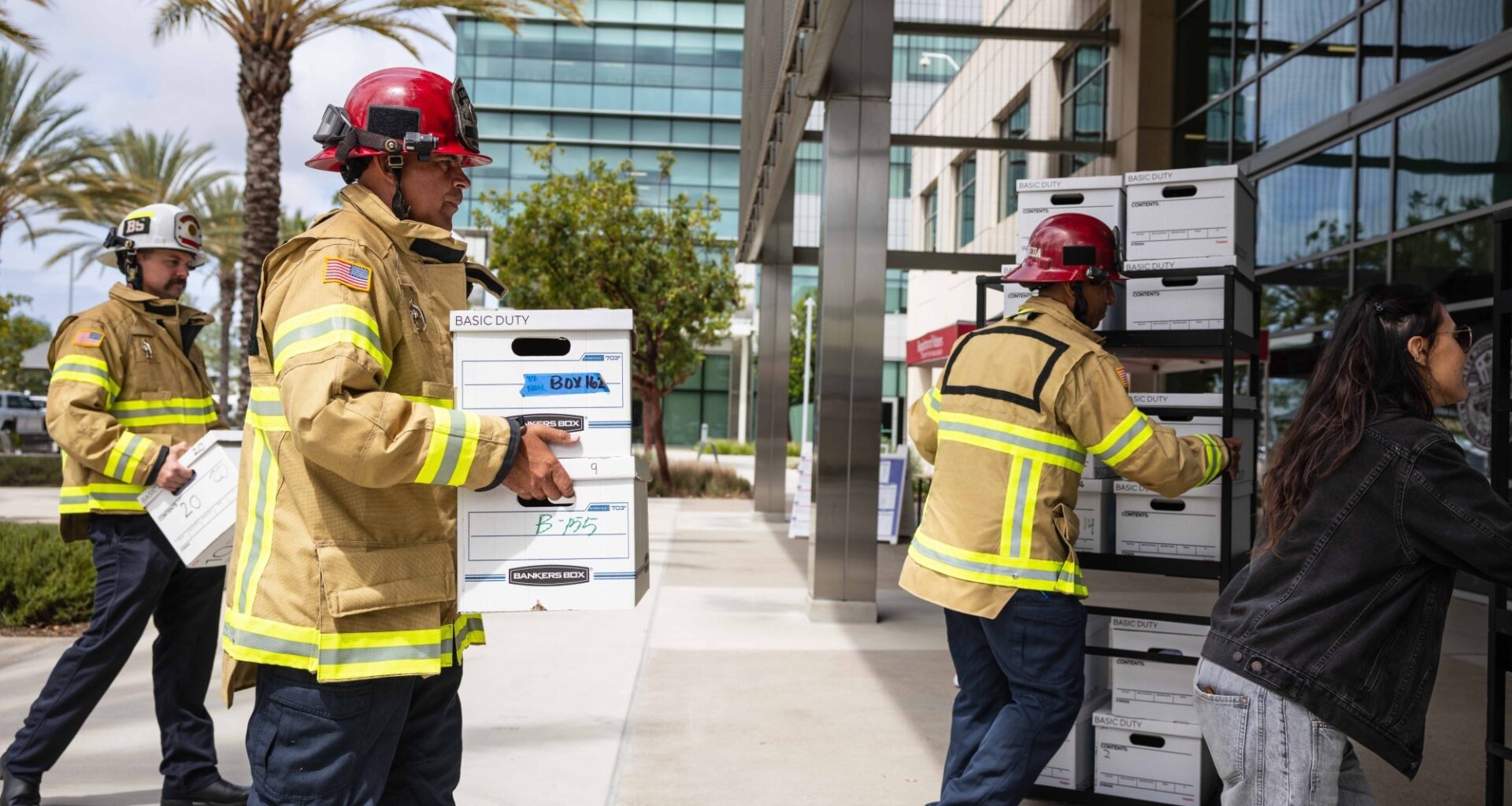
Depicting a county firefighter in uniform, a recent ad for Measure B tells viewers the half-cent tax hike would cut 911 wait times and prevent hospitals from closing. A vote for it “might just save your life,” a firefighter says.
The promises of the campaign go even further.
Measure B, which would raise the countywide sales tax rate by half a cent, is billing itself as a fix for a far-reaching set of problems faced by the San Diego region — among them childcare costs, social safety net cuts, wildfires, healthcare for children and the elderly and the sewage crisis in the Tijuana River Valley.
If the measure passes, taking on all those problems would be up to the government of San Diego County, which would be expected to bring in up to $450 million a year in new revenue. The money would be placed in a dedicated county fund, not the general fund, and by law must spent as the measure requires.
This election cycle, the proposed sales tax hike has turned into a leading issue in county politics, with a broad coalition of labor unions, nonprofits and Democratic supervisors backing it while Republican politicians have mounted a counter-campaign against it.
Backers argue Measure B would give county government greater financial independence and earmark permanent funding to key issues, all with an eye on insulating the region from the whims of the federal government.
“This is about not waiting for Washington, but taking matters into our own hands,” said David Lagstein, the political director for SEIU Local 221, the largest county employee union and a lead sponsor of the ballot measure.
Opponents, among them state Assemblymember Carl DeMaio, argue county residents shouldn’t have to pay more in taxes while county government fails to budget within its means. Another opponent, the San Diego County Taxpayers Association, warns that the sales tax hike, if passed, would be permanent unless overturned or amended by voters.
Measure B needs approval from only a simple majority of voters to pass.
Despite the new ad’s emphasis on public safety, the reality of the ballot measure is that the majority of the funding — 60% — would go to county social services, namely food assistance, healthcare services for low-income residents and childcare programs.
Another 17.5% would go to public safety, split between the county’s fire department and law enforcement.
And up to 22.5% would go to the sewage crisis. The measure doesn’t formally commit to any one project, but organizers have said they want it to go toward a county plan to build a $1 billion sewage treatment plant.
Brian Adams, a political science professor at San Diego State University, said it’s unclear whether the measure’s aim to address so many different issues will prove a strength or a weakness.
Tax measures such as school bonds are often successful for two reasons, he said: They face little opposition, and they formally pledge dollars to very specific projects.
“Given that these categories are so vague and large, I’m not sure that’s necessarily going to have the same effect,” Adams said.
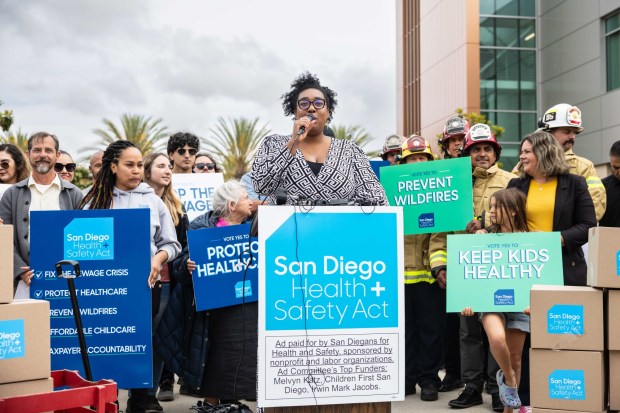 Crystal Irving, SEIU Local 221 president, speaks at a press conference as labor unions and nonprofits turn in signatures for Measure B on Monday, May 4, 2026, in San Diego. (Zoë Meyers / For The San Diego Union-Tribune)
As of mid-September, supporters had spent nearly $2.6 million pushing for Measure B, campaign finance disclosures show. Most of that was through a committee called Yes on B, San Diegans for Health and Safety, that is backed by nonprofits and unions.
The effort has gotten hefty support from prominent local donors, including Qualcomm founder Irwin Jacobs, who gave $250,000, and Manpower staffing agency co-founder Mel Katz, who loaned the campaign $500,000.
But perhaps its biggest benefactor has been SEIU and groups it controls; they have spent $356,000 backing the measure, according to disclosures through Sept. 19.
The union has a material stake in the measure: a clause in its contract allowing for reopening pay negotiations if a new tax measure brings in more county revenue. Crystal Irving, the union’s president, said that clause gives “frontline workers a voice in training and wages.”
Another committee — Children First San Diego for Measure B, Sponsored by Heising-Simons Action Fund — spent $394,000 toward the campaign, financed largely by a donation from the Bay Area-based Heising-Simons Foundation, disclosures show. The committee itself is led by leaders from some of the county’s biggest social services providers, including YMCA of San Diego County and an arm of Jewish Family Service of San Diego.
DeMaio has vowed to spend $1 million to defeat the measure through his conservative political advocacy group Reform California. And a committee controlled by Rebecca Jones, the Republican mayor of San Marcos who is now running for an open county supervisor seat in North County, had spent $94,000 opposing Measure B as of mid-September.
Striking back at H.R. 1
Measure B’s backers say much of the impetus for the ballot measure traces back to H.R. 1, legislation that was pushed by President Donald Trump, who nicknamed it the “One Big Beautiful Bill,” and passed by Congress last year.
The legislation imposes stricter eligibility requirements for Medicaid, administered in California as Medi-Cal, and the Supplemental Nutrition Assistance Program, or CalFresh here. To qualify, people must show they have a job or are in school, looking for work or performing community service, unless they’re elderly or disabled or have young children.
The law also requires people to prove they’re eligible for benefits more frequently to keep their benefits and bars most immigrants and refugees from being eligible for benefits at all.
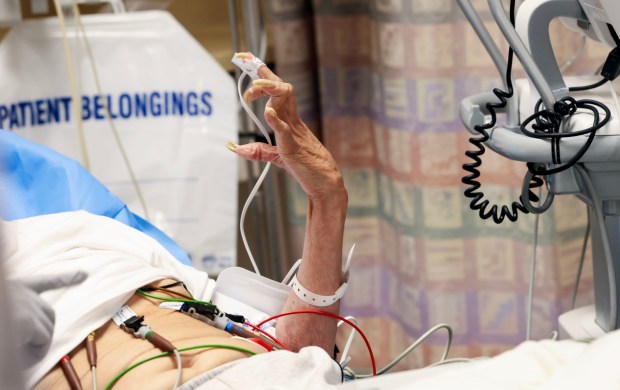 A patient is shown in the emergency room area at Scripps Mercy Hospital in Chula Vista on Monday, Dec. 29, 2025. San Diego County expects to take on millions in new costs to administer eligibility checks for Medi-Cal patients under new federal legislation. (Sandy Huffaker for The San Diego Union-Tribune)
In county government, these changes were met with serious alarm. The county, which administers the region’s social safety net, estimated that hundreds of thousands of people would be subject to new work requirements and that thousands would lose access due to their immigration status or new administrative hurdles.
Estimates of the impact have fluctuated since. But today, the county says that 310,000 Medi-Cal patients could be subject to new work requirements, and 17,000 may lose healthcare coverage because of their immigration status.
County officials have also said close to 100,000 people could gradually lose CalFresh benefits under new requirements that took effect June 1, on top of 13,000 expected to lose eligibility with other recent changes.
Last summer, the county estimated that — under a worst-case scenario, and with no help from the state — H.R. 1 could create as much as $300 million in new costs for it each year.
That figure is still being cited by Measure B supporters. But the county says that worst-case scenario hasn’t materialized for now, as the state has absorbed some of the new costs associated with the law.
At this point, changes to CalFresh have saddled the county with $29 million in new annual costs. New costs to the county for administering Medi-Cal rules now stand at about $24 million a year, though that is expected to rise as the county hires new staff and has to fund programs to provide healthcare to low-income residents.
How much money the county will have to do that is now up to voters.
If passed, up to 38% of the money raised by Measure B — potentially $171 million a year, based on supporters’ revenue estimates — would fund staffing and programs impacted by federal cuts and stricter eligibility for social programs.
Of the overall total, 5% would go to in-home health services for the elderly and infirm, 9% to hiring new county staff to process and check Medi-Cal eligibility and up to 7% to food assistance — no more than two-thirds of that going to hiring new staff for CalFresh eligibility checks.
Seventeen percent would fund county medical services — a little-known and little-used program that provides subsidized medical care for the indigent.
The county medical services program was much larger and more relevant before California expanded Medi-Cal under the Affordable Care Act. In 2009, the county was paying for the healthcare of about 19,000 people deemed indigent.
But as the program is now set up, San Diego County’s is the most restrictive among California’s biggest counties, with income limits far lower and requirements much stricter than those in Los Angeles, San Francisco or Sacramento.
‘Pennies on the dollar’
Another leading selling point that Measure B supporters tout is that it would fund childcare.
“This is really an aspirational and visionary movement to really start creating dedicated funding for childcare at the local level,” said Erin Hogeboom, a board member of Children First San Diego.
If passed, 22% of the measure’s funding — roughly $99 million a year, based on supporters’ revenue estimates — would be set aside for childcare programs. All of that would get directed to the First 5 Commission of San Diego, a county agency dedicated to funding early childhood development programs.
The commission, like others statewide, is funded primarily through tobacco taxes, based on a 1998 statewide ballot initiative — but falling smoking rates have reduced its budget.
“Those dollars are declining year after year, and yet the need keeps going up for families,” Hogeboom said.
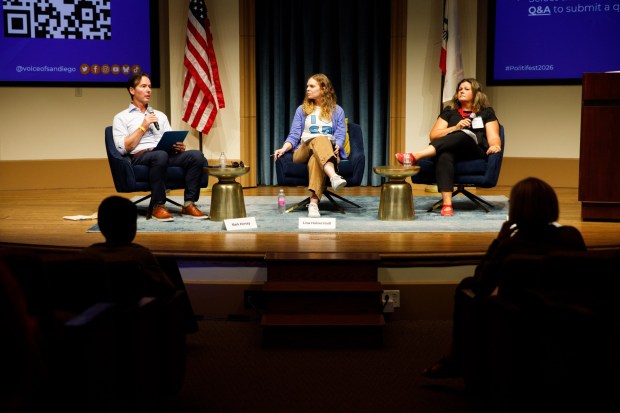 Mark Kersey, CEO of the San Diego County Taxpayers Association, left, and Courtney Baltiyskyy, director of Children First San Diego, right, speak at a forum on Measure B hosted by nonprofit news organization Voice of San Diego at the University of San Diego on Saturday, Oct. 3, 2026. (Kristian Carreon / The San Diego Union-Tribune)
The commission’s existing childhood development programs would get 6% of Measure B’s funding. Eight percent would fund stipends for childcare providers — a bid to preserve worker retention, a pervasive issue in an industry that runs on thin margins and low pay — and another 8% would go to vouchers, a form of subsidy given directly to low-income families to help them pay for childcare.
The effort cites some of the fundamental problems with childcare in California: Subsidies don’t cover childcare providers’ actual costs. State income limits for families to get help are too low for most to qualify, especially in expensive San Diego County. Even many who do qualify can’t actually get vouchers because waiting lists are so long.
“The state (government), for subsidized childcare, pays pennies on the dollar of what the cost of care actually is,” Hogeboom added. “So it’s really meant to support the sector so that we have adequate supply for the increasing demand that we see.”
Fire stations first in line
Backers of Measure B are leaning heavily on how it would fund wildfire prevention and reduce emergency response times, with public safety slated to get 17.5% of any new revenue.
At least 8% of the total revenue would be steered to fire preparedness programs from the county’s fire department, and at least 8% would go to law enforcement. Any of the remaining 1.5% could be spent on public safety generally.
“San Diego County has the means to provide the best fire protection in the state,” said John Clark, deputy vice president of CAL FIRE Local 2881’s San Diego chapter, a lead sponsor of the measure.
For the union, new fire stations would need to be first in line to get money raised from Measure B.
The county fire department plans to replace six fire stations over the next 15 years, according to its capital plan. Next on the list is the fire station in Descanso, a small community in the Cuyamaca Mountains. Replacing it is expected to cost $28 million.
The current station is little more than a house built in the 1940s, inherited by the county during a recent consolidation with some volunteer departments. It’s about 100 yards from the apparatus bay housing the fire engineers, a distance the union says worsens response times.
“All those seconds count,” Clark said.
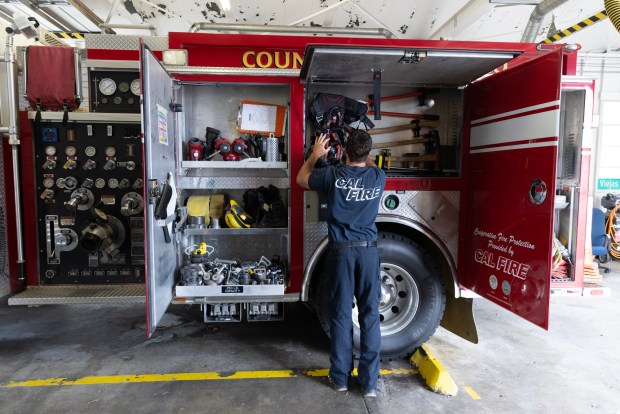 Jake Jarvis, CalFire fire apparatus engineer, checks equipment in the apparatus bay at the San Diego County Fire Station 45 on Wednesday, Sept. 9, 2026, in Descanso. (Luke Johnson / The San Diego Union-Tribune)
Measure B could also reduce the fire department’s need to compete with other county infrastructure projects for funding. Over the next five years, the county has said it plans to spend $1 billion on infrastructure and capital projects, ranging from new hiking trails and libraries to a new Vista jail.
“There’s not an endless amount of money,” Clark said. “Removing ourselves from that list and letting them compete, that’s one less competition in that process.”
Ameliorating the sewage crisis
The remaining portion of the measure’s funding — up to 22.5% — would be slated to fund projects to mitigate the Tijuana River Valley sewage crisis in South County.
But at least 20% has to go to infrastructure and engineering projects to stem sewage flows entering the United States, with any remainder going to general mitigation of the sewage crisis and its health impacts.
When the measure got on the ballot, organizers didn’t identify what engineering projects they had in mind.
But since, county leaders have pinned their hopes for the measure on building a plant to capture and treat the flow of the Tijuana River — not just the sewage flowing into it.
Existing sewage infrastructure near the border only treats wastewater that Mexico captures and conveys to a plant controlled by the U.S. section of the International Boundary and Water Commission. The county aims for a new plant to treat the river itself, after pollution has crossed the border untreated and flowed into it.
In August, supervisors directed the county to begin a $1.8 million engineering analysis to study if it’s feasible for the county to build such a plant. Under their proposal, the county would issue bonds to finance the project.
But the measure leaves the door open for contingencies: Should the sewage crisis end, funding from Measure B could be directed to general “environmental mitigation.”