
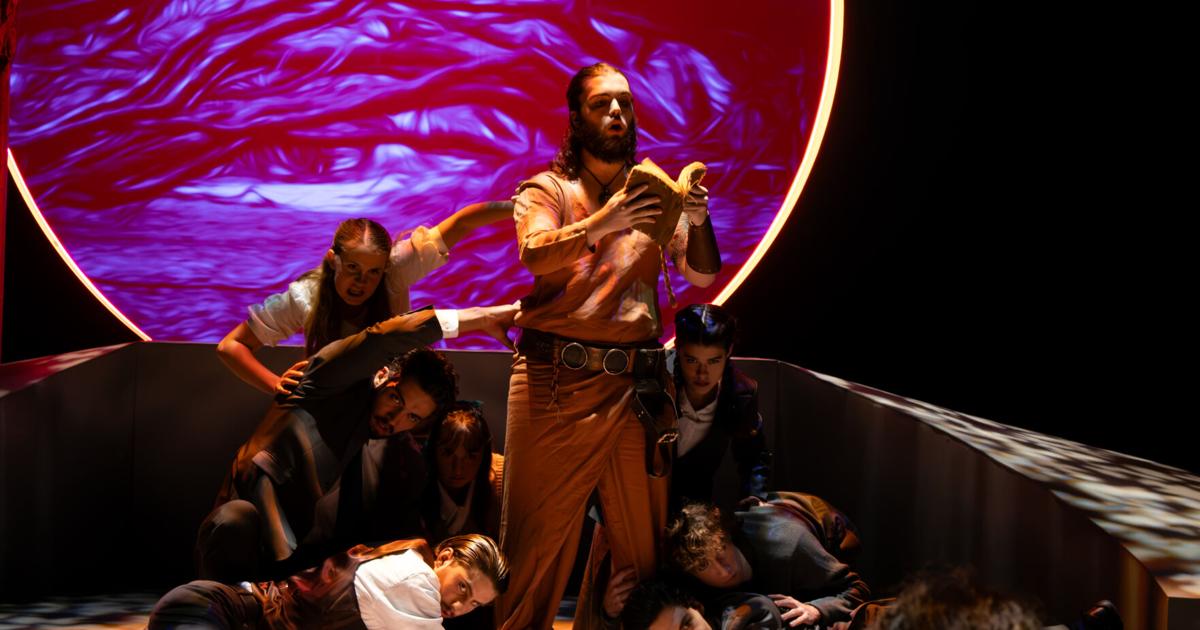
Thanks to powerful performances and a moving script, very few eyes were left dry in the James D. Young Theater Thursday night following the conclusion of the Cal State Fullerton Department of Theatre and Dance’s production of “A Monster Calls.”
Adapted for the stage by Adam Peck and based on the 2011 novel by Patrick Ness, “A Monster Calls” follows the story of 13-year-old Conor as he tries to cope with his mother’s terminal illness.
Conor is forced to deal with conflicts with his Grandma, his estranged father and bullies at school. All the while he receives visits from a monster who tells him three stories in exchange for one of his own after the three are done.
“A Monster Calls” is heavy on emotions, with the tension rising to a crescendo as Conor reaches his breaking point.
Despite this, the script also included humor throughout the first act which helped audiences grow attached to the characters and provided genuine hilarious levity for the first half. However, rather than turning into a tragedy for the second act, the latter half of the play instead focuses on instilling hope and not letting oneself be afraid of expressing emotions.
The story is heartbreaking, yet it has a heartwarming message based on several themes which include two conflicting things existing simultaneously, empathy toward others, and the correlation between human emotions and current life experiences.
“He’s a little kid who’s dealing with emotions that we deal with as adults,” said fourth-year devised performance/physical theater major TJ Rodriguez, who plays Conor. “He’s dealing with holding in his emotions while holding so many and I think that it’s important to realize that it’s okay to let those emotions out.”
Aiden Betts as the Monster was easily one of the strongest performances in the show. While he did not provide a voice for a giant tree monster, he nonetheless made up for it with a commanding physical presence on stage that brought the character to life.
Betts’s varied facial expressions, mannerisms and line delivery alongside how well he and Rodriguez worked together on stage led to a memorable performance that contributed greatly to the comedy in the first act and the more serious scenes in the second.
Caylie Natsch as Conor’s mother, simply referred to as “Mum,” was another standout performance. As the emotional heart of the story, Natsch excelled in giving off an endearing motherly warmth which grew weaker in correlation with her health.
From the portrayal of physical pain due to the illness and the emotional pain she felt from it affecting her son, Natsch’s performance allowed the emotional moments to land as intended.
With that said, while she did a fantastic job altering her voice to sound weaker as the play progressed, it in turn weakened the delivery of a highly pivotal and emotional monologue. However, the success of every other part of her performance allowed the lines to still be incredibly impactful, but slightly less so than was likely intended.
Between Conor’s nightmares and his experiences with the school bullies, the show featured no shortage of action. With stage combat being director Michael Pollak’s specialty it was, unsurprisingly, spectacular.
The choreography of Rodriguez being thrown around and lifted across the stage felt like a forceful yet fluid dance. Meanwhile, the violence looked brutal and realistic, to the point that it even caused the audience to flinch.
The show has little to no actual dancing but still includes a lot of physical movement from the actors both while on stage and while moving to and from backstage.
The entire cast except for Rodriguez and Betts transformed throughout the entire production. Alongside their designated characters, they served as part of an ensemble, changing characters when necessary. This would include becoming extras in miscellaneous scenes, threatening figures in Conor’s nightmares or the characters depicted in the Monster’s stories.
Each different role partook of different body language, from contorted feral and monstrous in the nightmare sequences to extras just sitting on stage where and however needed in other scenes.
There were very few if any negatives worth mentioning that go beyond nitpicks or personal grievances. One worth noting, however, was the inconsistency of props.
For the most part, the props were effective and added to the scene. Some, however, ended up being distracting. Furthermore, there were times when, for example, the absence of a tea cup was glaring and while the improvisation was done well on the actors’ part, it would’ve worked better had a teacup actually been there.
“A Monster Calls” is a tale of anticipatory grief and the feeling of loneliness that accompanies it. However, it also comes with a powerful uplifting message that is highly recommended to experience.
Performances will continue until Oct. 17. Information about specific dates, times and tickets can be found on the CSUF Department of Theatre and Dance website.