
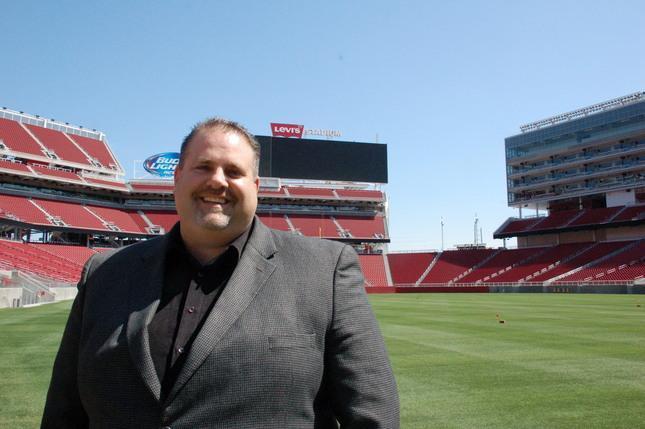
REDWOOD CITY — The former general manager of Levi’s Stadium, who was investigated for conflicts of interest in handling contracts, has been charged with misuse of public funds, embezzlement and 20 counts of bribery for an alleged scheme in which he awarded contracts for a San Mateo County nonprofit to a childhood friend, who then gave him $1.4 million in kickbacks, prosecutors said.
James “Jim” Cunningham Mercurio, a 55-year-old resident of Vacaville, was formally charged on Thursday alongside Michael Joseph Mclennan, a 66-year-old resident of Los Altos, after being indicted by a grand jury following two weeks of reviewing evidence in the case, according to the San Mateo County District Attorney’s Office.
Mercurio and Mclennan were each charged with two counts of misuse of public funds, one count of embezzlement and 20 counts of bribery, according to court records. Mclennan was additionally charged with one count of forgery. All the charges carry an aggravating factor of white collar crime, which could extend the sentence.
Both defendants pleaded not guilty on Thursday in front of San Mateo County Criminal Presiding Judge Jeffrey B. Jackson, where they were both remanded into custody on $750,000 bail. Lawyers were set to argue a motion to lower bail on Monday.
San Mateo County District Attorney said that each bribery count corresponds with a specific instance of payment of money between Mclennan and Mercurio.
“It’s semi-sophisticated corruption here,” Wagstaffe said. “For our county, this is shocking corruption. We don’t encounter this.”
Brian Getz, Mercurio’s defense attorney, said that his client is from Redwood City and has been very involved in San Mateo County affairs after working with the San Francisco 49ers, adding that he has “a lot of community support.”
“Jim Mercurio has never had so much as a parking ticket his entire life. He has a solid record for community service and has been en executive in both the public and the private sector for more than three decades,” Getz said. “We look forward to resolving it in court.”
Michael Guingona, Mclennan’s defense attorney, did not respond to a request for comment.
Between October 2024 and March 2026, Mercurio worked as a construction project manager for the nonprofit San Mateo County Events Center, where he was tasked with overseeing three construction projects that each received $1 million in county taxpayer funds, prosecutors said. In this role, he was paid a “sizable” salary in the high six figures to guide the projects to completion, which included the renovation of a bathroom, the construction of an RV park and the construction of a resiliency center, Wagstaffe said. The alleged kickbacks did not occur on the resiliency center project.
Mercurio allegedly directed those contracts fo Mclennan, who then returned portions of the money from those contracts to him, prosecutors said. Mclennan was a childhood friend, Wagstaffe said.
“He was supposed to put it out for bid,” Wagstaffe said. “Mclennan was just a small contractor who suddenly got into some big time contracts. … Mclennan would kick back part of that money he was paid to Mercurio for steering the contract to him. I mean, major kickbacks of money that Mercurio was not entitled to because he was being paid by the events center close to a million dollars just as the project manager for all these projects.”
The alleged embezzlement was discovered when one of the construction companies hired for the projects — which were ultimately built — reported the fact that they had not been paid to the county, prosecutors added. Investigators found that the total kickbacks to Mercurio added up to $1.4 million.
The payments were given to Mercurio both as direct payments and through purchases of goods and services, Wagstaffe added.
“Mclennan was running out of funds to pay his contractors, the people doing the actual work — because those buildings were being built by legitimate construction people who were contracted,” Wagstaffe said.
On the forgery charge, Mclennan is accused of falsifying a construction performance bond — which is a way to guarantee the payment of a construction project, Wagstaffe added. But when one of the unpaid construction companies went to the county attorney to raise issue with the fact that they had not been paid, the attorney realized that there was no performance bond for the projects.
Wagstaffe noted that Mercurio’s work with the 49ers, which was similar in nature to what he was tasked with at the events center, ended because of “some problems.”
In 2019, the city of Santa Clara filed an ethics complaint against Mercurio, accusing him of a conflict of interest for investing in two companies that worked with Levi’s Stadium. In his role as general manager, where he was managed by the San Francisco 49ers, he oversaw contracts and expenses paid for by Santa Clara. California’s Fair Political Practices Commission, an ethics watchdog, launched an investigation into the allegations a few weeks later.
Mercurio was fined $2,000 for failing “to timely disclose a source of income” on his 2018 economic interests form, according to a November 2022 news release from the FPPC.
If convicted, Mclennan and Mercurio could face more than 20 years in prison, Wagstaffe added.