
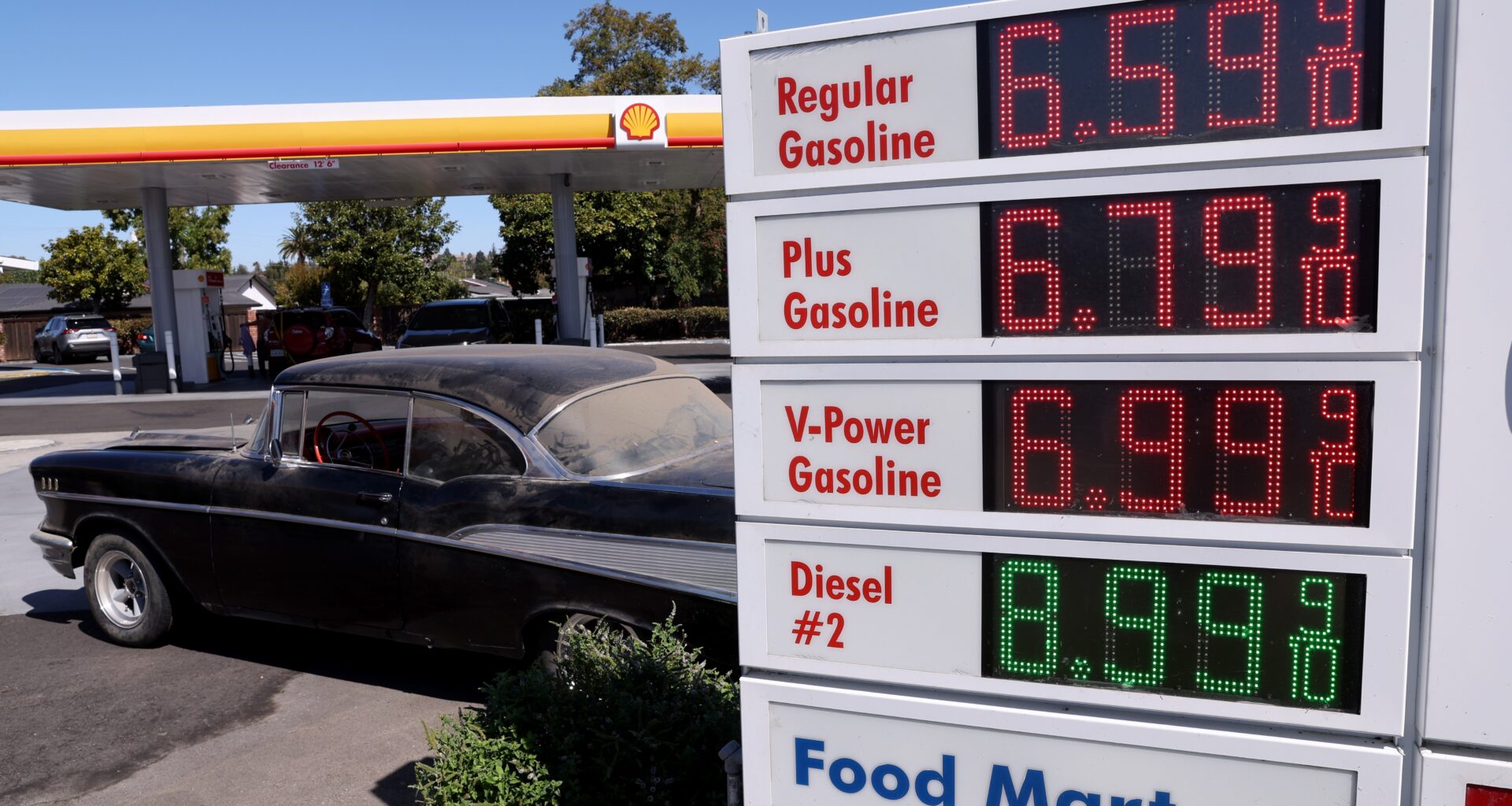
While the ongoing war with Iran has contributed to inflated gasoline costs across the country, today’s national average would seem like a bargain to Californians, who’ve long paid the country’s highest prices.
California’s current highest-in-the-U.S. statewide average of $6.31 per gallon of regular gas is almost $2 more than the $4.36 national average, according to AAA. It’s $2.48 more per gallon than the $3.87 average in Texas, $2.17 more than the $4.18 average in Florida and $1.88 more than the $4.47 average in New York. Parts of California are seeing even higher prices — in Mono County east of the Sierra Nevada, the average is $7.25.
With no relief in sight, the political rhetoric around gas prices has intensified heading into the November election. Gov. Gavin Newsom has criticized President Donald Trump for saying it’s a small price to pay to keep Iran from developing nuclear weapons. Steve Hilton, the Republican running to succeed Newsom, has said he’ll bring gas prices down to $3 a gallon by trimming state taxes and environmental programs that contribute to higher fuel costs in the state. Xavier Becerra, his Democratic opponent, said Hilton’s plan would roll back the state’s environmental protections.
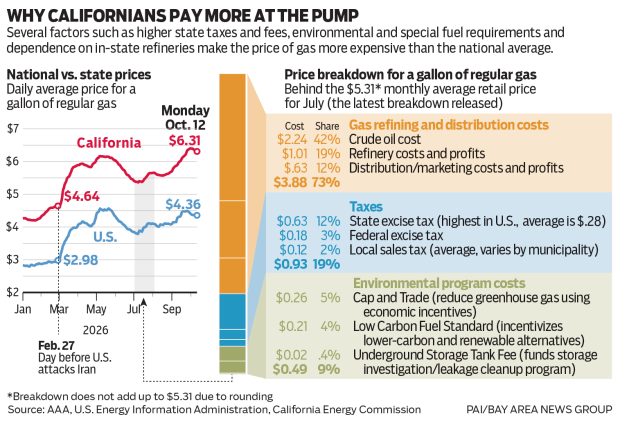
So what’s up with California’s especially high gas prices? State officials and industry experts at AAA point to higher state taxes and other added costs for environmental programs, unique fuel blend requirements to reduce air pollution, an isolated market and more limited industry infrastructure, including refinery capacity and pipelines.
“Short answer is, California gas prices are among the most expensive in the U.S. due to unique environmental regulations and taxes,” said Doug Johnson, communications lead with AAA Mountain West Group. “With more cars than any other state, California also has higher demand.”
The California Energy Commission notes that the state’s fuel market is isolated — no pipelines bring gasoline in from other states — and the California’s fuel blend requirements mean it can’t use gas from other states. Limited refinery capacity means unexpected maintenance issues can create shortages and price spikes.
While California’s consumption of oil, from which gasoline is refined, is less today than it was 30 years ago, the state is far more reliant on foreign oil supplies, which the California Energy Commission says means that “international supply shocks may last longer for Californians because resupply time is longer.”
California 30 years ago produced nearly half the oil consumed in the state, with more than 40% coming from Alaska and less than 10% from foreign suppliers. Today, California produces just 23% of its oil, with 16% from Alaska and more than 60% from foreign sources, mostly from the Middle East and Central and South America.
According to the U.S. Department of Energy, California’s 63-cent per gallon state gas tax is the highest in the country and more than double the 29-cent national average. The gas tax is 20 cents in Texas, 22 cents in Florida and 8 cents in New York. The California Energy Commission says the state’s tax funds road repairs, highway maintenance, bridge safety, public transit, and bicycle and pedestrian projects.
State sales taxes and fees, such as the underground storage tank fee, add 10 cents a gallon to California’s total state cost, almost twice the 6 cent national average. Texas doesn’t charge such fees, Florida’s are 18 cents and New York’s are 16 cents.
There also are local sales taxes.
California’s environmental and climate programs add costs as well. They include the Cap-and-Invest Program, formerly known as Cap-and-Trade, which creates financial incentives to reduce major sources of gases linked to rising global temperatures. That adds 26 cents to the price of a gallon of regular, according to the California Energy Commission. And the Low Carbon Fuel Standard, which creates financial incentives to reduce emissions of those gases in the transportation sector, and adds 21 cents a gallon.