
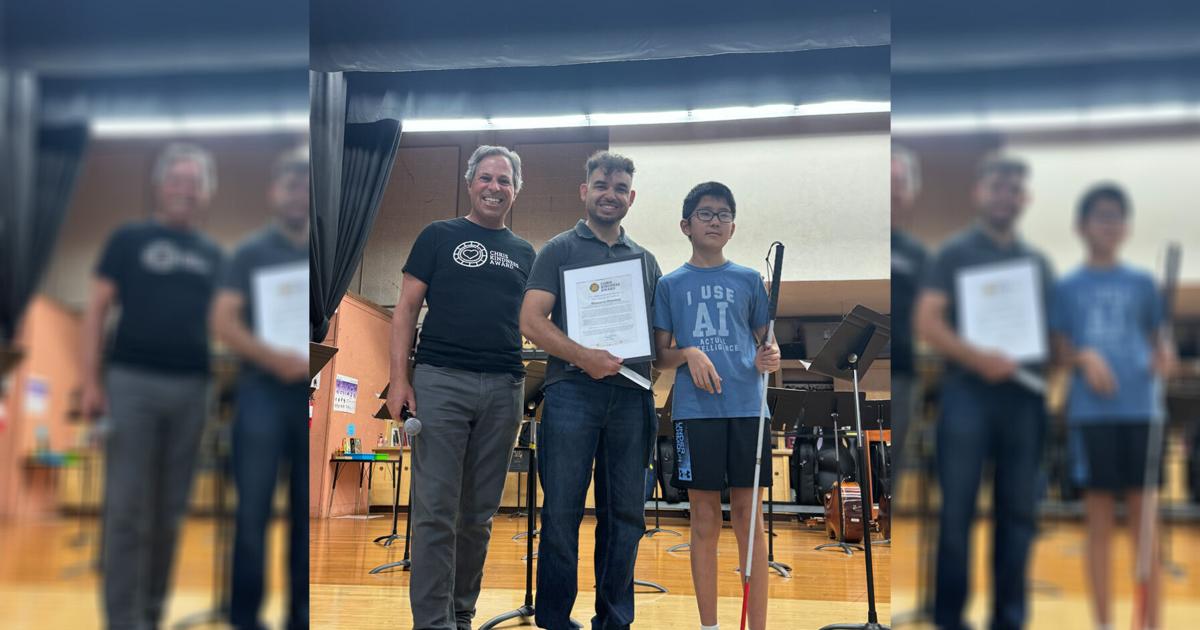
Before Kai Wang, a blind music student at Longfellow Middle School, could begin learning music on the violin, his sheet music had to be transcribed into braille, a process that initially took several weeks.
Now, he has it in minutes, thanks to his music teacher Shannon Houston, who founded a program that allows him to translate the sheet music into braille for Wang.
Houston is the most recent winner of the Chris Kindness Award — which celebrates people demonstrating exceptional kindness in their community. He was nominated by Wang himself, who said in the nomination that he is “probably the only music teacher in the country who offers this level of support to a blind student.”
“Mr. Houston never lowered his expectations or made me ‘just play by ear,’” Wang said in his nomination. “He also played and recorded my viola part in every piece we played, so I could hear it more clearly and memorize patterns. None of this was part of his job description. But he does it quietly and consistently, every day.”
The Chris Kindness Award gives $1,000 to a winner each month. It was created in 2022 in honor of Chris Walton, a beloved preschool teacher who passed away.
It was created by UC Berkeley professor Alan Ross, who said he hopes the award will inspire people to “go out and do something on their own.”
Every month, Ross picks three finalists and people “all over the world” vote on a winner. He said when he read Shannon’s story, he immediately knew he had a finalist.
“Shannon’s work that he’s done, both for the blind community and also just as a teacher, is awesome and totally something that should be celebrated,” Ross said. “That someone would go to those lengths to help another, it’s just a beautiful story.”
Outside of teaching, Houston is also the founder of the New Apollo Youth Symphony Orchestra, a nonprofit dedicated to making music accessible to young people of all backgrounds.
After noticing very few students of color at youth symphony programs around the Bay, he wanted to create one where students wouldn’t be excluded because of financial or audition barriers.
Houston said he decided to “completely take out those barriers and have a non-restrictive basis for getting into the program with (his) mantra — ‘if you could play, you could stay.’”
In the past six years, the symphony has expanded to 22 orchestras, two bands and a full symphony.
“There’s many things we talk about changing in the world, but then very few people actually put effort toward creating that change,” Houston said. “The only way we all can go from here is up, as long as we all put our hearts into what we love in this community.”