
San Francisco’s most influential political groups have fractured over who should fill three school board seats in next month’s election, breaking apart a coalition that largely lined up behind the same candidates two years ago.
GrowSF and the San Francisco Democratic Party are backing board President Phil Kim, former PTA president Autumn Brown Garibay and municipal finance analyst Tim Tung. SF Parents Action, meanwhile, is backing Kim, Brown Garibay and incumbent Alida Fisher. The teachers union has endorsed an entirely different slate. The third seat is open because Commissioner Lisa Weissman-Ward, a Breed appointee who won a full term in 2022, isn’t running.
The divisions mark a sharp turn from 2024, when the teachers union, along with moderate groups, such as GrowSF, the Democratic Party and SF Parents Action, all backed Parag Gupta and Jaime Huling, who went on to win seats on the board. Now, the groups are splintering as the district faces major decisions over its enrollment system, school portfolio, and instructional practices.
Behind the split are two political fault lines: the union’s falling-out with Fisher and a divide among the city’s moderate political groups over Tung.
Fisher’s shifting political fortunes illustrate how dramatically the alliances around the school board have changed since the bitter 2022 recall.
Fisher, a special education advocate, won her seat in 2022 with the union’s endorsement, in the first regular election after voters recalled three board members. Fisher, who had opposed the recall, beat Breed appointee Ann Hsu by about 3,600 votes.
Over the following years, however, Fisher’s political alliances shifted. She developed a close working relationship with Kim, whom Mayor London Breed appointed to the board in August 2024, and became a steady supporter of Su. At the same time, her relationship with the teachers union deteriorated.
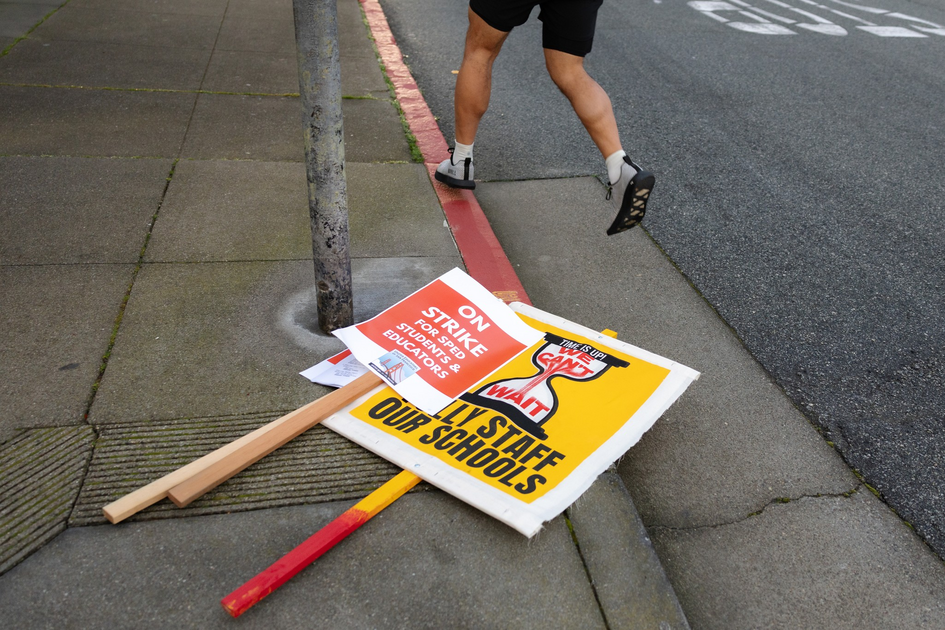
The split widened during February’s teachers strike. Commissioner Matt Alexander, the board’s most consistent union ally since the 2022 recall, walked the picket lines with teachers. Fisher did not. When United Educators of San Francisco dropped her, it cited her response to the strike and her close alignment with Su, whom the union has organized against.
“When thousands of educators and their communities are out on the picket line taking a risk, putting their livelihood on the line, fighting for better schools, that’s when we really expect people that are our friends to show up for us,” Alex Shmaus, who runs UESF’s political program, told The Standard.
In June, Fisher endorsed Kim in his special election to complete the term to which Breed had appointed him. The union backed his opponent, Virginia Cheung, who lost and is running again on the union’s slate with Reina Tello and Ryan Hazelton. Cheung finished sixth of 11 candidates for four seats in 2024 and picketed with teachers during the strike. Tello, an SFUSD graduate and organizer with the Latino group PODER, has two children in district schools. Hazelton runs Mariposa Kids, an after-school nonprofit, which he kept open at no cost during the strike.
“Alida isn’t clearly aligned with either one,” Shmaus said of the labor and moderate camps. “If you try to be everything to everybody, you end up being nothing to nobody.”
As Fisher lost the union’s support, however, she gained the backing of a group that had once been firmly opposed to her: SF Parents Action, which opposed her in the 2022 election and during the bitter fights over school closures during the pandemic.
“Fisher made the slate despite how far apart we were during the COVID years,” the group wrote in a recent email to members. “Her record over this term changed minds.”
The group cited Fisher’s support for literacy and math reforms and her steady backing of Su whose leadership SF Parents Action has supported. But SF Parents has been her only major endorsement.
If Fisher’s candidacy has exposed the divide between labor and parent groups, Tung’s has opened another fault line — this one among the city’s moderate political organizations.
Tung entered the race in late July, after SF Parents Action had completed its endorsement process, but quickly won the backing of GrowSF and the Democratic Party. His sister, Nancy Tung, chairs the San Francisco Democratic Party and has advocated for his election.
Tung is pitching his finance background. He spent 12 years at S&P Global Ratings as lead analyst for California local governments, and he chairs the district’s bond oversight committee.
In an August email, former SF Parents Action executive director Meredith Dodson wrote to her group that Tung’s entry into the race put Brown Garibay, the group’s top pick, “at greatest risk.” Brown Garibay, a first-time candidate, has spent six years serving on parent-teacher associations at Flynn Elementary and James Lick Middle School.
Dodson suggested that other moderate groups were pressing SF Parents Action to add Tung to its slate, despite concerns that doing so could draw support away from Brown Garibay. Nancy Tung did not dispute that account. “Even if he were not my brother, I would be so excited to have a candidate like this in the race,” she said. “He’s incredible.”
GrowSF has committed to spending six figures on Kim, Brown Garibay and Tung, an investment the group says would be the largest ever by an outside group in a San Francisco school board race.
The spending gap sets up another test for the teachers union: whether it can translate the organizing strength it demonstrated during February’s strike into electoral influence. The union does not expect to match GrowSF’s spending and instead plans to rely heavily on grassroots organizing.
“We’re not going to be able to keep up with the billionaire PACs,” Shmaus said. “But other traditional grassroots organizing tactics, like real people talking to real people face to face, can still win.”